Nepal scores 34 in 2025 Corruption Perceptions Index, remains 109th
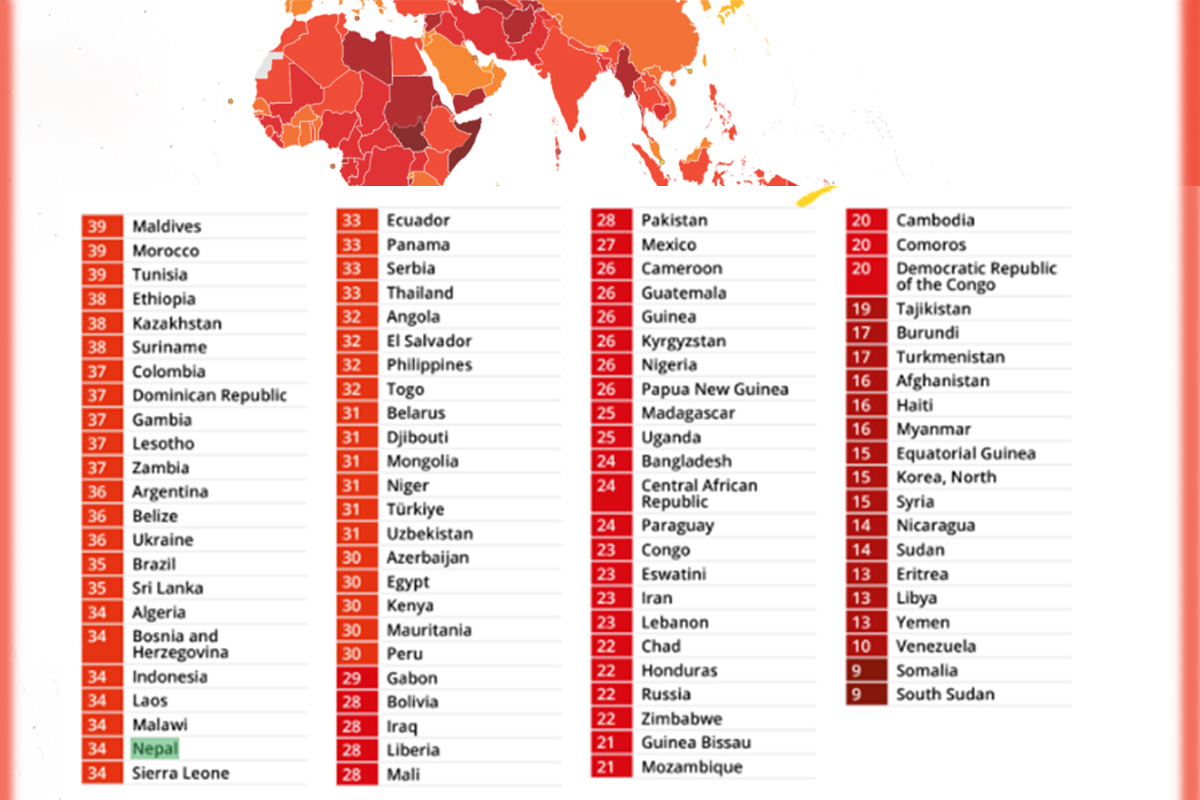
KATHMANDU: Nepal has scored 34 in the Corruption Perceptions Index 2025 published by Transparency International Nepal today. The report indicates that Nepal’s score remains unchanged from last year, suggesting no visible improvement in corruption control. With the unchanged score, Nepal has been ranked 109th out of 182 countries, placing it below the moderate level in corruption prevention.
The index is based on governance-related data collected until August 2025 from sources including the World Bank, World Economic Forum, Bertelsmann Foundation, Global Insight, World Justice Project and V-Dem.
TI Nepal concludes that a high risk of corruption persists in public service delivery, contract procurement, the tax system and judicial processes. Political instability, weak governance, abuse of public office, impunity and a lack of transparency have been cited as major reasons for worsening corruption in the country. Despite growing people’s movements, youth activism and citizen pressure against corruption, substantive policy and structural reforms are still awaited.
-1770716056.jpg "2025-Corruption-Perceptions-Index,-Transparency-International-Nepal-(1)-1770716056.jpg")
-1770716056.jpg "2025-Corruption-Perceptions-Index,-Transparency-International-Nepal-(2)-1770716056.jpg")
Among South Asian nations, Bhutan has the highest score at 71, followed by Sri Lanka (35), India (30), the Maldives (30), Pakistan (28), Bangladesh (24) and Afghanistan (16). Nepal’s close northern neighbour scored 43.
TI Nepal President Madan Krishna Sharma said Nepal’s score remaining stable at 34 this year, as it was last year, indicates that governments have not taken concrete action against corruption. According to Sharma, Nepal has suffered a huge loss of life and property due to corruption, governance has weakened, and there is increasing dissatisfaction among citizens.
“In this backdrop, the recently observed Gen-Z and youth movements were focused on combating corruption. A firm commitment from political leadership, full implementation of the law, adherence to international obligations and strengthening of regulatory bodies are essential for controlling corruption,” he emphasised.
TI Nepal’s former President, Padmini Pradhananga, stressed that the need of the hour is to elect honest and committed leadership through the upcoming elections, who will not be involved in corruption. TI Nepal’s Secretary General Sagar Raj Sharma noted that Nepal has not been successful in the field of corruption prevention and emphasised that it is necessary to take initiatives across all sectors for corruption prevention in the days to come.
The TI global report states that the fight against corruption has been undermined globally. “Corruption is worsening globally, with even established democracies experiencing rising corruption amid a decline in leadership,” the report says.
François Valérian, Chair of Transparency International, said, “Corruption is not inevitable. Our research and experience as a global movement fighting corruption show there is a clear blueprint for how to hold power to account for the common good — from democratic processes and independent oversight to a free and open civil society. At a time when we are seeing a dangerous disregard for international norms from some states, we are calling on governments and leaders to act with integrity and live up to their responsibilities to provide a better future for people around the world.”
The global average score has decreased by one point compared with last year, dropping to 42. According to the index, a score of 100 indicates extreme transparency while a score of 0 indicates extreme corruption. Overall, globally, two-thirds of countries have scored less than 50 points.
The number of countries scoring more than 80 in the index was 12 a decade ago, and this number has decreased to five in 2025. According to TI, the status of corruption control in more than 50 countries has weakened since 2012, while the number of countries that have shown improvement is only 31.
Denmark remains at the top for the eighth consecutive year as the least corrupt country with a score of 89. South Sudan and Somalia are among the most corrupt countries, both with a similar score of nine.