
An Open Letter to PM Balen

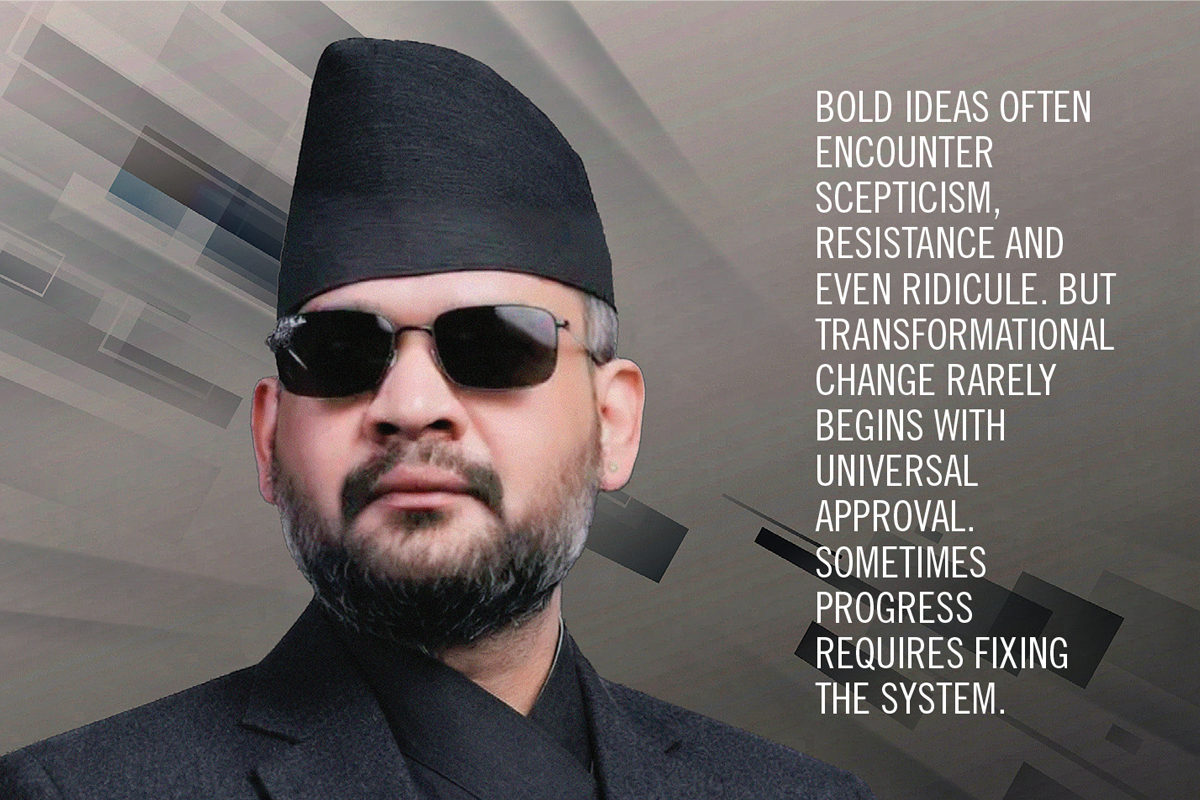
Democratic transitions remain one of the few enduring strengths of our nation. Whilst the optimism that accompanied them in the past fizzled every time a momentous change occurred, people feel it differently this time. The mandate you have received represents a seismic shift in the national consciousness. Instead of being consumed by your big political victory, you have an unenviable task of delivering on your lofty promises and expectations you have created for meaningful economic progress. Also, this presents an exceptional opportunity for you to emerge as the transformative leader that Nepal has long aspired for.
For decades, Nepal has been described as a country of immense potential. It is a phrase so hackneyed that it has become a polite substitute for under-performance. You inherit an economy that has hovered in a low-growth cycle, fundamentally hamstrung by structural misalignments. Our youth unemployment is in excess of 20%, and the recent grey-listing by the Financial Action Task Force has cast a long shadow over our international investment credibility.
To succeed, your administration must hit the ground running with a two-speed approach to economic transformation. You need to fix the system as well as start producing results within months.
Bureaucratic Reform
The first track is the arduous, unglamorous work of institutional reform. Nepal’s bureaucracy is a formidable fortress of procedural rigidity and risk aversion, shaped by decades of political patronage. Successive governments have promised to ‘modernise’ the civil service, only to be consumed by it.
The strong mandate you have earned grants you the power and authority to effectively pursue the long-term strategy of transitioning the bureaucracy from a control-based administration to a service-oriented one. This entails complete digitisation of government interfaces to eliminate the rent-seeking middlemen. It is also essential to amend laws and regulations to remove political influence over key appointments. The nation anticipates that you will take unpopular actions whenever necessary, as you demonstrated during your tenure as mayor.
However, while this work is essential, it is slow. It will take years to yield measurable outcomes. If this track is your only engine, the country may once again experience prolonged periods of stagnation before citizens perceive tangible progress potentially leading to greater frustration.
The Fast Track
Alongside the slow reform process, Nepal therefore needs a fast-moving economic initiative capable of delivering visible growth within a shorter timeframe. Without such momentum, public frustration will re-emerge, investor confidence will remain cautious and the reform agenda itself may lose momentum.
One possible approach is the creation of a high-performance economic ecosystem within the state: a governance-led platform designed to operate with speed, clarity and integrity. Think of it as a Virtual Autonomous Economic Region (VAER).
Unlike the failed physical Special Economic Zones (SEZs) of the past, such as Bhairahawa where only a fraction of plots is operational due to infrastructure gaps, the VAER is a governance-led platform. It is a high-performance ecosystem where clean processes, predictable regulations and rapid decision-making come together to create a trusted environment for investment and enterprise.
This initiative would entail assembling a small yet highly capable team comprising competent civil servants, technocrats, diaspora leaders and private sector executives. This team would operate under a well-defined results framework and report directly to the Prime Minister’s Office. Their mandate would be straightforward yet impactful: coordinate policy implementation, eliminate bureaucratic obstacles and provide investors with a reliable, seamless interface for obtaining approvals, expediting the process from months to days.
VAER would leverage on our strengths to build a modern economy with speed. Nepal already possesses several comparative advantages that could support a modern growth platform.
Our expanding hydropower capacity that offers abundant clean energy coupled with cooler climate and geography are suitable for computing infrastructure. Connectivity has improved significantly in recent years. And perhaps most importantly, Nepal has a large pool of young, educated, globally exposed talent. These factors create opportunities in sectors that do not depend heavily on seaports or large-scale manufacturing logistics. Digital infrastructure, data centres, cloud services, artificial intelligence support platforms, technology outsourcing, fintech and digital services exports all represent areas where Nepal could realistically compete: areas already identified in your election manifesto.
Unlike traditional industries, these sectors require three things above all else: reliable electricity, strong connectivity and regulatory predictability. Provide those conditions within a credible ring-fenced governance framework and global investors will take notice. Such an initiative could also nurture a new generation of Nepali entrepreneurs, i.e., founders who are globally connected, technologically sophisticated and eager to build companies that operate beyond domestic protectionism. At the same time, this model would challenge Nepal’s private sector to evolve. For too long, segments of domestic business have grown behind tariff barriers, regulatory favouritism and rent-seeking practices. Sustainable economic growth requires a shift toward innovation, productivity and global competitiveness.
For this platform to succeed, it would require a strong legal foundation and institutional protections that shield it from routine political interference, bureaucratic obstruction and the policy volatility, i.e., a legal fortress backed by an Act of the Parliament. Regulatory credibility is the cornerstone of investment. Contracts must be enforceable. Rules must be transparent. Dispute resolution must be efficient. Tax policies and incentives must be predictable enough to survive electoral cycles. When investors see such stability, capital begins to move.
Strategic Choice
The combination of these two tracks – long-term institutional reform and a fast-moving economic platform – may be the only realistic pathway for Nepal to achieve the kind of growth it has long aspired to. If reforms gradually improve governance while a high-performance economic engine attracts investment and innovation, Nepal could realistically aim for sustained double-digit growth over time.
Building one high-performance governance ecosystem is far more achievable in quick time. If successful, it can serve as a national proof of concept that demonstrates how transparency, efficiency and accountability can translate directly into economic growth. Success in one area often creates pressure for reform across the system.
This is not fantasy. It is a strategic choice. And your party’s sweeping election victory gives you the authority to unleash something audacious. At a time when young Nepalis are leaving the country in record numbers and public confidence in governance is fragile, a credible economic breakthrough will reset the national mood. It will signal that the state is still capable of imagination, discipline and delivery.
Prime Minister, leadership moments are rarely comfortable. Other times it requires building something new that proves a better system is possible. Right now, Nepal needs both. The primary responsibility rests squarely on your shoulders. And you do not have the luxury of time. This is your moment. Will you seize it?

-1786356423.jpg)
-1784192408.jpg)
-1782644079.jpg)