
CNI president calls for faster reforms to boost domestic production, attract investment

-1782039841.jpeg)
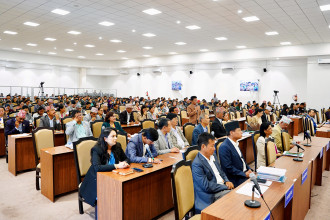
KATHMANDU: Confederation of Nepalese Industries (CNI) President Birendra Raj Pandey on Friday urged faster implementation of reforms to boost domestic production and attract investment. He made the remarks at the CNI’s 23rd annual general meeting (AGM) in Kathmandu.
Finance Minister Dr Swarnim Wagle, the chief guest, inaugurated the programme.
At the opening of the AGM, CNI President Pandey highlighted CNI’s flagship campaign, 'Make in Nepal – Swadeshi', and offered a ready-to-transfer B2B portal to promote the use of domestic goods in public procurement. He said the campaign has secured a collective trademark and cited CNI research, including the CNI Industry Status Report and CNI Nepal Economy Insights, as influencing government policy.
In addition, he outlined efforts to link industry and education, noting an employment and internship fair held with Kathmandu University that created more than 100 opportunities across more than 25 industries. He also outlined CNI initiatives on skills development, social security expansion and support for women and youth entrepreneurship.
-1782039842.jpeg "CNI-23rd-AGM-(1)-1782039842.jpeg")
-1782039842.jpeg "CNI-23rd-AGM-(4)-1782039842.jpeg")
-1782039842.jpeg "CNI-23rd-AGM-(6)-1782039842.jpeg")
However, Pandey warned that aggregate demand remains weak despite healthy foreign exchange reserves and low inflation, leaving more than Rs 1 trillion idle in banks and financial institutions (BFIs). He said non-performing loans have reached 5.60% and that more than 160,000 borrowers are blacklisted, urging the upcoming monetary policy and budget to address these constraints.
Welcoming the government’s budget for fiscal year 2026/27, Pandey praised measures to promote industry, including reduced customs duties on 273 items and removal of excise duties on 360 items, which he said should lower production costs and improve competitiveness. He also welcomed provisions for automated VAT refunds, withdrawal of cases upon payment of 1% of disputed tax, and waivers of interest and penalties, calling them practical relief for investors.
Among outstanding concerns, Pandey called for strengthening quality control institutions and laboratories; creating an inter-agency payment adjustment system to ease cash flow between government and industry; resolving land ceiling issues that hinder large investments; and implementing rent concessions for industries in industrial areas announced in the budget. He urged legal changes to avoid imprisoning businesspeople during investigations into economic offences and recommended shifting to financial penalties for corporate violations.
On long-term goals, Pandey presented a joint CNI–Investment Board study mapping a path to expand Nepal’s economy from about $45 billion to $100 billion within a decade. He said the study, prepared by more than 20 experts with international partners, projects that Nepal can reach a $100 billion economy by 2033 with sustained average growth of about 6%.
Concluding his remarks, Pandey reaffirmed the private sector’s commitment to invest and create jobs and pledged CNI’s support for the government’s reform agenda.
-1790953895.jpeg)
-1790952398.jpeg)
-1790946272.jpeg)