
MoFA concludes summer fellowship to link youth with diplomatic practice

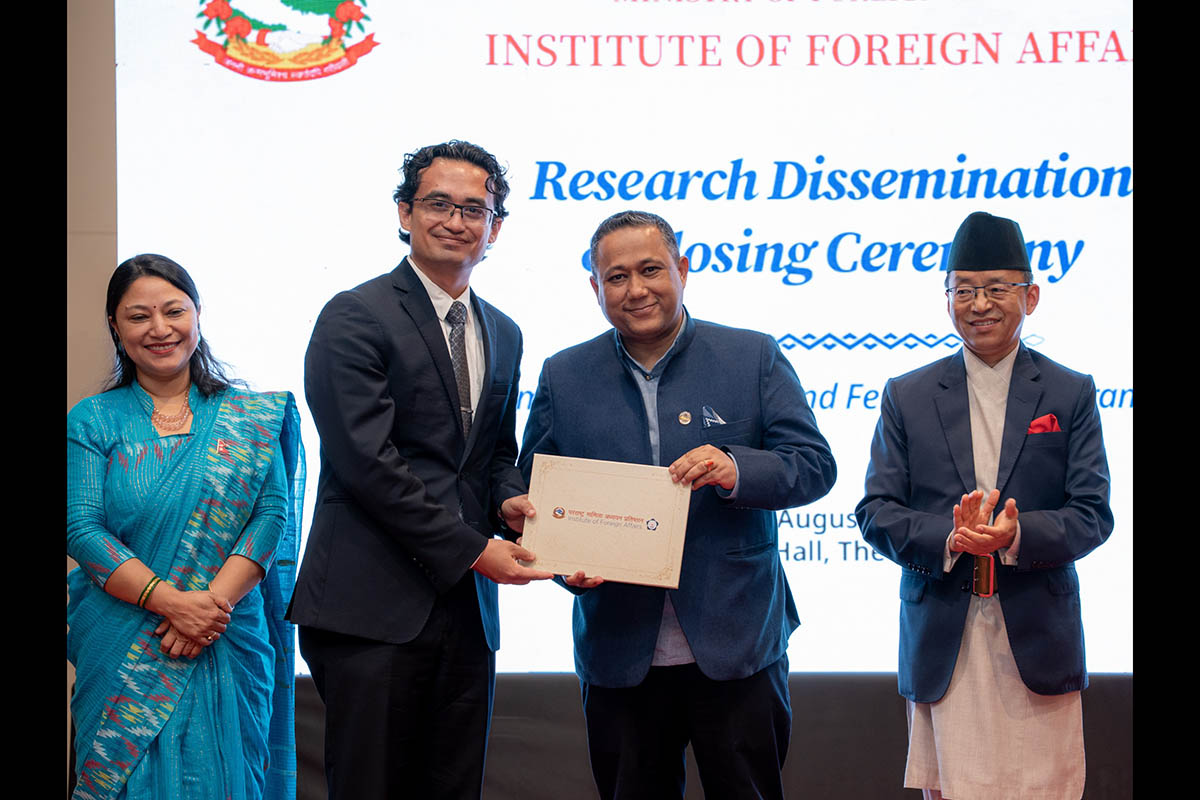
KATHMANDU: An eight-week Foreign Ministry Summer Fellowship and Internship Programme concluded in Kathmandu on Wednesday. The scheme brought together early‑career researchers and practitioners to support evidence‑based foreign policy.
Organised by the Institute of Foreign Affairs Nepal at the initiative of the Ministry of Foreign Affairs, the programme aimed to make Nepal’s foreign policy more research‑driven and timely while linking young researchers, professionals and students with diplomatic practice. Ten fellows and ten interns from Nepal and abroad took part.
Participants carried out research on strategic issues, digital governance, clean energy, development finance, emerging technologies, climate diplomacy and the Nepali diaspora. They followed a structured eight‑week schedule of weekly progress meetings, guidance sessions with senior professionals, mid‑term reviews and written feedback on complete drafts.
The main output was a set of targeted policy research documents intended to assist policymakers in foreign policy formulation. Research materials produced during the programme are the joint intellectual property of the participants and the Ministry of Foreign Affairs.
Foreign Minister Shisir Khanal emphasised the value of youth expertise for the national interest and the importance of research and evidence‑based analysis in strengthening foreign policy. "As Nepal redefines its diplomatic priorities on issues like the changing world order, technology, climate change, labour migration, energy transition, investment and development finance, this effort to connect the research and expertise of the younger generation to policy‑making is presented as a programme linked to building long‑term diplomatic capacity," he said.
Dr Hindu Sanskritika Karki, who holds a PhD in International Politics from Fudan University and researched defence diplomacy during the programme, said the fellowship provided close engagement with government and other bodies and had enhanced participants’ capabilities. "During the fellowship, we had the opportunity to work closely with the government and collaborate with other bodies. Furthermore, this has contributed significantly to enhancing our capabilities and will also support the country in foreign affairs," she said.
Rashesh Shrestha, a research fellow at the Institute of Developing Economies in Japan who researched labour issues, said the programme helped link national foreign policy with the overseas diaspora. "This programme has allowed us to learn a lot," he said.
Rozina Tamrakar, Executive Director of the Institute of Foreign Affairs, said the initiative helped young researchers gain practical diplomatic experience and connect academic work with policy implementation. Following the conclusion of the programme, participants have been integrated into a network intended for future collaboration with the Ministry of Foreign Affairs.
-1790953895.jpeg)
-1790952398.jpeg)
-1790946272.jpeg)