Nepal wins first IOAI medal as Sidant Chaturbedi takes bronze
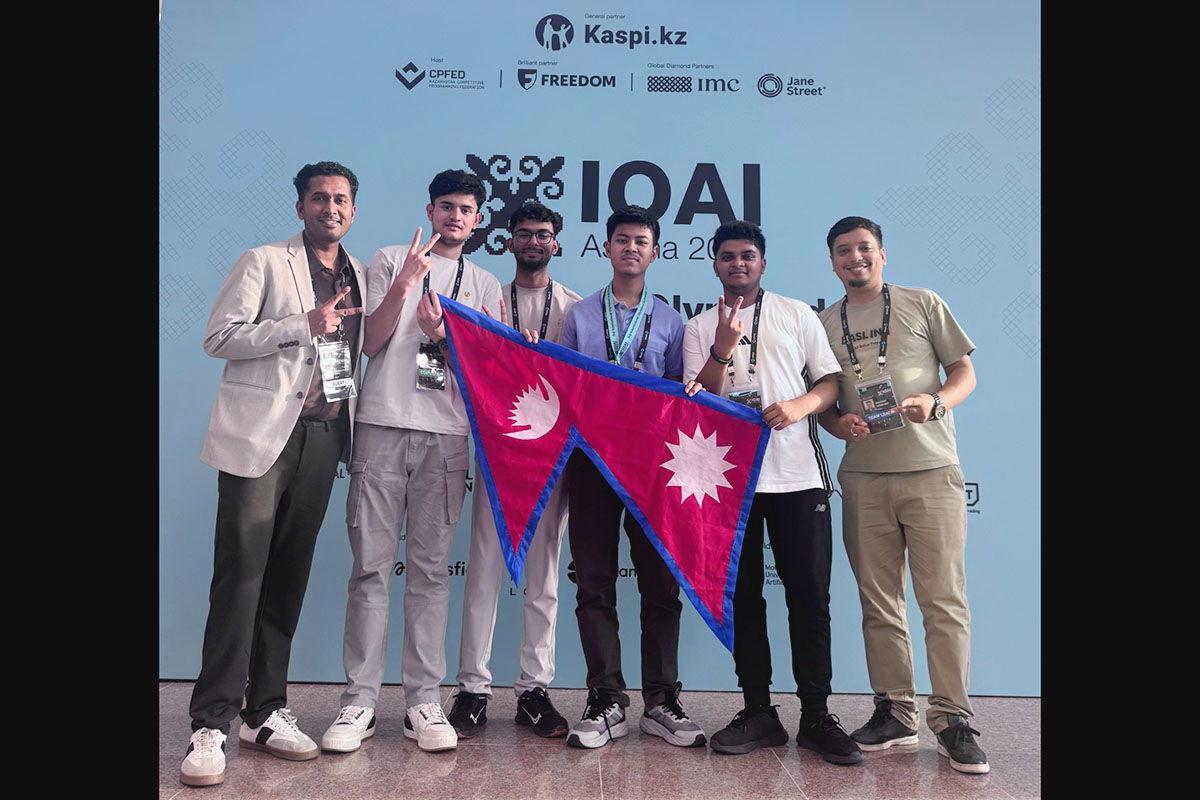
KATHMANDU: Nepal won its first-ever medal at the International Olympiad in Artificial Intelligence (IOAI) as Sidant Chaturbedi took bronze at the third edition in Astana, Kazakhstan, held from August 2 to 8.
Three other members of the Nepali delegation — Prasiddha Mainali, Pitambar Lamichhane and Aayush Yadav — each received an Honourable Mention, so all four contestants returned home recognised. All four are students of St Xavier’s College, Maitighar, Kathmandu.
The Olympiad, hosted by the Competitive Programming Federation of Kazakhstan, was the largest to date, with 462 contestants from 103 delegations. Participants competed individually in two six-hour rounds on August 4 and August 6, using Python and Jupyter Notebook to solve machine learning problems set by an international scientific committee. Medals were awarded based on the combined score from both days.
Nepal had taken part in the first two editions, in Burgas, Bulgaria, in 2024 and Beijing, China, in 2025, and returned from both without an award.
The national team was chosen through the National AI Olympiad in Nepal (NAION), a multi-stage nationwide competition organised by the Himalayan Computational, Linguistic and AI Olympiad in Nepal (HLON) for secondary school students. Pitambar Lamichhane placed first and Prasiddha Mainali second in the 2026 national round.
Team leader Aayush Adhikari oversaw technical preparation and accompanied the team to Astana. Programme coordinator Pranshu Joshi managed the national selection rounds and delegation logistics. Chandan Goopta travelled as observer. Finalists received training from experts at Fusemachines, led by Rojesh M Shikhrakar, covering machine learning foundations, model training and applied problem-solving.
Goopta, Co‑Founder and Co‑Chair of HLON, said the improvement followed better preparation. “In the first two editions we won nothing, and the honest reason is that we went in unprepared,” he said. “This year we were a little prepared, and the difference showed immediately. With proper preparation and a Nepal‑wide campaign to find and train students, I believe we can achieve far better results in the years ahead.”
Team leader Adhikari said time had been tight, but training had been effective and that the team planned more intensive preparation in future. Dr Bal Krishna Bal, Co‑Founder and Co‑Chair of HLON and Professor in the Department of Computer Science and Engineering at Kathmandu University, said the squad’s performance had wider significance, adding that the results reflected early identification and proper teaching of talented students and the opportunity to test themselves against the best in the world.
HLON said the outcome goes beyond the medal table and will help produce AI professionals in Nepal as students learn programming, AI and machine learning skills from an early age. “This also fulfils the Nepal government’s larger vision of generating AI professionals,” Goopta said.
Nepal’s participation was partly funded by the IOAI, which covered 50% of the delegation’s registration fee and travel costs for three members. The next cycle of the National AI Olympiad will open later this year under the BRAIN Foundation, which will assume legal and financial responsibility for Nepal’s AI and Linguistics Olympiad programmes.
-1791196144.jpeg)