NYEF Lalitpur Chapter launches 'Think Tank' series to address economic policy gaps

-1790011438.jpeg)
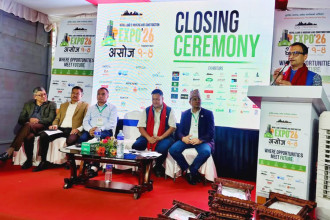
KATHMANDU: Nepalese Young Entrepreneurs' Forum (NYEF Lalitpur Chapter has launched its inaugural 'Think Tank Series' programme to address policy gaps and economic challenges in the country.
Speaking at the launch event, Finance Secretary Ghanshyam Upadhyaya stated that Nepal's economy is currently navigating between economic concern and a path to progress, noting that while certain aspects remain weak, the overall financial condition is comparatively strong.
The finance secretary identified weak private investment, declining capital expenditure, a high trade deficit, and low productivity as the primary challenges facing the economy. With imports currently making up approximately 90% of Nepal's trade compared to just 10% exports, he emphasised the urgent need to increase domestic production and exports through an improved investment climate for both domestic and foreign direct investment.
-1790011438.jpeg "NYEF-Lalitpur,-Think-Tank-(2)-1790011438.jpeg")
-1790011438.jpeg "NYEF-Lalitpur,-Think-Tank-(3)-1790011438.jpeg")
Addressing the country's broader economic performance, Upadhyaya pointed out that Nepal's average economic growth over the past 25 to 40 years has sat below 4%, turning negative during the Covid19 pandemic. However, he highlighted several positive economic indicators, including remittance growth, hydropower expansion, moderate inflation, low interest rates, and adequate liquidity, adding that public debt standing at roughly 43% of gross domestic product should be utilised for productivity, industrialisation, and infrastructure development.
He further suggested that directing remittances into productive sectors, rather than limiting them to consumption, would contribute significantly to employment and economic growth. He also informed attendees that government efforts are underway to attract private sector investment in public infrastructure through a newly introduced alternative development financing fund.
Finance Secretary Upadhyaya stated that Nepal must link hydropower production with industrialisation and ensure foreign employment is based on skills and higher income. He concluded that good governance, an improved investment climate, and effective public services are essential to transform the country's economic strengths into tangible productivity and job creation.
During the event, NYEF Preident Aabhushan Jyoti Kansakar spoke openly regarding the struggles of the middle class, expressing that current policies focus primarily on the rich and the poor.
He said, "Currently, middle-class entrepreneurs and businesspeople are suffering greatly; the Gen Z movement and the Bhotekoshi floods have swept away all their assets, insurance has not made payouts, and the remaining assets are pledged as collateral with banks, leaving no capital for further investment."
Kansakar urged the government to create a supportive environment that allows middle-class business owners to return to their enterprises.
NYEF Lalitpur Chapter Preident Anukul Shrestha stated that the Think Tank series was established to bridge the significant gap between government policy and the practical concerns of young business owners. He said the inaugural event will be followed by ongoing policy debates in the coming days.

-1790001011.jpeg)
-1789983661.jpeg)