'Money is available, but confidence, opportunity and risk appetite are negligible'


Prithivi Bahadur Pandé
Chairman, Nepal Investment Mega Bank
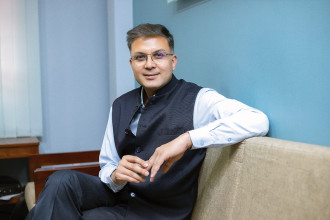
Prithivi Bahadur Pandé is a highly respected figure in the banking industry, known for his long career and steady influence on the country’s financial sector. Over nearly five decades, he has held leadership roles across both public and private institutions, beginning with Nepal Rastra Bank after completing his Chartered Accountancy in India. His time at the central bank included a two-year secondment to the International Monetary Fund in Washington, an experience that helped shape his understanding of global financial systems.
Pandé later took on major responsibilities in commercial banking, first as General Manager of Rastriya Banijya Bank and then as the founder of Himalayan Bank, established in 1993 as a joint venture with Habib Bank. In 2002, he led a private equity group to acquire Nepal Indosuez Bank, transforming it into Nepal Investment Bank. Alongside his banking career, he has been active in heritage conservation, art and tourism development, areas he continues to support with personal interest.
-1767346919.jpg)
Today, Pandé serves as Chairman of Nepal Investment Mega Bank and Aloft Hotel at Chhaya Centre in Thamel. His insights carry weight not only because of his experience but also because of his long view of Nepal’s economic shifts, policy landscape and institutional challenges. In a conversation with Business 360, Pandé reflects on the state of the banking sector and the broader economic issues shaping Nepal’s future. Excerpts:
Are the rising non-performing loans in Nepali banks an indicator of a structural flaw in their credit assessment and risk management processes, or is it simply a cyclical effect resulting from the current economic stagnation?
This is a complex question. The recent climb in non-performing loans (NPL) in Nepali banks likely reflects both structural weakness in credit assessment and risk management and broader macroeconomic headwinds. Loan deficits are due to the sluggish economy, weak borrowing activity and constrained cash flows. There are deeper structural and institutional problems in credit appraisal, risk management, and regulatory oversight. The accumulation of non-banking assets (NBAs) suggest that collateral based lending has not been enough to guarantee recovery (especially when real estate loses value or there is no market demand). This is a result of, or points to, poor loan-screening, and excessive directed lending. The phenomenon is in all commercial banks, development banks and finance companies hinting that the issue is not limited to a few badly run institutions but linked to structural weakness in lending practices, regulatory oversight and the economic condition of the country due to instability i.e. frequent changes in government.
When there is prolonged economic slowdown, the NPA tends to rise.
• Businesses are struggling due to weak demand and low economic activity
• Borrowing cash flow is tight making loan repayment harder
• Real estate and the SME sector’s major borrowers have slowed sharply
• Collateral is not selling so recovery is stuck; non-banking assets are rising
• Economic stagnation combined with poor credit
• Discipline assessment is triggering
We also have to look at the fact that in the last 10 years, starting from the 2015 earthquake plus the economic blockage at the Nepal-India border, and Covid have all contributed to a rise in NPLs. Rising NBAs reflects state of stress in our economy and how fragile it is. The recovery mechanism is not very effective when there are prolonged economic slowdown and sluggish investment. Banks suffer and are vulnerable. I do not think the problem is purely cyclical; it reflects broader economic stagnation.
Does the current situation of surplus liquidity in banks alongside weak credit growth primarily signify a crisis of confidence among potential borrowers, a failure by banks to develop appealing lending products, or deeper, more fundamental weaknesses in the country’s overall investment environment?
Nepal’s current situation reflects all the above mentioned three factors, and the deeper weakness is the investment environment supported by lower borrower confidence and limited innovation in lending by banks.
• Business demand is weak and profitability is low across sectors
• Political uncertainty makes things unpredictable
• The previous stresses of the past 10 years are also contributing factors.
• Banks failing to innovate is another issue
Nepali banks are relying heavily on:
• Collateral based lending
• Real estate and import-trade financing
• Traditional working capital loans
There are very few product innovations for SME startups, digital businesses and value chain lending. This limits access for viable but ‘non-collateral rich borrowers’. A weak investment environment is the main issue.
The core problems are:
• Very few new large projects
• Industry capacity exposure is stagnant
• FDI inflow is very low
• Policy instability discourages long-term investment (e.g. Case of Income Tax on FPO)
• Cost of doing business is high (corruption issues)
So even if loans are cheap and available (excess liquidity), the demand will not be there.
We can describe our economic situation as something where the money is available but confidence, opportunity and risk appetite are negligible.
The combination of weak economic activity, low private sector optimism, limited product innovation and structural barriers to investment are the reasons why credit growth remains low despite liquidity being high. Nepal does not have a liquidity problem; it has a confidence and investment problem.
We have to improve the investment climate and restore business confidence. We have to ensure transparent, stable and predictable government policies; reduce delays, uncertainty and frequent rule changes; and speed up approvals of investment, constructions, hydropower and other industries. When businesspeople feel the environment is stable, they will start borrowing again.
With profit margins shrinking and continuous dividend expectations, are banks effectively compromising their long-term stability for immediate short-term shareholder satisfaction, and is this practice sustainable given the challenge of rising provisioning costs?
Nepali banks are under a lot of pressure to meet the dividend expectations of shareholders. Return on equity of the banks has been going down for the past five years and has come down to single digits. Unless shareholders get their expected return, the banking sector will continue to be pressured. Due to dividend pressure, some banks expanded aggressively in higher risk lending sectors for faster short-term gains. Pricing should be risk-based rather than interest-based. If banks make profit, they can easily absorb provisions. When profit is increased, banks can pay out decent dividends to investors.
There is definitely a tension between maintaining profit and ensuring long-term stability. As profit margins shrink, banks might be tempted to loosen credit standards or focus on riskier loans to maintain returns. Persistent pressure on adequate dividend can push banks to prioritise on short-term gains. But this may lead to rising provisioning costs and lower profits in the long run which in turn affects ability to pay good dividends. Banks will have to find a right balance between maintaining healthy policies and risk assessment and meeting shareholders’ expectations.
Banks should focus on long-term profitability rather than short-term gains. Yes, the profitability of banks is going down in recent years, but with careful planning and proper policies, profits can be enhanced to ensure public confidence. The dividend capacity of banks can also be helped by revising the central bank’s policy. Excessive tightening by NRB in recent years is negatively affecting sustainable banking. Oversight is important but micromanagement and excessive tightening of policy can and has been detrimental to the economy of the country.
What specific mechanisms and policy adjustments can be implemented to realign the incentives within Nepal’s banking sector so that it actively and effectively supports economic productivity and job creation?
Nepali banks can support real economic growth and job creation by shifting incentives from short-term profits to productive lending. Some important points are as follows:
• Banks must prioritise their long-term portfolio health
• Must look at long-term cash flow and value chain-based lending
• Must promote high employment sectors such as tourism
• Nepal Rastra Bank should consider SME based sectors in terms of relaxing provision criteria if collateral back-up is there
The central bank should revise its provisioning norms. Nepali banking loan exposure is mostly collateral based. To realign banks’ priorities to support economic growth, incentives should be provided for productive sectors, i.e. deprived sectors, hydroelectricity, agriculture, tourism and SMEs. Such productive sectors take long period to generate returns. The central bank should revise risk weight for productive sectors while determining capital adequacy. The same policy should not be applied for both productive and non-productive sectors.
What essential actions must the central bank and banking and financial institutions undertake to effectively restore public confidence, considering the increasing public concern regarding regulatory oversight and governance lapses?
Given mounting concerns about regulatory oversight and governance lapses, Nepal Rastra Bank should not continue a micromanagement policy over banks and financial institutions. Instead, banks that do not adhere to corporate governance should be strictly punished and heavily penalised. The central bank should not restrict the investment policy of banks.
Banks should focus on long-term profitability rather than short-term gains. Yes, the profitability of banks is going down in recent years, but with careful planning and proper policies, profits can be enhanced to ensure public confidence. The dividend capacity of banks can also be helped by revising the central bank’s policy. Excessive tightening by NRB in recent years is negatively affecting sustainable banking. Oversight is important but micromanagement and excessive tightening of policy can and has been detrimental to the economy of the country.
Financial institutions should transparently report their financial condition without compromising in provisioning and without tampering with its financial statements. They should focus on institutional interest rather than personal interest to restore public confidence.
Public confidence will return when people see credible supervision, transparent reporting, accountable bank management and effective depositor’s protection. Cosmetic fixes will not be enough or good.
To fix public confidence, the following factors are mandatory:
• Tighten oversight and enforcement by promptly and strongly penalising banks that have governance lapses, rather than applying blanket policies to all banks
• Conduct early-warning monitoring
• Strengthen bank governance, ensure independent, accountable Board of Directors (BOD) and risk-focused management
• Build transparency
• Increase independent audits and third-party verification for credibility
• Increase deposit insurance (bank has to bear the cost)
• Effective coordination between Nepal Rastra Bank and BFIs.