
SAWTEE, ILO dialogue warns Nepal's garment sector may face labour shortages after LDC graduation

-1769681482.jpeg)
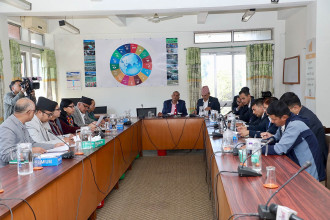
KATHMANDU: South Asia Watch on Trade, Economics and Environment (SAWTEE), with support from the International Labour Organization (ILO), organised a policy dialogue on apparel exports in Kathmandu on Wednesday. The event discussed competitiveness, critical challenges and the way forward.
The dialogue formed part of a research and capacity‑building programme examining opportunities and challenges facing Nepal’s garment sector as the country prepares to graduate from least developed country (LDC) status. The project seeks ways to promote the sector despite emerging obstacles such as LDC graduation and more restrictive trade conditions, including US reciprocal tariffs.
-1769681482.jpeg "SAWTEE-dialogue,-ILO,-garment-sector-(8)-1769681482.jpeg")
-1769681482.jpeg "SAWTEE-dialogue,-ILO,-garment-sector-(13)-1769681482.jpeg")
-1769681482.jpeg "SAWTEE-dialogue,-ILO,-garment-sector-(14)-1769681482.jpeg")
-1769681482.jpeg "SAWTEE-dialogue,-ILO,-garment-sector-(12)-1769681482.jpeg")
Building on that work, the final policy dialogue, jointly organised by SAWTEE and the Garment Association of Nepal (GAN), consolidated insights from a diagnostic study based on a survey of apparel-producing and exporting firms. Dr Prakash Kharel, executive director of SAWTEE, presented the study’s major findings.
According to the study, Nepal’s garment sector shows strong growth potential but faces urgent constraints: a shortage of skilled and semi-skilled labour, high labour turnover, low productivity, inefficient logistics, difficulty in establishing contacts with buyers and costly access to land. The findings, drawn from surveys of 28 firms accounting for around 22% of Nepal’s garment exports, warned that exporters and workers may face mounting challenges as trade preferences will change after graduation.
While nearly 40% of firms reported some level of female ownership, women remain largely absent from top management, with only 7% of firms led by a woman. The study identified labour shortages, high worker turnover, skills gaps and rising logistics costs as the most pressing constraints facing exporters.
Meanwhile, the study has warned that these constraints raise concerns about the industry’s ability to remain competitive after Nepal graduates from LDC status. It noted that without preferential market access, exporters will need to upgrade products and business models, but high marketing costs, weak links with foreign retailers and limited compliance with ESG standards are slowing that transition.
-1769681481.jpeg "SAWTEE-dialogue,-ILO,-garment-sector-(2)-1769681481.jpeg")
-1769681481.jpeg "SAWTEE-dialogue,-ILO,-garment-sector-(3)-1769681481.jpeg")
-1769681482.jpeg "SAWTEE-dialogue,-ILO,-garment-sector-(11)-1769681482.jpeg")
Speakers at the event urged coordinated action. Rabi Shanker Sainju, vice‑chair of SAWTEE, said logistics remains a major obstacle and emphasised that the absence of an integrated industrial ecosystem is affecting the supply chain. He urged Nepal’s diplomatic missions to work actively to create new international markets.
Similarly, GAN President Pashupati Dev Pandey called on the government to prioritise the garment and apparel sector and to ensure close coordination among labour, producers and policymakers. He cautioned that India’s free trade agreements (FTAs) with the European Union (EU) could pose additional challenges for Nepal amid LDC graduation.
At the programme, Prakash Sharma, national project coordinator of the LDC Graduation Project at ILO Nepal, said the garment and textile sector is expected to be among the most affected by graduation, including in terms of job losses. He added that the United Nations’ assessment of Nepal’s readiness has revealed significant apprehension within the private sector and that any deferral would require consideration of partners such as the EU and the United States. He also highlighted Nepal’s lack of a clear strategy to use a deferral if granted.
In addition, Shiv Prasad Bhatta, general secretary of Federation of Export Entrepreneurs Nepal (FEEN), urged the government to pilot a digital platform to promote Nepali garments and textiles internationally, stressing the role of digital marketing in boosting competitiveness.
Ram Hari Ghimire, secretary of the Ministry of Industry, Commerce and Supplies (MoICS), said the textile and garment sector holds high potential and has shown resilience despite structural challenges, including the downturn after the phase‑out of the Multi-Fibre Arrangement (MFA). He urged the government and private sector to identify and strengthen Nepal’s core competitive advantages and to present clear, concrete challenges so that effective solutions can be designed and implemented.
Policymakers, private sector representatives, civil society members, media and experts attended the event.

-1788413020.jpg)