Dr Wagle assumes office as finance minister

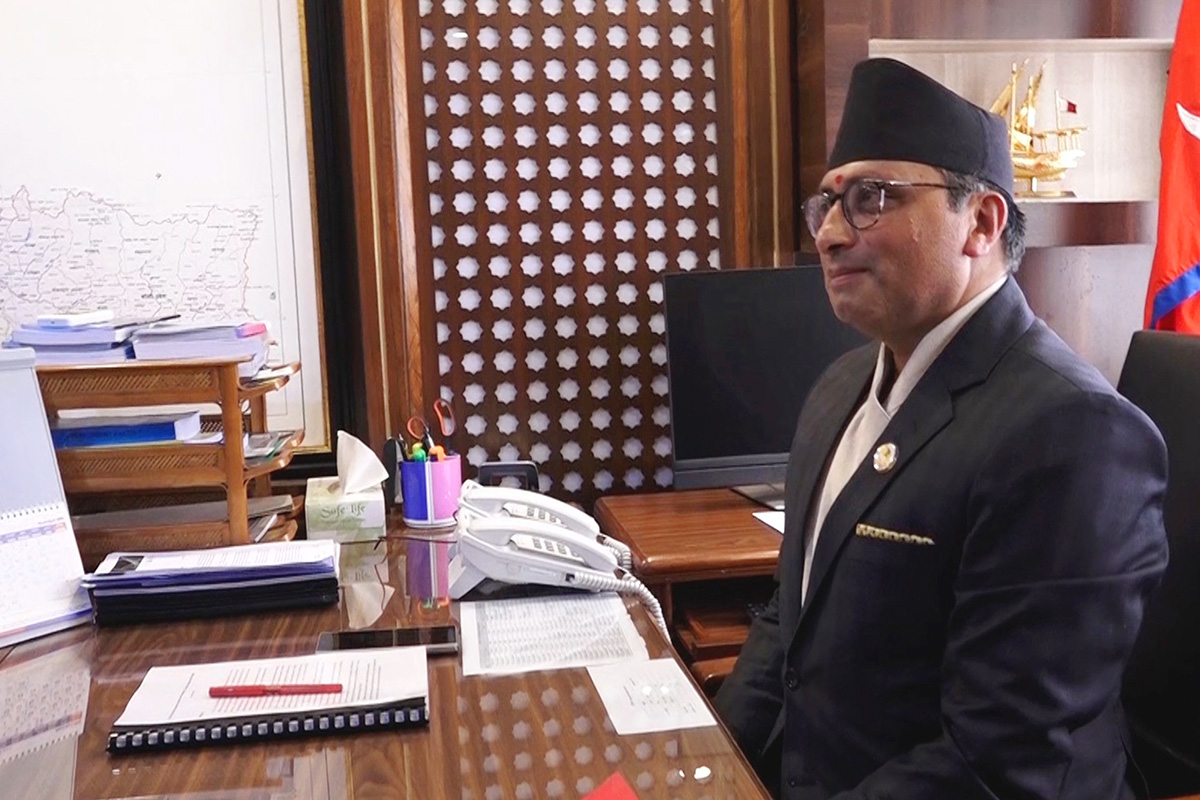
- Newly appointed Finance Minister Wagle vows to abolish Revenue Investigation Department, 15 acts
KATHMANDU: Dr Swarnim Wagle has assumed office as the finance minister. After taking the oath before President Ramchandra Paudel, he reached the Ministry of Finance today to formally assume his responsibilities.
While assuming office, Minister Wagle said he was committed to implementing important suggestions from the High‑Level Economic Reforms Recommendation Commission, 2024. He said that, based on the commission’s recommendations, a decision has been made to abolish the Department of Revenue Investigation and to proceed immediately with the process of abolishing or amending 15 acts.
The newly appointed finance minister said an economic status paper up to March 24, 2026, will be prepared within five days, and 100‑day, semi‑annual and annual action plans will be formulated to implement the government’s election manifesto. He added that the government would move forward with effective implementation by internalising the manifesto.
He said priority will be given to drafting new bills and amending existing laws to ensure the security and promotion of private enterprises, facilitate large development projects and remove procedural hurdles, creating an environment where large projects can move forward swiftly.
Finance Minister Wagle said a policy will be adopted to solve economic problems holistically rather than piecemeal, and that systemic reforms will be made by removing discretionary powers. He said priority will be given to implementing the recommendations of the Public Expenditure Review Commission, increasing domestic production, creating jobs and formulating a transformative budget.
Wagle said efforts to promote a paperless and cashless system through electronic governance have begun at the Ministry of Finance itself. He added that the current international situation, especially the issues seen in the Middle East, will be analysed closely and its impact managed through inter‑agency coordination.
According to the report of the High‑Level Economic Reform Recommendation Commission, the acts for which the abolition process will be initiated include: Income Ticket Charge Act, 1962; Black Marketing and Certain Other Social Crimes and Punishment Act, 1975; Pvt. Forest Nationalization Act; Administrative Procedure (Regulation) Act, 1956; Compensation Act, 1963; Birta Abolition Act, 1959; Act Prohibiting Birta Owners from Levying and Collecting Amounts in Birta, 1958; Revenue Leakage (Investigation and Control) Act, 1995; Act Restricting Investment Abroad, 1964; Nepal Agency Act, 1957; Provincial Development Plan (Implementation) Act, 1956; Export Import (Control) Act, 1957; Social Practices (Reform) Act, 1976; Act to Increase Nepalese Currency Circulation, 1957; and Financial Intermediary Act, 1998.
Dr Wagle, who is also the vice chairman of Rastriya Swatantra Party (RSP), said the government, which received a historic mandate, would adopt private sector‑friendly policies and advance a comprehensive roadmap for economic and legal reforms.
Wagle, elected as a member of the House of Representatives from Tanahun Constituency No. 1, secured 38,040 votes in the recent election. Being placed second in the order of precedence in the newly formed cabinet indicates that the government’s economic agenda is a high priority.
Born on May 30, 1974, in Gorkha, Wagle has been active in democratic movements since the 1990 People’s Movement. He has served as chief economic adviser at the United Nations Development Programme (UNDP) Asia‑Pacific Regional Bureau and worked as a senior economist at the World Bank, contributing to economic transformation in developing countries. He also has experience in formulating national development strategies, inter‑ministerial coordination and guiding long‑term plans as a member and later vice‑chairman of the National Planning Commission.
He has served as a consultant to international organisations such as the Asian Development Bank and the International Trade Centre, been a Senate member of Kathmandu University, and been a member of the World Bank’s South Asia Champions Group.
Academically, Wagle holds a bachelor’s degree from the London School of Economics, a master’s degree in International Development from Harvard University, and a PhD in economics from the Australian National University. He is also active as a writer and intellectual contributor; books he co‑edited, such as The Great Upheaval, and co‑authored, such as The Rise of the South, have been published by international publishers.
Wagle’s appointment comes amid challenges such as Nepal’s slow economic growth, declining revenue collection, rising public debt and low implementation of development expenditure. In such complex circumstances, Wagle, who has extensive international development and policymaking experience, is expected to bring concrete reforms. The major challenges before him appear to be maintaining economic stability while creating jobs, increasing investment, restoring private‑sector morale and strengthening fiscal discipline within the federal structure. Although he is expected to pursue a reform‑oriented agenda based on his past policymaking activity and international experience, questions remain about how effective his performance will be given political pressure, administrative complexities and structural weaknesses.
-1791464816.jpeg)