Parliament session with new public mandate to commence today

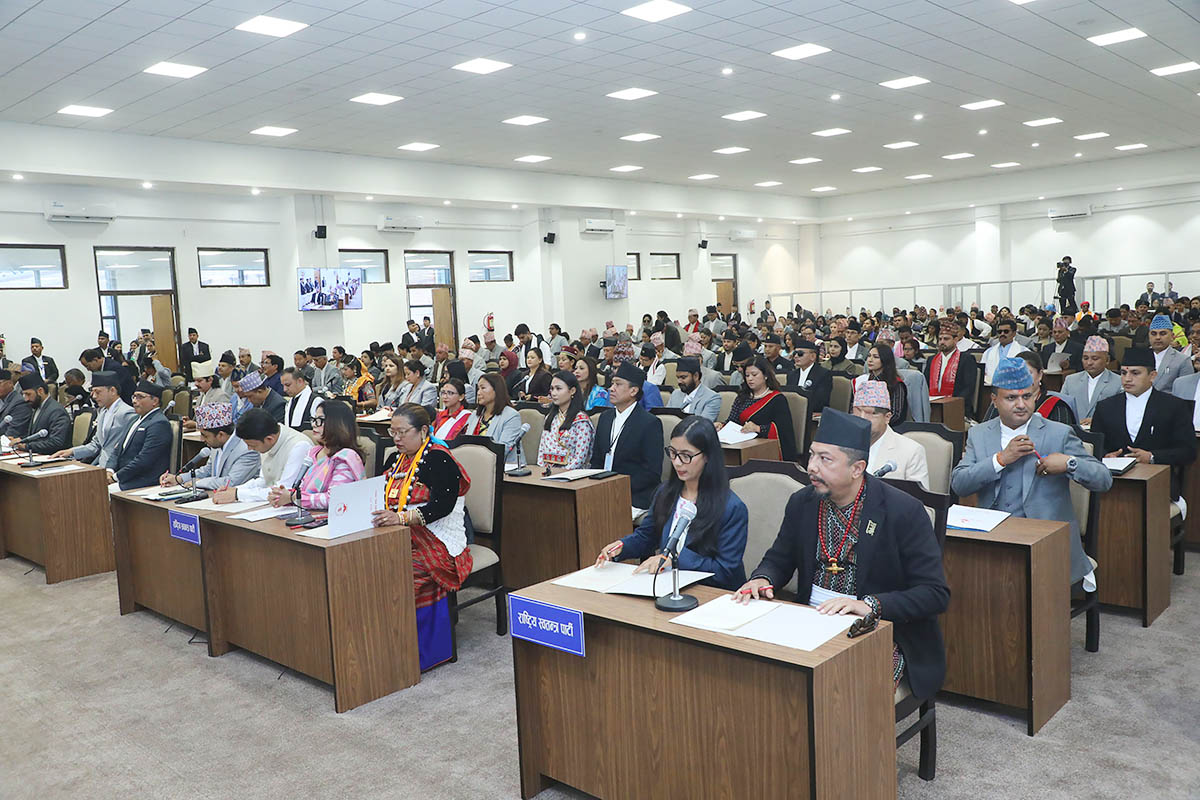
KATHMANDU: The House of Representatives (HoR), elected in the March 5 election, will convene for its first session on Thursday.
President Ramchandra Paudel has summoned sessions of both Houses of the Federal Parliament for 2:00 pm on Thursday on the recommendation of the Council of Ministers and in accordance with the Constitution of Nepal. The session follows the Rastriya Swatantra Party (RSP) securing a nearly two‑thirds majority and is being viewed as important both nationally and internationally.
The HoR will meet in the multi‑purpose hall of the under‑construction Federal Parliament Building at Singha Durbar, while the National Assembly will meet in the old building of the Federal Parliament Secretariat. This is the 20th session of the National Assembly. After the formation of the 601‑member Constituent Assembly in 2007, HoR sessions were held at the International Convention Centre in New Baneshwor; they are now set to be held in the Parliament Building at Singha Durbar for the first time in 18 years. After the first general election held in 2015 BS, parliamentary sessions had been taking place in the old parliament building (Gallery Hall) at Singha Durbar.
The Constitution provides that the President shall summon a session of the Federal Parliament within 30 days of the date on which the final result of the HoR election is announced. The Election Commission submitted the Report on the Election Results of the House of Representatives Member Election 2082 to the President on March 19. Through the election, the people have given the RSP a nearly two‑thirds majority mandate to govern and steer the country towards stability and prosperity.
The Federal Parliament Secretariat has said all preparations have been completed in terms of physical, security, technical and personnel management for conducting the meetings of both Houses. Seating for MPs has been determined according to past tradition. According to the Parliament Secretariat’s spokesperson Ekram Giri, in the HoR seats for MPs from the ruling party are arranged to the right in front of the Speaker’s chair, government seats in the centre, and opposition MPs to the left in front of the Speaker’s chair. Under this arrangement, the Prime Minister and the leader of the main opposition party will be seated close by. Unlike previous sessions, members of the Council of Ministers and MPs from the RSP will be seated in the section set aside for the ruling side, while 93 members, including one independent, will be seated in the section set aside for the opposition.
As this is the first session of the HoR, the election of the Speaker and Deputy Speaker will be the main business. Under the constitutional provision, HoR members shall elect the Speaker and Deputy Speaker from among themselves within 15 days of the date of the first meeting. Either the Speaker or the Deputy Speaker must be of a different party and of a different gender. In the first meeting, the senior‑most MP presiding over the session will welcome members of parliament and provide information regarding the calling of the session. The schedule for the election of the Speaker and Deputy Speaker, and other business, will be determined by consensus at an all‑party meeting; the Parliament Secretariat has called an all‑party meeting for today.
The session is responsible for presenting and passing bills such as those related to the Federal Civil Service Act, the Police Act and the School Education Act, which are directly relevant to the implementation of federalism. It is reported that the Federal Civil Service Bill will be drafted within 45 days as part of the 100‑point Governance Reform Blueprint approved by the Cabinet on March 27.
The 275‑member HoR comprises 165 members elected through the first‑past‑the‑post (direct) electoral system and 110 members through the proportional electoral system. The Rastriya Swatantra Party has 182 members; the Nepali Congress 38; the CPN (UML) 25; Nepali Communist Party (NCP) 17; Shram Sanskriti Party seven; Rastriya Prajatantra Party (RPP) five; and there is one independent MP in the HoR. In terms of gender representation, there are 179 male MPs and 96 female MPs. Reflecting the sentiment of the Gen Z movement in September 2025, demanding generational change in politics, there is currently a predominance of young MPs in Parliament.
As provided by the Constitution, President Paudel will address the joint sitting of both Houses of the Federal Parliament at the first session of the House of Representatives following the election.
The Constitution of Nepal provides for a bicameral Federal Parliament. The lower house is called the House of Representatives, and the upper house the National Assembly. The main responsibilities of the Federal Parliament include making laws on matters within the jurisdiction of the federation, forming the government, discussing and passing government policies, programmes and budgets, deciding on constitutional amendments and referendums, monitoring and directing government activities, and approving international treaties and agreements.
There are currently 10 subject committees under the House of Representatives: the Finance Committee; the International Relations Committee; the Committee on Industry, Commerce, Labour and Consumer Interests; the Law, Justice and Human Rights Committee; the Agriculture, Cooperatives and Natural Resources Committee; the Women and Social Affairs Committee; the State Affairs Committee; the Good Governance, Development and Technology Committee; the Education and Health Committee; and the Public Accounts Committee. The Parliamentary Hearing Committee and the Committee for the Implementation, Monitoring and Evaluation of the State’s Directive Principles, Policies and Responsibilities are the two joint committees of the House of Representatives and the National Assembly. The HoR formed after the fresh election could amend parliamentary rules and alter the number of parliamentary committees.
By RSS
-1791630230.jpeg)
-1791623099.JPG)