At FNCCI's 60th AGM, finance minister pledges to deliver prosperous change

-1777901222.JPG)
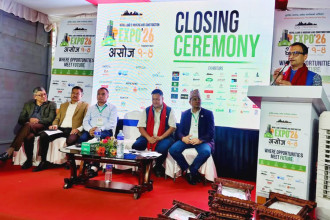
KATHMANDU: Federation of Nepalese Chambers of Commerce and Industry (FNCCI) held its 60th annual general meeting (AGM) on Monday. Finance Minister Dr Swarnim Wagle officially inaugurated the AGM. A closed session to select new leadership was scheduled for Tuesday.
At the AGM, Minister Wagle reiterated the private sector’s contribution and pledged to deliver prosperous change in line with the Rastriya Swatantra Party’s (RSP) 100‑point action plan. He said the government and private sector must work hand in hand to build a more prosperous Nepal and to expand the country’s economy to $100 billion within five years.
-1777901222.JPG)
He warned, “Only those hiding behind the label of a business owner to run illegal operations need to worry. Honest entrepreneurs who work hard, follow the law and run their businesses with integrity have nothing to fear.” He added, “The cases we are seeing today are not new; they are old cases. It is those who misuse political patronage for illegal activities who should be concerned, not those who earn their living through hard work and honesty. The fear that the government will crack down on legitimate businesses is nothing but a misconception.”
-1777901223.jpg "Chandra-Prasad-Dhakal,-FNCCI-60th-AGM-(1)-1777901223.jpg")
-1777901223.jpg "FNCCI-60th-AGM-(4)-1777901223.jpg")
Meanwhile, outgoing FNCCI President Chandra Prasad Dhakal reflected on six decades of the federation’s journey and set out a vision for Nepal’s economic future. He highlighted a policy win for the private sector, saying the government passed the Private Sector Promotion and Protection Strategy (PSPPP) at its first cabinet meeting — a demand FNCCI had long pressed for. Dhakal said the strategy will guarantee both physical security for businesses and policy‑level protection that the private sector has lacked for decades.
On the investment front, Dhakal said the Nepal Development Public Limited Company has been established with a paid‑up capital target of Rs 10 billion to mobilise domestic investment for large‑scale infrastructure projects. “This sends a clear message that big projects can be built with homegrown capital and that the narrative of ‘nothing gets done in Nepal’ can be broken,” he said.
Dhakal called for a new phase of economic reforms built on three pillars: legal stability; good governance through the maximum use of technology; and full utilisation of Nepal’s untapped potential in energy, agriculture, tourism and minerals. He urged the government to make the budget for the upcoming fiscal year a genuine departure point for reforms.
He also urged stakeholders to seize what he called a rare and historic opportunity, noting a near two‑thirds majority government is now in place following the March 5 elections to the House of Representatives. “Nepal has the political stability it has long been waiting for and must not waste it as it has in the past. Eighty‑six per cent of employment is still provided by the private sector,” Dhakal said. “Every government body must exist for one purpose, to create an environment for investment.” He pointed out that Cambodia, which joined the World Trade Organization (WTO) at the same time as Nepal, now attracts 10 times more foreign direct investment (FDI). “If they can do it, why can’t we?” he asked.
Under the FNCCI’s existing statute, Senior Vice President Anjan Shrestha will automatically assume the presidency, while the remaining positions will be filled through elections. A total of 137 candidates are competing for 73 elected positions across district, commodity, associate, bilateral chamber and founder group clusters. Representatives from 1,892 member organisations will cast their votes. Two candidates from Karnali Province, Padam Bahadur Shahi and Purichandra Devkota, have already been elected unopposed.
The new executive committee will include one senior vice president, five vice presidents and one treasurer. Four officers will be elected by general members and three — including the senior vice president, a women’s vice president and the treasurer — will be chosen by the elected executive committee.

-1790001011.jpeg)
-1789983661.jpeg)