GLOBAL BY DESIGN

Why Quality, Not Geography, Is the Ultimate Competitive Advantage
BHUPENDRA KHANAL
Co-founder & CEO, Dogsee and Himalayan Natives
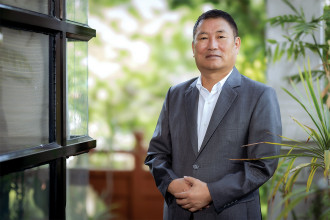
Global brands are rarely built from overlooked industries. Fewer still emerge from products rooted in centuries-old Himalayan traditions. Bhupendra Khanal has done both. At a time when investors are chasing artificial intelligence, fintech and software, Khanal has quietly built one of South Asia’s most compelling consumer success stories by transforming an indigenous Himalayan cheese recipe into Dogsee, a premium pet nutrition brand sold in more than 30 countries through global retail leaders including Walmart, Petsmart, Petvalue and Amazon. In the process, he has proven that innovation is not always about inventing something new; sometimes, it is about reimagining what already exists and executing it at a world-class level.
A serial entrepreneur with deep roots in technology, Khanal has consistently demonstrated an ability to identify underserved markets before they become mainstream. From building analytics and customer engagement companies to creating globally scalable consumer brands, his ventures have been united by one defining principle: finding value where others see limitations. That philosophy led him to establish Khanal Foods with his wife and co-founder, creating a business that has connected thousands of dairy farmers across Nepal and India to premium international markets while redefining how Himalayan products are positioned on the global stage.
Today, Khanal Foods is more than a pet nutrition company. It is a case study in how disciplined execution, supply chain innovation and long-term brand building can transform a niche agricultural product into a globally recognised enterprise. As the company expands into broader pet wellness categories and scales one of the world’s largest dedicated pet-grade cheese manufacturing facilities, Khanal is pursuing an ambition that extends well beyond market share – to build a globally respected consumer products company originating from South Asia.
In this exclusive conversation with Business 360, Khanal discusses the strategic decisions that shaped his entrepreneurial journey, the realities of scaling manufacturing and exports, the future of premium pet nutrition, and why globally competitive businesses can emerge from places the world often overlooks.
-1784540100.jpg)
Could you take us back to your roots in eastern Nepal and how your early exposure to business shaped your entrepreneurial mindset?
I was born and raised in Urlabari, Morang where I completed my high school education. My initial introduction to the mechanics of business came directly from my father. We operated a small family pharmaceutical shop in Urlabari, and my brother and I spent a significant amount of time managing it. That experience instilled a foundational business thought process in us from childhood.
Later, I moved to India on a scholarship from the Indian government to pursue a degree in Computer Science Engineering at the National Institute of Technology (NIT) Durgapur in West Bengal. Even in an engineering environment, my inclination toward business and economics was distinct. While my peers in the hostel read general newspapers like The Telegraph or The Statesman, I subscribed weekly to The Economic Times and Business World. I found myself vastly more captivated by macroeconomic trends and business strategy than conventional political news.
Was there a specific turning point during your college years that bridged this gap between computer science and economic theory?
A pivotal moment occurred during our fifth semester when I took an economics course. The professor, who also headed the MBA department, noticed my enthusiasm and we developed a close academic mentorship. Around the same time, I casually participated in a global workshop on Human Values organised by IIM Calcutta and Vivekananda Nidhi at our campus, where I was unexpectedly selected for an Excellence Award. This opened doors for me to connect deeply with economics professors at IIM Calcutta.
By the end of my third year, I presented a paper at a National Paper Presentation Contest advocating for a South Asian Economic Union, modelled after the European Union. I remember being incredibly intense about it. When they allocated eight minutes, I negotiated for more time because I prioritised delivering the depth of the research over simply winning the competition.
By my final year, I was practically living in the library, devouring dozens of foundational texts, from Paul Samuelson’s economics to various specialised treatises. Though I was one of the finest programmers in my batch, I knew deep down that I did not want a traditional coding job. I wanted to apply data to business strategy.
How did you transition from that academic passion into the corporate analytics sector?
I entered the professional arena as a business analyst, joining a company called Global Analytics in Chennai where I spent a couple of years specialising in risk management analytics for global clients. From there, I moved to Fair Isaac Corporation (FICO) which at the time was the world’s leading analytics firm. While there, I received an unexpected email from an individual in the United States who wanted to establish an analytics firm in India and was looking for a local partner. I agreed to meet and that led to the launch of Marketelligent in 2007. The company scaled remarkably fast, ranking among the top five fastest-growing analytics firms in India.
After two years of consulting, I wanted to pivot. Instead of executing piecemeal, project-based consulting, I wanted to build a scalable software product using subscription revenue. My two partners preferred the predictability of consulting which was already highly profitable. Because we could not align on that strategic vision, I chose to exit.
That exit led to the creation of Simplify360. What were the realities of building a tech product from scratch?
Simplify360 was a classic, grit-tested startup story. Initially, it was a massive struggle. We ran the company without a single rupee of revenue for 26 months, literally surviving on credit cards. But once the product hit the market, it proved to be one of the best enterprise systems in the industry.
Our early client acquisition was tough but we eventually broke through by signing major accounts like Coffee Day followed by Zee Media, Viacom Media, Airtel and Vodafone. By 2014, we made the company profitable and successfully raised institutional funds. We were growing well but our aspirations were global. We wanted to scale it into a billion-dollar enterprise. To achieve that, I knew we needed world-class enterprise sales leadership.
You made a very unconventional decision during that high-growth phase by effectively replacing yourself as CEO. What drove that choice and how did it impact you personally?
I went looking for a heavy-hitting sales leader and attracted two brilliant profiles, one from SAP and another from HP Software, both handling portfolios worth over a billion dollars. Obviously, a small company like ours could not afford their standard market compensation. I invited one of them to dinner and offered him the CEO position instead, presenting an equity and leadership proposition he could not refuse.
Technically, I fired myself from the operational role to make room for a leader who could take the company to the next level. I communicated the transition to my partners and stepped down. It was an incredibly intense period. Suddenly, I found myself in a profound psychological void. When you step out voluntarily from a company you built from scratch, you lose your daily sense of purpose.
I reached out to Krishna Gopinathan, the founder of Global Analytics (my first company) and a seasoned entrepreneur who had built and exited three companies. I asked him for 15 minutes of his time. What he told me changed my entire perspective. He said, “Every entrepreneur going through their first major exit experiences this void. You feel lost because you do not realise a fundamental truth: shareholding is ownership but being the CEO is just a job. You have not lost your company. You have just moved on from a job.” That single piece of advice relieved an immense amount of pressure and allowed me to think about my next venture with absolute clarity.
-1784540264.jpg)
How did that lead you from high-tech digital analytics to exploring the export of indigenous Himalayan agricultural products?
I took a soul-searching trip to reset. I started analysing global export opportunities, specifically focusing on how authentic Himalayan, North-East Indian and Nepali agro-products could be introduced to international markets. I curated a list of 36 potential items.
The real breakthrough happened during a research trip to Darjeeling. My wife, Sneh, flew in from Bangalore to join me. While visiting a local dairy processing unit that manufactured chhurpi (traditional hardened yak milk cheese), we encountered the local lore that dogs frequently try to steal chhurpi from the drying racks. As pet parents ourselves, that caught our attention. Dogs do not care about cultural novelty. They care about taste and texture. We bought 22 kilograms of chhurpi right there in the local market to take back to Bangalore for our own dog.
Sneh was running a successful marketing agency at the time, handling major corporate clients like ITC and Emami. When we looked closely at the chhurpi, she became incredibly excited from a branding perspective. She pointed out that the modern global pet consumer is obsessively searching for very specific attributes: 100% natural, grain-free, gluten-free, human-grade and single-ingredient. This traditional Himalayan product inherently possessed every single one of those premium value propositions. She told me, “The marketing is already built into the product. You just have to tell the truth about what it is and the market will respond.”
I loved the concept but my background as an analyst demanded empirical validation. I needed to understand market sizing, consumer segments and regulatory barriers. I began researching food testing protocols, veterinary safety and market trends. I discovered a video of an early iteration of Himalayan Dog Chew being pitched on Shark Tank in the US which proved the consumer concept was valid. At that time, the dental treat market in the US alone was worth five billion dollars. Today it is over seven billion. The addressable market was massive, the premium health trend was accelerating and market testing had already been validated by early movers. The only remaining challenge was institutional supply and global scaling.
How did you transition the business from a home-based pilot operation to an organised commercial enterprise?
Initially, we toyed with various names. My favourite traditional Nepali sweet treat is lapsi (hog plum), so we played around with that sound which eventually morphed into Dogsee, combined with Chew to clearly signal the product category. Everyone loved the brand identity, so we committed to Dogsee Chew.
In the earliest phase, it was entirely grassroots. I would order batches of chhurpi from Darjeeling, pack them manually at our house, load the boxes into the trunk of my car and drive around to retail pet stores and veterinary clinics across Bangalore. I designed an educational booklet to explain to vets and store owners exactly why this hardened cheese was an exceptional, long-lasting dental treat. Slowly, stores began giving us shelf space and the product began to move.
When did you realise Dogsee could be a global brand?
Our research revealed that while a few pioneering Nepali suppliers were successfully exporting chhurpi to three or four established brands in the United States, the massive European market was completely unpenetrated. During my research, I found that there was an insurmountable legal and regulatory barrier.
To export dairy products from Nepal to the European Union, the government must establish a formal national dairy standard that aligns directly with the European Convention. Furthermore, individual production facilities must secure stringent EU certifications. It was a regulatory logjam that had stalled progress for years. Seeing this gap, I realised that if we could solve the supply chain compliance and establish our regulatory footprint, Europe could be our launchpad.
We immediately mapped out an aggressive international trade show strategy. Over the next few years, we established prominent exhibition booths at the world’s largest B2B pet industry events: the Global Pet Expo in Orlando, SuperZoo in Las Vegas, Pet Fair Asia in Tokyo, the China International Pet Show (CIPS) in Shanghai, and major trade events in Asia and the EU.
By establishing a premium brand presence at these global expos, converting international distributors became seamless. The demand was overwhelming; they desperately wanted the product. Our primary challenge shifted completely from demand generation to supply chain formalisation.
Securing a consistent, high-quality supply of chhurpi from remote Himalayan regions is notoriously difficult. How did you restructure the economics on the ground to incentivise rural farmers?
To meet international standards and scale volume, we had to go directly into the mountains and completely re-engineer the local dairy economy. We met with rural communities and smallholders, asking them a fundamental economic question: Why focus solely on selling highly perishable fluid milk, curd or paneer?
In those remote terrains, fluid milk spoils rapidly before it can reach major commercial markets, leaving farmers with razor-thin margins, often yielding a net profit of just 1 to 1.5 rupees per litre. We demonstrated the financial model of processing that milk into chhurpi right at the source. By converting their yield into a stable, non-perishable commodity, they could increase their earnings to 2 or 3 rupees per litre of milk equivalent.
We did not just give advice. We institutionalised the supply chain. Dogsee Chew provided capital loans to local cooperatives and farmers to set up or upgrade their processing units. We invested heavily in upgrading their hygienic practices, manufacturing standards and equipment. It required immense, gruelling groundwork from the bottom up, but by 2019, our robust supply network was fully operational, delivering consistent, export-grade volume.
-1784540394.jpg)
In 2019, an unexpected domestic crisis forced you to pivot your business model from a pure pet-care focus into a human-grade food brand under the Himalayan Natives banner. What happened?
As more dairies began producing chhurpi – and existing ones scaled up – a new problem emerged. They were left holding large quantities of ghee (clarified butter), a byproduct of the chhurpi-making process. Chhurpi is made from skimmed milk, and the fat removed in that process is converted into ghee.
These smaller dairies had no way to sell that ghee. The local market could not absorb it, and they lacked the supply chain to reach larger cities. What should have been a valuable byproduct instead became a financial burden.
We decided to step in and solve this for them. We stepped in to absorb this surplus by bringing the ghee down to metropolitan hubs like Bangalore to sell via business-to-business (B2B) channels.
Initially, the reception from established restaurant chains and institutional buyers was incredibly disheartening. They tried to exploit the situation, offering rock-bottom prices that would completely squeeze out any fair compensation for our mountain farmers. Sneh and I realised that we could not rely on existing B2B distributors who prioritised short-term margins over value.
Being a proud native of the Himalayas, I decided that we needed to build an autonomous brand that preserved the integrity of our origins. That became one of the most phenomenal strategic choices we ever made. When the Covid pandemic disrupted global markets shortly after, food logistics faced massive lockdowns. However, because our human food brand was categorised as an essential commodity, we were permitted to operate cleanly through the peak of the pandemic. While other companies were contracting due to operational risk, our twin engines, Dogsee Chew and Himalayan Natives, just kept accelerating.
By 2021, what led you to move away from outsourcing and build your own highly specialised industrial facilities?
By late 2021, it became glaringly evident that our third-party suppliers simply could not scale at the velocity we were growing in the global market. Furthermore, outsourcing crippled our agility. If I required highly specific sizing, dimensions or custom formulations to satisfy international regulatory bodies, the factories could not adapt quickly enough.
The final straw was quality consistency. In the premium pet food market, structural defects like fracturing, internal air pockets or cracking result in immediate container rejections at international borders. I realised that if we wanted to maintain our market leadership, we had to control our own production.
We began by opening an advanced pilot facility in Nandi Hills, Bangalore. To build the backbone of this factory, I brought together a highly dedicated team of professionals: food technologists, dairy engineers and quality specialists recruited directly from global corporate giants like ITC, MTR Foods and Almarai Dairy in Saudi Arabia.
I literally paired these world-class corporate engineers with traditional craftspeople from Darjeeling and Ilam in eastern Nepal. I took my technical team directly into the mountains to study how chhurpi is made traditionally and then challenged them to spend 18 months re-engineering every microscopic detail of that ancient process for a structured, industrial environment.
How did you industrialise a centuries-old Himalayan product without compromising its authenticity?
It required deep thermodynamic and microbiological innovation. In Bangalore, the ambient temperatures during February and March hover around 30 to 32 degrees Celsius with variable humidity, which is completely antithetical to the cold, dry, thin air of the Himalayas where chhurpi naturally cures.
To overcome this, we collaborated with advanced engineering firms to design a completely unique, semi-automated climate chamber. We utilised custom industrial air conditioners, high-capacity dehumidifiers and advanced airflow mixers to artificially replicate the exact micro-climate of a high-altitude Himalayan valley inside a Bangalore factory.
Microbiology was another massive hurdle. Traditional mountain chhurpi is highly prone to surface mould or fungal contamination due to traditional curing methods. We embedded a specialised team of microbiologists in our R&D lab for four months to study every single stage of the dairy coagulation, pressing and drying cycles.
Our root-cause analysis revealed that traditional contamination stems primarily from the quality of water used in the initial cleaning and processing stages in rural areas. Once we pinned that down, we introduced multi-stage water purification plants and strict sanitation protocols. Over an intensive 18-month period, we engineered our own custom slicing machinery, heavy-duty pressing compressors, and automated drying zones, moving entirely away from slow, unscalable manual labour.
Once our baseline technology was proven, we scaled aggressively. By 2022, our commercial manufacturing line was processing thousands of kilograms of milk daily. We then established a state-of-the-art facility in Uttarakhand, situated at an altitude of roughly 1,700 metres, which handles an impressive 30,000 litres of milk per day.
To further optimise our production lines, we acquired an existing dairy facility on a long-term lease in Tamil Nadu and retrofitted it exclusively for the manufacturing of specialised chhurpi.
Across all facilities, we have an installed capacity that currently yields over 1.2 million kilograms per year. At the same time, as a committed partner of the hill ecosystem, we completely upgraded our network of independent rural suppliers across Sikkim, Himachal Pradesh and Nepal by exporting our custom-designed machinery back to them and training their local teams in advanced operational standards in the hills and in our facilities in Bangalore.
Coming from a rigid corporate B2B background, I knew that standard product pitches mean absolutely nothing to global buyers without the structural backing of international certifications. When you are auditing a factory to supply giant retailers like Amazon Global or Walmart, or the top-tier pet chains in Japan and the United Kingdom, they demand extreme systemic transparency.
To achieve this, I hired a veteran Head of Production who was a certified British Retail Consortium (BRC) auditor out of Almarai, alongside a heavily trained Quality Assurance head. We did not settle for baseline local food safety standards. We pursued the most rigorous global supply chain credentials available.
We successfully secured the comprehensive BRC GS Global Standard for Food Safety, Sedex compliance for ethical supply chains, and BSCI (Business Social Compliance Initiative) certification. The BSCI audit is crucial because it mathematically proves to international regulators that we treat our dairy farmers and factory employees ethically, pay them fair wages and enforce zero exploitative practices.
We went a step further by installing massive industrial solar arrays across our primary production facilities, effectively transforming our operations into a carbon-negative manufacturing powerhouse. When Walmart audited the global pet treat landscape, our facilities passed their rigorous compliance checks seamlessly, while almost every other competing entity across Europe, India and Nepal failed. Quality became our greatest marketing tool. Standing in Tokyo, Milan or Las Vegas and defending your product with 10 ironclad global certifications gives you immense negotiation leverage.
In 2025, Dogsee Chew made a highly audacious strategic move by parting ways with traditional international distributors to manage your supply chain directly. What drove that high-risk decision?
We realised that while traditional regional distributors provide a safe entry point, they ultimately slow down a company’s long-term compounding growth because they insulate you from direct consumer insights and control over pricing strategy. We decided to execute a high-stakes test market. We politely asked our third-party distributors in Canada and the United Kingdom to step aside so that we could establish our own corporate subsidiaries and go direct-to-market.
It was an incredibly risky operational pivot but it paid off spectacularly. Within just 12 months of cutting out the middlemen, our direct-to-channel sales rocketed to half a million dollars monthly in those territories alone. Having a massive, direct presence in a single consolidated channel gives you a stable cash-flow anchor.
We are currently replicating this exact ‘Farm-to-Fork’ model across continental Europe, establishing direct corporate entities in Italy and Germany to own the consumer relationship from end to end.
Managing an international supply chain for a specialised product like chhurpi involves massive working capital cycles. How do you maintain capital efficiency despite long transit times?
The cash conversion cycle for chhurpi is notoriously capital-inefficient if not managed with analytical precision. For example, to sustain a 20-crore rupee monthly sales run-rate on Amazon US, you constantly require an inventory buffer of at least 120 crore rupees across various stages of the pipeline. Ocean freight from South Asia to American ports takes anywhere from 70 to 90 days, meaning you permanently have 40 crore rupees worth of product floating on the water.
Furthermore, you need 20 crore rupees of inventory sitting in active packaging units, and another 60 crore rupees locked up in the 70-day drying and curing chambers in the mountains. All while paying rural farmers every single week without fail.
To solve this capital velocity bottleneck, I designed a hybrid sourcing model and continuous fund raise model in equity and debt mix to fund inventory requirements. We mix our high-volume in-house factory manufacturing with strategic procurement from qualified external suppliers across Sikkim, Uttarakhand and Himachal Pradesh.
Additionally, our US subsidiary imports directly from verified Nepali exporters and we even buy inventory directly within the United States from established Nepali-owned trading houses. Sourcing domestically within the US is naturally more expensive on a unit-cost basis but it rotates our capital significantly faster, optimises our cash flow and allows us to feed our rapid growth without stalling.
What is next for your group?
Our immediate focus for the next two years is centred on absolute infrastructure dominance. We are currently building the world’s largest dedicated pet-grade cheese manufacturing plant in Andhra Pradesh, having recently acquired 20 acres of industrial land from the state government. This massive plant will process 200,000 litres of milk every single day. The output will be strategically tri-factored: premium chhurpi for international pet markets, high-grade traditional ghee for human consumption and specialised whey protein isolates.
Simultaneously, over the last six months, we have broken out of our niche natural treat category into broader pet wellness segments. We recently launched Denties, an accessible line of functional dental chews, to compete directly with non-natural market leaders like Pedigree’s Dentastix and Greenies.
Furthermore, we have aggressively entered the high-margin pet supplement industry by launching daily nutritional food toppers and daily supplement bites with the brand extension, Dogsee Activet+. Most home-cooked pet diets are severely deficient in micro-nutrients. Our new single-serve sachets solve both palatability and strict clinical nutrition. Except for our core chhurpi lines, all of these new accessory categories are being manufactured via highly vetted third-party co-packers, allowing us to remain asset-light and incredibly fast on market execution.
What separates entrepreneurs who build enduring global companies from those who simply build successful businesses?
If I have to distill everything I have learned into foundational rules for global business, three things stand out above all else.
First, you must possess a ruthless, absolute commitment to professional quality. If you are constantly hunting for new clients because your product quality cannot retain your old ones, your business model is fundamentally broken and unsustainable.
Second, never launch an enterprise in a highly restricted or miniature addressable market. No matter how brilliant of an operator you are, if your market lacks depth, your growth will hit a hard ceiling very quickly, leading to operational stagnation and team frustration. You must rigorously analyse your Total Addressable Market (TAM) before spending capital, or like Elon Musk and Steve Jobs, be prepared to build the infrastructure to create an entirely new market from scratch.
Third, you are only ever as good as the team you build and empower. Many small business owners stay small forever because they suffer from an inability to delegate. They try to micromanage every single invoice and operational cog. We all have the same 24 hours in a day. If you do not focus intensely on talent acquisition, corporate culture and structure, you will burn out and your scale will collapse.
Has the rise of the conscious consumer fundamentally levelled the playing field for regional brands, or does competing globally now demand an entirely new approach to product development, branding and execution?
The modern consumer is the ultimate driver of the industry, not the corporation. Gone are the days of the mid-20th century where simple production volume or heavy corporate advertising could dictate consumer choices. Today’s consumer has instantaneous access to global data, competitor analytics, scientific papers and independent influencer reviews. You cannot mislead them.
If the market demands carbon-neutral manufacturing, you have to build solar-powered factories. If they demand gluten-free alternatives, you must re-engineer your ingredient deck. The onus is on the company to stay deeply aligned with consumer behaviour and constantly reinvent itself.
For entrepreneurs in regions like Nepal and India, the opportunities are boundless if we look past local constraints. Stop obsessing over macroeconomic negatives or government policy friction. Focus entirely on execution. Look at how landlocked nations like Singapore or resource-scarce nations like the Netherlands leveraged innovation to dominate global trade.
We sit on a goldmine: incredibly fertile land, abundant fresh water resources, massive clean hydropower potential and world-class agricultural products like high-altitude cardamom and chhurpi. Furthermore, the open-border economic integration between Nepal and India means regional entrepreneurs should view the entire subcontinent, and neighbouring China, as a single, massive, arm’s-length market of nearly three billion consumers. The moment we transition our mindset from local survival to global dominance, the entire architecture of our economy will shift. Think big, build robust teams and let your quality speak for itself on the global stage.