
We have paid a heavy price for negligible mistakes: PM Shah


KATHMANDU: Prime Minister Balendra Shah has said Nepal has paid a heavy price for negligible mistakes, citing the devastating flood in the Bhotekoshi River in Rasuwa as a clear consequence.
Writing on social media today, Shah said the disaster had left the nation in excruciating pain.
“We have been telling the world for a long time that climate change is having a major impact on the Himalayas and that the glaciers are melting. The effects are not confined to the Himalayas but reach as far as the coasts. The fear we had for a long time has come true in the form of the devastating flood in the Bhotekoshi River in Rasuwa,” he wrote.
Shah said Nepal had faced a tragic event.
“We need to seek a response from the global community and provide an answer to humanity about this,” he added.
The Prime Minister said managing natural disasters was a herculean task and that the authorities were working around the clock using available resources. He added that Nepal was also receiving international assistance following the disaster.
He said holding centres had been established in coordination with provincial and local authorities to accommodate affected citizens. Food, clothing and daily necessities were also being provided.
“In Nuwakot, 2,796 citizens are staying in 24 holding centres. In Rasuwa, 195 people are accommodated in five holding centres, and we have set up holding centres at two locations in Kathmandu to accommodate 300 citizens from different flood-affected areas of Rasuwa. Similarly, we are delivering relief by helicopter every day to 4,500 citizens in various areas of Rasuwa,” Shah said.
He said the federal, provincial and local authorities had obtained information from local staff and representatives in the affected districts immediately after the flood. The disaster response was launched on the basis of their preliminary information.
The Office of the Prime Minister and Council of Ministers has remained in direct and continuous coordination with the authorities, and their grievances are also being addressed, he said.
“On the day of the catastrophic incident, a meeting of the Council of Ministers declared the local-level units of the affected districts disaster-prone areas for three months under Clause 32 of the Disaster Risk Reduction and Management Act, 2074,” Shah said.
The Prime Minister said he held discussions with the Bagmati Province Chief Minister’s team about disaster management when he visited the flood-affected areas on August 27.
He said the National Disaster Risk Reduction and Management Authority subsequently held discussions with the authorities and decided that they should take their disaster-management responsibilities more seriously.
Infrastructure restoration
PM Shah said work was underway to restore infrastructure damaged by the floods.
Communication services have been restored by more than 95% in the affected areas, while electricity remains unavailable to 5.77% of households.
He said work to restore other infrastructure was progressing rapidly under the leadership of the relevant ministries. Restoring infrastructure was another form of relief for citizens affected by the disaster, he added.
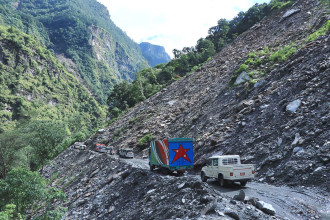
“On the Galchhi-Muglin road section, construction work is in progress on the Krishnabhir hillside, including a gabion breast wall to allow vehicles to operate over it. Work to cut trees and remove walls to open the track began today,” Shah said.
He said studies would be conducted on options including tunnels, soil nailing and sheet piles as part of a long-term solution to the problems at Krishnabhir. Traffic on the road section would resume by mid-September, he added.
A diversion has been constructed at Parewabhir and is already carrying traffic, while upgrade work is continuing.
Debris has been cleared from eight kilometres of the 10-kilometre Trishuli-Betrawati road section, with work continuing along the remaining two kilometres.
Emergency tenders have also been invited for work on an additional 35 kilometres of damaged roads, Shah said.
Foundation work has begun for the installation of a Bailey bridge over the Tadi River, and efforts are under way to transport the bridge there by tomorrow.
At Betrawati, a survey for a Bailey bridge has been completed and foundation work has begun. Surveying has also started at Trishuli, where a 120-metre-long Bailey bridge is considered necessary.

-1788413019.jpg)

-1788452630.jpeg)