BUILDING WHAT OUTLASTS POWER

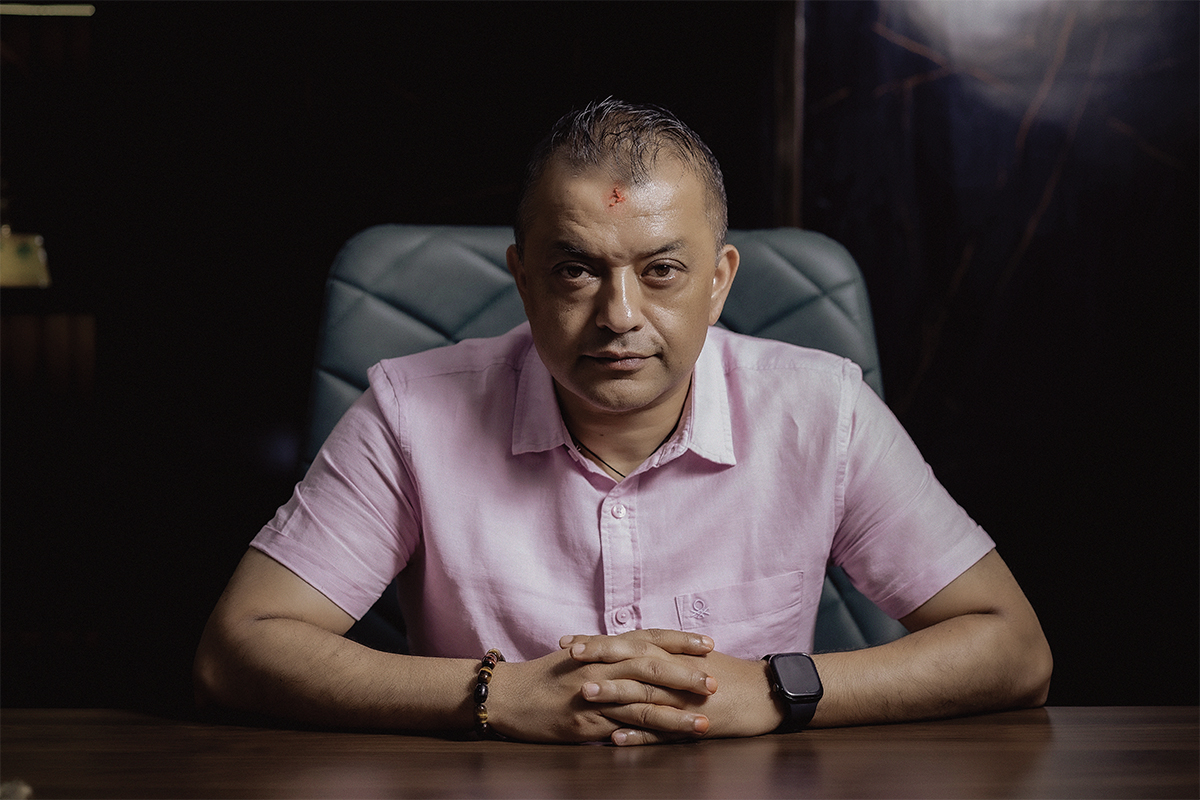
GAGAN THAPA
President, Nepali Congress
Nepal has changed governments 15 times since 2012. Gagan Thapa argues the fix is not another new face but a state built to outlast whoever holds office, and he has spent twenty years making the case.
Gagan Thapa was 40 when he took over Nepal’s health ministry, with no prior experience of running one. He left 10 months later having pushed the Health Insurance Act through parliament - an individual mandate with the state paying premiums for those who could not - expanded subsidies for heart, kidney and cancer treatment, simplified the rules governing organ transplants, and set out a seven-year plan to rebuild health infrastructure, staffing and equipment. It remains the clearest evidence anyone has of what he does with executive power: he legislates, and the legislation outlasts him.
That record is the reason his name has been attached to the Prime Ministership for the better part of a decade. Born in Kathmandu to a middle-class family, a chemistry graduate from Tri-Chandra who took a master’s in sociology at Tribhuvan, Thapa came into politics through the student movement and into parliament in 2008. He won Kathmandu-4 three times running. He chaired the Agriculture and Water Resources Committee, where he built a reputation for issuing directives the government could not comfortably ignore. In December 2021 he topped the poll for Nepali Congress General Secretary with nearly 65% of the vote. In January 2026, after years of arguing that his party could not keep asking a young country to wait its turn, he was elected its President, and named its candidate for Prime Minister.
Then March happened. The Congress took 38 of 275 seats, its worst result, and Thapa lost Sarlahi-4 by 12,857 votes after 18 years in parliament. He offered to resign.
His committee refused to accept it. In August, the Supreme Court agreed to review the ruling that had recognised his leadership, leaving him in charge but with his mandate under judicial scrutiny.
What has not shifted through any of it is the argument. Thapa’s contention is that Nepal’s constraint has never been the identity of its leaders but the condition of its state: a civil service recruited and promoted badly, regulators and anti-corruption bodies staffed by patronage, enforcement that businesses cannot predict from one administration to the next. Fix the machinery, he says, and the politics follows.
The economy is not waiting. Remittances run at roughly a quarter of GDP, more than 70% of migrant workers are in the Middle East, and 839,266 Nepalis left for foreign employment last fiscal year. The World Bank expects growth of 2.3% in FY26. Few figures in Nepali politics have been readier for the job, or have had a harder road to it.
In this conversation with Business 360, he discusses the state, the private sector, the digital economy and what generational change is actually worth if it arrives without a mandate. Excerpts:
You have long been seen as the leader who could reshape the Nepali Congress from within. Looking back, were there moments you should have challenged the status quo earlier? What held you back?
My view has always been that the Nepali Congress must renew itself from within. After the 2022 general elections, I was offered senior executive portfolios, including deputy prime minister, but declined and contested the parliamentary party leadership against Sher Bahadur Deuba. It was not a generational conflict; I believed Nepal could no longer be governed through the old political paradigm.
I stood, contested and accepted the democratic outcome. But looking back, I made two mistakes. First, I did not communicate the stakes clearly enough. Second, I overestimated public patience with the pace of institutional change. I believed discipline and process required me to wait for the next party convention. The younger generation, however, had neither the patience nor the reason to wait.
I still believe democratic institutions matter and change must have legitimacy. But humane politics also requires listening when people tell you that the system is moving too slowly. I respected the process; perhaps I should have challenged the status quo more boldly, without waiting for the next political cycle.
Leadership is measured not only by the battles you fight but by the ones you choose not to. Which decision would you approach differently today?
The aftermath of the 13th General Convention stands out most clearly. After contesting for general secretary, I should have drawn a firmer line against the status quo and taken a far more uncompromising stand.
I have always been clear about my foundational principles. But to achieve anything inside an established party, you are forced to play by the existing rules — to sit within the mess and navigate its internal mechanics to secure victories.
For six or seven years, I fought within those confines. My only shortcoming was staying in the political comfort zone too long. A party with deep-rooted traditions requires building teams and making compromises, but when you adapt too much to the existing rules, you risk becoming indistinguishable from the system you set out to reform.
I cannot complain about the system while acting as a passive participant in it. My greatest regret is that at critical junctures I chose conventional patience over going all-out. Real reform requires uncomfortable, high-risk steps, not the predictable rhythms of party machinery.
Citizens today are demanding not just new leaders but a new political culture. How does someone from your generation convince young Nepalis you can still lead that transformation?
My generation occupies a complex middle space. We spent decades working alongside senior leaders with a glorious history of struggle against autocratic regimes. We respected that contribution while pushing for modern administrative skills, transparency and accountability. But while we fought to bridge the gap, we were not able to establish the new political culture we advocated.
Today a generation 20 to 25 years younger than me dominates public discourse. They are the majority, and their expectations are fundamentally different. Rhetoric and speeches do not work with them. They are not aware about our past sacrifices, historical pedigree or personal aspirations. They judge us purely on present decisions, authenticity and observable actions.
Winning their trust requires two shifts. Personally, I have to demonstrate my values through transparent choices rather than political posturing. Institutionally, we have to turn the Nepali Congress into an open, accessible platform. A 25-year-old with fresh ideas should not have to spend decades in an institutional queue to have their capability recognised. My strategy is to break open those rigid structures so young talent can enter and lead on merit rather than seniority.
My generation occupies a complex middle space. We spent decades working alongside senior leaders with a glorious history of struggle against autocratic regimes. We respected that contribution while pushing for modern administrative skills, transparency and accountability. But while we fought to bridge the gap, we were not able to establish the new political culture we advocated.
-1788684634.jpg)
Nepal has seen significant political change and the rise of new political forces. Yet migration remains high and many young Nepalis still believe their future lies elsewhere. Why has political change not translated into public confidence?
There is a fundamental disconnect between political milestones and daily material realities.
Around 2004–05, and again after the armed conflict ended in 2010–11, public hope was immense. People recognised the monumental nature of transforming war into peace and drafting a democratic constitution.
But major political achievements have a short shelf life. Once state structures stabilise, people look for tangible improvements in their lives. Over the past decade, despite historic transitions, citizens saw minimal structural improvement in public education, healthcare access, job creation or basic economic security.
The political class - including the near two-thirds majority government [of 2018] - made the critical error of taking public trust for granted. Parties kept pointing to past sacrifice or raw popularity as sufficient proof of legitimacy. The same mistake is also being repeated by this new generation of leaders as well, if i may add.
In a functional democracy, past sacrifice only gets you through the door. From that day on, leadership means passing a daily exam on economic delivery, governance and institutional efficiency. Because our previous leadership treated historic victories as permanent endorsements rather than daily obligations, confidence collapsed, and many young Nepalis went looking for their futures abroad. Rebuilding that confidence requires delivering outcomes day after day, without leaning on the achievements of the past.
Many argue Nepal’s greatest crisis is not leadership but institutions. Which ones need the most urgent rebuilding, and what would meaningful reform actually look like?
Leadership and institutions are inseparable. When an elected leader assumes power here, a sense of political luxury takes over. They feel they have time; they take the mandate for granted because they won an election. They forget their primary responsibility, which is ensuring state institutions function independently and effectively. Fix the institutional machinery and everything else follows.
The most urgent area is public administration - civil service and service delivery. That requires a complete overhaul, from the intake process through performance evaluation to career incentives. Incoming governments have suffered from the delusion that every prior decision was flawed and that their own isolated interventions could magically fix things which undermines institutional continuity.
Rebuilding an institution does not mean wiping the slate clean. You build on existing foundations - traditions, institutional memory, values, history. The challenge is deciding what to preserve, what to disrupt, and how to implement change gradually but decisively. Instead of that methodical respect, political leadership has repeatedly reached for flashy quick fixes while placing partisan loyalty above institutional integrity.
The same failure runs through our constitutional bodies, to a large extent. The Constitution provides robust rights and establishes powerful anti-corruption bodies such as the Commission for the Investigation of Abuse of Authority. Yet systemic corruption remains pervasive because these bodies have been politicised and lack scrutiny.
Instead of fortifying regulatory authorities, public universities, the Nepal Police and the bureaucracy, many leaders have prioritised placing their own cadre and loyalists inside them. Rebuilding Nepal requires stepping away from partisan patronage and committing to independent structural reform of the public service, law enforcement and regulatory bodies, without the need to install loyalists who do not ask questions, or raise pertinent issues.
What is one structural reform Nepal desperately needs that no party, including your own, has had the courage to pursue?
Exactly what I have just outlined: comprehensive, uncompromising public sector reform, spanning the civil service, the police and administrative restructuring.
Every party and leader in Nepal admits in private that our public sector is inefficient and structurally flawed. None has had the courage to execute real reform, because it demands enormous political risk.
Populism from a podium and on social media is easy. Structural reform demands risk-taking, strategic foresight and administrative experience. You have to disrupt entrenched interest groups, eliminate redundancies and enforce strict meritocracy. You have to navigate resistance from inside the bureaucracy and inside your own party. Until a government is willing to spend its political capital on overhauling how the state operates, our governance will stay trapped in inefficiency.
Nepal has grown increasingly dependent on remittances while productive sectors weaken. Are remittances an economic cushion, or a political excuse to postpone difficult reform?
Remittances are an economic reality. They are neither a failure to be condemned nor a permanent economic model to be celebrated. For many developing countries, migration and remittances are part of a transitional phase. The real question is whether a nation uses that phase to build the next economy, or simply becomes comfortable living off the labour of its people abroad.
Nepal must reject two false choices. We cannot simply demand that young people stop leaving when the economy has not created credible opportunities for them at home. But neither can we continue treating remittances as an inexhaustible cushion that allows governments to postpone structural reform.
The goal should not be to stop Nepalis from going abroad. In an increasingly interconnected world, mobility is an advantage. Our ambition should be to globalise the Nepali - our skills, talent, businesses, capital, knowledge and networks - while building an economy strong enough that going abroad is a choice, not an economic necessity.
Remittances should therefore become transition capital. The fiscal space they create must be directed towards a coherent national strategy: reliable infrastructure, digital connectivity, high-quality education, research, technology and globally competitive industries. At the household level, the priority should be investment in health, nutrition and education so that the next generation is better prepared to compete internationally.
The greatest failure has been fragmentation. Too much of our public expenditure is scattered across politically convenient projects - small roads, bridges and local schemes designed to satisfy immediate constituencies—rather than concentrated on the capabilities that can transform national productivity. Nepal cannot build a globally competitive economy by dividing its resources into thousands of disconnected projects.
For the younger generation, the question is not whether Nepal should choose between migration and domestic employment. It is whether we can build a country where a young Nepali can work for the world from Nepal, build a global company from Nepal, leave to gain skills and return with capital and knowledge, or remain abroad while investing and creating opportunities at home.
That requires a more ambitious political economy. Over the next seven to eight years, Nepal should make a concentrated national investment in technology education, university research, digital infrastructure and high-value services. We must move from exporting primarily labour to exporting knowledge, technology, services and ideas.
Remittances should give us the breathing room to make that transition. They must not become the political excuse for avoiding it. The purpose of economic policy should ultimately be simple: not to prevent Nepalis from becoming global, but to ensure that Nepal becomes strong enough to benefit from the global success of its own people.
When a government takes power pledging zero tolerance for corruption, that commitment has to be backed by institutional strengthening, policy transparency and strict adherence to the rule of law. Enforcement must be ruthless but also predictable and free of political selectivity.
-1788684687.jpg)
Recent corruption investigations have exposed alleged wrongdoing across governments, institutions and businesses. How does Nepal strengthen accountability while ensuring the rule of law builds investor confidence rather than deepening uncertainty?
When a government takes power pledging zero tolerance for corruption, that commitment has to be backed by institutional strengthening, policy transparency and strict adherence to the rule of law. Enforcement must be ruthless but also predictable and free of political selectivity.
The primary issue confronting Nepal’s business community today is unpredictable governance and the fear of selective enforcement. When anti-corruption drives resemble arbitrary political witch hunts rather than systematic, evidence-based proceedings, the private sector panics. Business leaders are willing to speak out in principle, yet they operate under a cloud of anxiety, unsure what measure will be rolled out tomorrow. Consistency in the policy sphere with clear rules is imperative for business growth.
If every administration redefines the rules of the game on a whim, targeting individuals while ignoring systemic fixes, it destroys investor confidence and stalls economic progress of Nepal. Businesses cannot operate in an environment where past norms are suddenly weaponised without clear, transparent and prospective regulatory frameworks.
Genuine accountability requires the government to demarcate the rules of compliance clearly, strengthen investigative agencies to act independently of executive interference, and ensure legal action follows due process rather than political headlines. Accountability and a thriving investment environment are not mutually exclusive. Clear, predictable enforcement is precisely what gives investors the confidence to commit capital. The state and the private sector have to engage constructively so that anti-corruption measures produce a fair, transparent marketplace rather than economic paralysis.
The global economy is being reshaped by AI, supply-chain realignment and geopolitical competition. Where does Nepal realistically fit, and what are we at risk of missing?
The global architecture that existed for decades - one from which Nepal derived relatively little strategic or economic benefit - is shifting fundamentally. Conflict in the Middle East, changes across Western economies and evolving dynamics between our northern and southern neighbours are producing a new order. Historically, out of fear and an overemphasis on complexity, Nepal has responded to international shifts with policy paralysis, often losing even the modest gains it held.
We are missing a vital realisation: every major global disruption opens distinct niches for agile, smaller economies. While AI and supply-chain realignment disrupt developed nations at a high capital level, they simultaneously unlock new service, digital and outsourcing markets that countries like Nepal can capture - provided we prepare the domestic ecosystem.
The state cannot be an isolated spectator. In a modern economy it acts as the team captain, working alongside the private sector, academia and policy think tanks.
We are failing to conduct that strategic discourse where it matters. Are our universities analysing these realignments? Are government think tanks or parliamentary committees mapping Nepal’s competitive edge in an AI-driven economy? They are not. Parliament has largely devolved into an arena for mudslinging rather than policy strategy.
A government with a strong mandate ought to assemble leaders from industry, tech and academia to build a cohesive national strategy. A captain cannot win the match alone. Without a unified, multi-stakeholder effort, Nepal will keep watching historic economic transitions pass it by.
Gen Z challenged the establishment not simply because of age but because of its expectations around transparency, speed and accountability. What did they understand that your generation overlooked?
The generation of leaders before mine operated in an era marred by physical and political sacrifice - decades of imprisonment, underground resistance, state censorship. That forged immense moral authority, but it also created institutional limitations.
My generation worked closely with those leaders, and in doing so we overlooked a critical shift: the younger generation demands real-time transparency, administrative speed and uncompromising accountability.
We took public trust for granted. Inside the parties, we assumed internal struggles and procedural delays were acceptable internal matters. We failed to realise that the younger public has every right to know how decisions are made, how resources are allocated and why results take so long.
Gen Z does not evaluate political movements by historical sacrifice or internal party narratives. They see governance through immediate delivery, open data and institutional clarity. What my generation struggled to grasp, and must now fully adopt, is that transparency is not a strategic concession. It is the baseline of modern democratic legitimacy.
What conviction have you held for decades that you have fundamentally changed your mind about?
Early on, I believed that meaningful change had to come strictly through formal political office and state power. Our political education conditioned us to see executive appointments and ministerial positions as the primary mechanism of societal transformation.
That has changed completely. Position and office are temporary instruments. They guarantee nothing lasting. Real structural change comes from building independent, resilient systems that outlast any individual politician or government. True political influence lies not in occupying a seat but in building institutions - regulatory bodies, educational frameworks, public delivery mechanisms - that function effectively regardless of who holds office.
When history judges your political journey, what do you hope it says - not about the offices you held, but the changes you made possible?
I do not want my legacy measured by a catalogue of offices or tenures. Titles are temporary; institutions outlast those who hold them.
What I hope history records is that I helped shift Nepal towards a stronger political culture, one that put capable institutions, equal opportunity and the dignity of citizens above the interests of those in power.
If, decades from now, Nepalis can rely on quality healthcare and education, an independent judiciary and a professional, accountable state, I would hope that, at a critical moment, my generation helped make those foundations stronger.
But institutions must ultimately serve a larger purpose: to give every Nepali the confidence that their future is not determined by family connections, political access or the circumstances of their birth. A young person should be able to build a life of ambition and dignity, whether they choose to succeed in Nepal or compete anywhere in the world.
Personal political victories fade quickly. The real test of leadership is whether the country becomes stronger, fairer and more capable because you were there. That is the legacy I would hope to leave behind.
What is your message to the present government?
Three things.
First, do not sacrifice institutional process and the rule of law for short-term political results. Throughout our modern history - under royal rule and under strong parliamentary governments alike - administrations have tried to bypass democratic process in the name of quick execution. That trade-off always fails. Bypassing norms, weakening fundamental rights or compromising the rule of law damages state legitimacy.
Second, exercise profound maturity on constitutional and social harmony. Nepal operates on a delicate balance of ethnic, cultural and religious diversity. Treating constitutional provisions or social cohesion lightly risks igniting fault lines no government can easily contain.
Third, treat economic reform with absolute seriousness rather than political optics. Governance cannot be sustained through surface-level public relations, curated meetings or symbolic gestures. The state has to execute genuine, painful structural reform across the fiscal, administrative and economic sectors.
The prime minister is the captain, but a captain cannot score without supporting players. If the government fails to bring the private sector, civil society and institutional stakeholders into a unified strategy, it will not deliver the economic transformation Nepal urgently requires.
What can Nepali Congress supporters expect from you in one year, and in five?
The Nepali Congress must remain aligned with the evolving aspirations of the country’s youth. I grew up in Kathmandu and studied at a private school - a privileged background compared with the older generation of leaders such as BP Koirala, who endured persecution, exile and long imprisonment to establish our democracy. My generation did not inherit a history of personal sacrifice. We were the beneficiaries of the open environment the Nepali Congress fought to create.
When I joined the student movement in Class 9, my motivation was a basic trust in what the party represented. Like millions of young Nepalis, my aspiration was simple and personal: to build a good life, secure a meaningful future and live in a prosperous, stable society. I trusted the Nepali Congress because I believed an institution capable of transforming a nation could also deliver an environment where an individual could realise their potential.
Today, we face a fundamental institutional challenge. For too long our outreach has relied on recounting the heroic struggles of yesterday and expecting loyalty in return.
A young person hears those stories, acknowledges the sacrifice, and still feels entirely disconnected from the organisation. Respecting history does not translate into joining a political party.
A political movement cannot sustain itself looking in the rearview mirror. We have to demonstrate what the party can do for a young citizen’s future today - a credible roadmap for economic opportunity, quality public education, transparent governance and merit-based advancement.
Over the next one to five years, my focus is to pivot the Nepali Congress from a legacy institution defined by past achievements into a dynamic, forward-looking platform: a party young Nepalis can trust and participate in, and an organisation that actively creates the conditions for them to build their lives and careers here in Nepal.