
Nepal in a World of Reorder

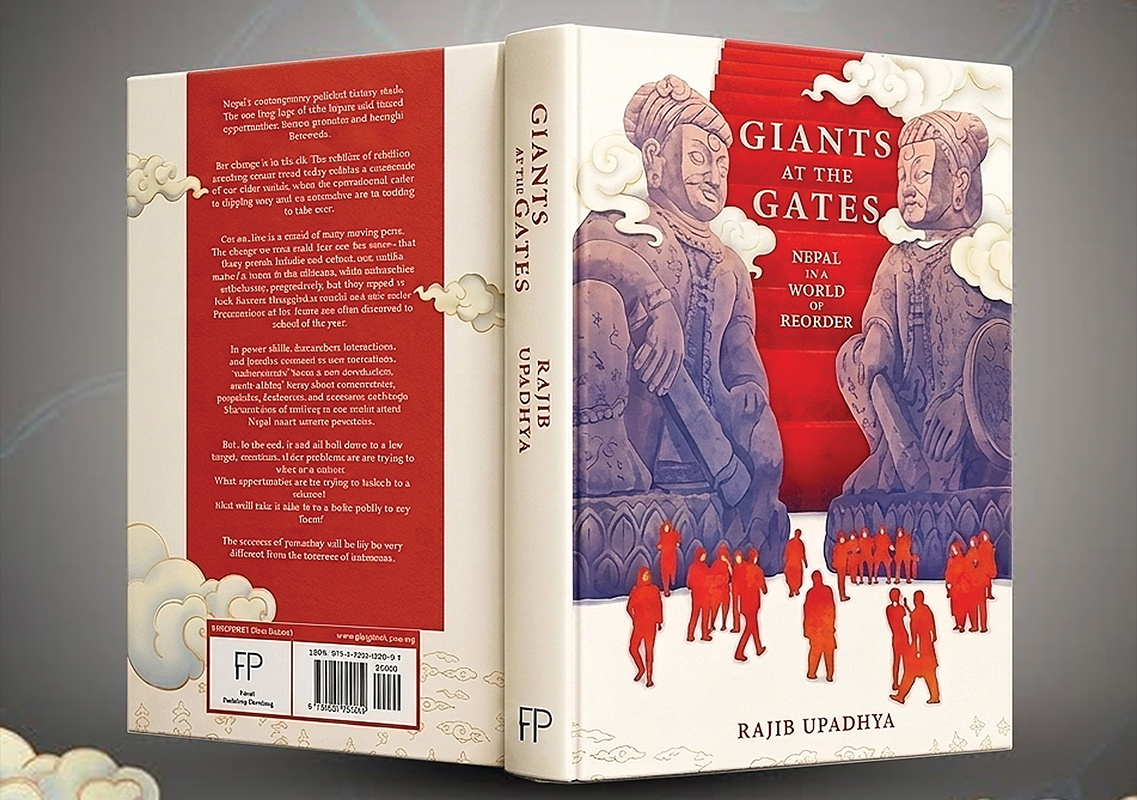
Rajib Upadhya’s inaugural publication, Cabals and Cartels, resonated profoundly with me upon its immediate release in 2021. The book meticulously chronicled Nepal’s political economy during an era in which I was actively involved in leading financial institutions. As a senior development economy professional, his ringside view provided him with a unique perspective on the subject matter. Consequently, when the author requested that I review a few chapters of his second book, Giants At the Gates, I was honoured to oblige.
Over the couple of weeks in early December last year, I traded a small stack of emails with the author‚ chapter by chapter, and I want to walk you through some of that exchange here.
My overall impression of this book is that it is audacious in terms of ambition or scope. It seamlessly transitions from the Bretton Woods conference to the burning of Singha Durbar, from the Triffin Dilemma to the cost of a Dubai Golden Visa. Few writers would dare to juxtapose the architecture of the global financial order with the dysfunction of Nepali governance. Remarkably, the author expertly presents these two as a cohesive argument.
It is also pertinent to consider the historical context in which this book was written. Nepal was still reeling from the events of September 2025, which had resulted in the dismantling of parliament, the de-legitimisation of the existing order and the imminent election. The author did not have the luxury of writing this from a safe historical distance.
I was asked to speak to three chapters in this book. I took them with genuine admiration and a couple of honest quarrels.
Chapter Seven stands as the book’s most comprehensive and confident exploration of global finance. It traverses a captivating journey from the illustrious Mahendramalli silver coins of the Malla kings to the transformative impact of Nixon’s 1971 shock, ultimately culminating in the present-day phenomenon of Central Bank Digital Coins.
Amidst the intricate tapestry of global financial events, a significant domestic concern emerges: Nepal imports inflation significantly due to its exposure to the dollar and rupee markets.
My primary concern lies in the disproportionate allocation of space within the book. While the book is ostensibly about Nepal, the majority of its pages are dedicated to Washington, Riyadh and Beijing, with only brief excursions back to Nepal. Despite the world being a global economic village, Nepal remains isolated in several critical areas due to its closed foreign exchange regime.
And when I got to the passage on the Nepali rupee, I engaged in a small technical quarrel with the author. The book notes that the rupee ‘floats freely’ against other convertible currencies, alongside the fixed peg to the Indian rupee. Technically true, but in practice, those floating rates are derived almost entirely by taking Indian rupee cross-rates and applying our peg on top. I felt that was worth underlining, precisely because this book is fundamentally about the changes we seek and fear at the same time. Our currency ‘float’ is a small but telling example of monetary policy freedom that exists mostly on paper.
In the current context of healthy macro-economy, does our government dare to re-adjust the peg to say 1.25 from existing 1.6? Such a move would undoubtedly curb the rise in prices to some extent. Gen Z dividend?
Chapter Eleven stands as the emotional core of the book and I read it twice. The statistics presented are compelling and meticulously organised: since 1990, there have been 30 prime ministers, half of the country’s university students are now studying abroad, a billion dollars annually is spent on foreign degrees while the public education budget bleeds out.
The line that stands out is that remittance functions as a ‘resource curse’ that enables the ruling class to ‘get away with murder’. I found myself contemplating the more profound question that lies beneath it: why do us Nepalis continue to succumb to the same rigged game, generation after generation?
Instinctively, I reached for a lazy and thoroughly discredited explanation that our collective intelligence is low. However, what we eventually arrived at together was a more honest and practical answer: that unlike many of her neighbours, Nepal has not experienced colonisation or truly existential hardship in recent memory. Perhaps that is precisely why the desire for well-governed institutions has never fully taken root here.
That’s not in the chapter verbatim but you can feel the ghost of that conversation in it. And I would love to see the author take it further in the next edition, maybe even as its own chapter.
Chapter Twelve is where the book tries to cash the cheque the first 11 chapters wrote. The Four Fs, form, function, functionary, finance, is a clean organising frame. The chapter is genuinely generative on the fourth: a sovereign wealth fund built from excess reserves, Bhutan-style hydro-backed crypto mining, carbon offtake positioning, the Temasek comparison. These are live ideas.
This is the chapter where I had the most fun pushing back. Two of my notes to the author still feel unfinished to me, in a good way.
First, his line about businesses treating politicians and bureaucrats as an ‘investable asset class’ is, frankly, one of the best phrases in the book. But it undersells itself by keeping the ruling class in the frame alone. ‘Privatising profits and socialising losses’ is a private-sector habit too. I am convinced that Nepal needs its own movement for
Responsible Business Conduct sitting alongside every call for political reform. If accountability does not run in both directions, it isn’t accountability, it’s just blame.
Second, on the crypto-mining proposal, I like the instinct, but crypto remains close to sacrilege in Nepali public discourse, rightly or not. I have been an early proponent of framing our surplus hydropower around computing capacity and data centres. The same comparative advantage, the same ring-fenced ecosystem.
Neither of these is a criticism of the chapter’s ambition. If anything, it’s the opposite. The ambition is exactly right. I just want the packaging to be as persuasive as the substance deserves. The book’s back cover blurb succinctly captures the essence though: “Nepal’s contemporary political history reads like one long saga of false hopes and missed opportunities, broken promises and outright treachery.”
On the whole, this is a serious, well-sourced, occasionally fearless book that refuses to let Nepal off the hook. It is an audacious project but extremely well put together.
It is a book harder to write than it looks.
-1786356423.jpg)
-1784192408.jpg)
-1782644079.jpg)