
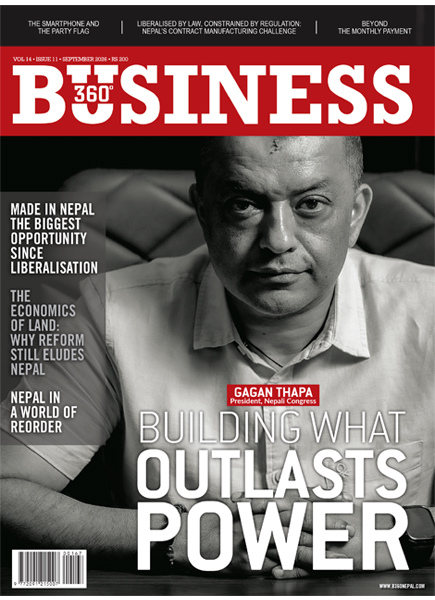
MADE IN NEPAL: THE SLOGAN AND THE TRADE DEFICIT

-1789290954.jpg)
The hype around “Made in Nepal” has never been louder. Politicians invoke it in budget speeches, influencers hashtag it on Instagram, and shopkeepers in Thamel stick it on everything from pashmina shawls to instant noodles. On August 19, the Office of the Prime Minister and Council of Ministers issued a directive urging federal, provincial, and local authorities, along with Nepali diplomatic posts, to give priority under the existing Public Procurement Act to domestic goods, including stationery, printing materials, furniture, office decor, construction materials, machinery, agricultural produce, and food items, where those goods meet requirements on availability, quality, price, and safety, with quarterly ministry inspections to check compliance.
But behind the slogan sits a harder story: a country that imports roughly 6.65 times what it exports, a policy apparatus still catching up to its own rhetoric, and a small, determined group of entrepreneurs who are proving that Nepali-made can compete, if given the room to. Walk through New Road on any weekday evening, and you will see vendors calling out ‘authentic local Nepali goods, buy it’, stickers with the outline of Mount Everest slapped onto everything from soap bars to biscuit packets, and young shoppers scanning labels the way they once scanned prices.
Something has shifted in how Nepalis talk about what they buy. Whether that shift has moved deep enough into factories, farms and export ledgers is a different question altogether, and one nobody can answer sector by sector, because no such breakdown of domestic production exists.
The hype is real, and so is the trade gap
There is no denying that “Made in Nepal” has become a genuine cultural moment. Since the September 2025 Gen Z-led protests that reshaped Nepal’s political landscape, a wave of economic nationalism has swept through the country’s youth, many of whom now describe buying local as a form of civic participation rather than just a shopping choice. Online marketplaces built entirely around domestic goods have multiplied, and older brands that once struggled for shelf space are suddenly being rediscovered by a generation raised on imported labels.
But hype has a way of outrunning fact, and Nepal’s trade numbers are a sober corrective. The country’s merchandise trade deficit crossed the $10 billion mark years ago, and it has only widened since.
According to the Department of Customs’ FY 2025/26 data, Nepal imported goods worth Rs 2.096 trillion against exports of Rs 315.29 billion, a trade deficit of Rs 1.78 trillion that widened 16.63% year on year, as import growth of 16.20% outpaced export growth of 13.81%. Nepal ran a trade deficit with 128 of its 162 trading partners.
India remains Nepal’s dominant trading partner, supplying goods worth Rs 1.2106 trillion, followed by China with imports worth Rs 425.25 billion. What flows in is telling: petroleum products, gold, steel, vehicles, smartphones, pharmaceuticals, and increasingly, finished consumer goods that Nepal could plausibly manufacture at home.
What flows out are soybean oil, cardamom, palm oil, jute goods, noodles, zinc sheets, particle board, tea, woollen carpets and handicrafts.
Having said that, Nepal’s single largest export commodity in FY 2025/26 was soybean oil and related products, worth roughly Rs 128.74 billion, refined largely from raw material imported for the purpose and then sold on to India under a tariff differential that has made the trade commercially attractive. It is the country’s biggest export.“Our exports are stuck at just 3-4% of GDP, and whatever incentives exist focus on only a few sectors, the same old products like ginger and tea, chosen because they grow here naturally, not because we have scaled them,” said Kalpana Khanal, Senior Research Fellow and Head of the Centre for Economic and Infrastructure Development Policy, Policy Research Institute.
“We have never pushed increasing production size or processing raw materials into finished goods before export. Take ginger: we barely produce a few truckloads a season, yet incentives should target final products like ginger candy, alongside quantity, logistics, and processing investment,” said Khanal, adding, “Subsidies mostly go to already established players, and some exports still rely on imported raw material instead of local backward linkages. Imports diversify simply because remittance boosts purchasing power while our own production stays low, making us a target market for the world.”
Likewise, Rajan Sharma, a trade expert and General Secretary at the Nepal-India Chamber of Commerce and Industry (NICCI), said that Nepal’s export basket has stayed narrow because production, testing, certification, logistics, and trade finance have not kept pace with importing-country requirements.
“Government strategies identify more products, but firms still struggle to meet basic sanitary, environmental, packaging, traceability, and certification standards. Imports diversify more easily because large importers have capital, established networks, and political influence, while exporters have limited voice in policy and business-support institutions,” added Sharma.
The imbalance is not just a statistic. It sits underneath almost every policy conversation happening in Kathmandu right now, from the Ministry of Industry’s revived talk of import substitution to the new government’s “self-reliant economy” pledge, and it is the quiet, uncomfortable backdrop against which every “Made in Nepal” sticker is placed.
Sharma further suggests that Nepal should leverage its location by becoming a trusted connector, not a geopolitical proxy. It should pursue commercially viable connectivity with both neighbours while maintaining transparent, rules-based project selection.
What the Policy Documents Actually Promise
For years, “Made in Nepal” existed mostly as a marketing phrase used by private retailers and diaspora-run online stores. That has started to change. Nepal’s National Commitment document, released on April 14, by the current government, explicitly folds economic self-reliance into its governing agenda. The 18-point framework, built from the manifestos of the six nationally recognised parties that contested the election, commits to what it calls a self-reliant economy campaign that connects citizens directly to production, manufacturing, and innovation, alongside promises of investor-friendly laws, a simpler tax system, and an exit from the Financial Action Task Force grey list to make Nepali exports and investment more credible abroad.
Agriculture, long treated as a subsistence sector rather than an industrial one, gets specific mention too, with pledges to make farming a dignified and secure profession and to expand forest-based production so that timber, herbs, and non-timber forest products feed domestic supply chains instead of leaking out as raw material for someone else’s factory.
“On paper, Nepal’s Trade Integration Strategy 2023 proposes developing competitive products, trade infrastructure, logistics, digital trade, and priority sectors such as agriculture, textiles, cement, iron and steel, IT/BPO, tourism, and electricity,” said Sharma.
“However, this is not yet a credible, operational import-substitution programme with clear targets, financing, procurement support, or protection for domestic value chains. Effective action would require targeted support for local raw materials, agro-processing, machinery, standards labs, and reliable energy; not merely broad policy announcements,” he added.
The government’s broader policy and programme for fiscal year 2026/27, presented by President Ramchandra Paudel to a joint session of parliament on May 11, layers on a hundred-point roadmap touching hydropower expansion, a “borderless digital economy,” and structural reform of public enterprises, even as Nepal has formally requested a three-year deferral of its graduation from Least Developed Country (LDC) status, originally scheduled for November 24, 2026, citing the loss of duty-free quota-free access and an International Labour Organisation projection of roughly 132,000 jobs lost within five years. Hydropower in particular is being positioned as the country’s best shot at an industrial base, since cheap, reliable electricity is the single input Nepali manufacturers have historically lacked.
Yet industry voices remain cautious about how much of this translates into daily operating reality. Access to affordable working capital, inconsistent customs procedures at border points, an unpredictable tax administration, and the slow pace of trade agreement renegotiation with India and China are the complaints that surface again and again in business chambers.
Sharma states that the central problem is implementation. Exporters face high borrowing costs, slow customs and border procedures, expensive logistics, and duty/VAT burdens or cash-flow problems when importing inputs.
“Although bonded warehouses and duty exemptions exist for export-oriented firms, access can require documentation and bank guarantees, which smaller exporters cannot easily provide. Nepal should simplify refunds and bonded facilities, cut border delays, provide affordable export credit, and fund accredited testing and certification laboratories,” added Sharma.
Nepal imports raw materials for many of its own “Made in Nepal” products, from packaging paper to synthetic yarn to machine parts, which means genuine self-reliance is not a switch that can be flipped by sentiment alone. It requires backward linkages, something Nepal’s industrial base has never fully built, and something no slogan, however popular, can substitute for.
Domestic market and scaling
If there is one Nepali product that proves domestic manufacturing can scale far beyond the domestic market, the clearest cases are Wai Wai noodles and Goldstar shoes. The instant noodle brand, now a household name across South Asia and parts of the Middle East and Africa, is the flagship product of the Chaudhary Group.
What makes the Wai Wai story instructive for the current “Made in Nepal” conversation is not just its commercial success but the philosophy behind it: the deliberate decision, decades ago, to move the business away from pure trading and into manufacturing.
The shift from importing and reselling to actually producing inside Nepal anchored jobs, technical know-how, and value addition within the country rather than sending it abroad with every transaction. It has become a common example that policymakers often refer to when discussing how Nepal can reduce imports by producing more goods domestically, although very few businesses have been able to achieve the same scale.
Wai Wai’s manufacturing model was replicable; its scale was not.
Binod Chaudhary has time and again in interviews highlighted product differentiation, rural-market penetration, strategically located factories, and strong distribution, stating that the product could be copied, but replicating CG’s scale, supply chain, and brand-building required substantial investment.
The lesson is not that every Nepali business needs to become a multinational conglomerate. It is that the gap between a trading economy and a manufacturing one is exactly the gap Nepal is now trying, belatedly, to close at a national level.
Similarly, few Nepali brands carry cultural weight like Goldstar Shoes by Kiran Shoe Manufacturers. During the decade-long Maoist insurgency, owning a pair was, absurdly, treated by security forces as circumstantial evidence of rebel sympathy. That grim footnote in the brand’s history says something about how ubiquitous Goldstar became among ordinary Nepalis who simply needed an affordable, durable shoe.
Today, the brand manufactured by Kiran Shoe Manufacturers has expanded into markets including India, Australia and Malaysia. Its popularity has even spawned a familiar problem for successful local brands everywhere: a flourishing trade in counterfeit Goldstar shoes sold on the strength of the original’s reputation, which is its own backhanded compliment to how strong the brand has become.
What Goldstar demonstrates is that Nepali manufacturing does not need to be exotic or artisanal to succeed. Sometimes it is as simple as a reliable, affordably priced product that earns loyalty over half a century, built by workers on a factory floor in Nepal rather than assembled from imported components elsewhere.
Small Makers, Big Ambitions
Beyond the conglomerates and the legacy brands, a newer, scrappier layer of Nepali manufacturing has been quietly gaining ground, often built by first-generation entrepreneurs solving very specific problems.
Sherpa Adventure Gear is one example that has punched well above its size. Named for the mountaineering community whose name is now globally synonymous with high-altitude endurance, the outdoor apparel brand manufactures a substantial share of its products in Nepal, running counter to an industry where most outdoor gear labels manufacture overseas and merely market a Himalayan aesthetic, though even here down jackets are made in Vietnam and some fabrics are sourced from Japan, South Korea, and Taiwan, part of a deliberate shift toward broader Southeast Asian sourcing.
Similarly, Himalayan Dog Chew tells a different but equally telling story about what “Made in Nepal” can mean in practice. The company’s yak and cow milk cheese chews are rooted in Nepal’s rural dairy supply chain, connecting local farmers and small dairies to an international market. The product originates in Nepal, but parts of the finishing and packaging process take place overseas to support distribution. It is a useful reminder that “Made in Nepal” in a globalised supply chain is rarely a simple binary.
Likewise, Himalayan Chiuri Oil tells another story of what “Made in Nepal” can look like when local resources, traditional knowledge and modern enterprise come together.
All these products offer another example of how Nepali businesses are trying to turn the constraints of a landlocked economy into an advantage by focusing on distinctive, higher-value products rather than competing on volume.
Shambhu Babu Koirala, Director of Himalayan Chiuri Oil, said that being landlocked forces a kind of honesty on you. “You can’t chase volume, so the only goods worth exporting are ones with margins big enough to absorb costs a coastal competitor never pays, like extra trucking, extra time, and extra risk,” Koirala said, adding that non-perishables need real margin, and perishables need to be premium enough that even air freight doesn’t erase the profit.
“That constraint is actually what pushes us toward authenticity in the first place. You can’t fake your way into that kind of margin. A generic commodity crop can’t absorb our transport costs, but something genuinely, provably Nepali can, something a buyer willingly pays a premium for because nowhere else produces it the same way. The geography that makes exporting hard is the exact same thing forcing us to be honest about what we build,” added Koirala.
Then there are the entrepreneurs tackling problems most policy documents never mention.
Textile waste has become another frontier. HattiHatti, an NGO that specialises in upcycling vintage sarees, has built a model around rewriting the country’s relationship with textile scraps, turning what would otherwise be discarded fabric into new, sellable products, a small but pointed answer to the sustainability question that increasingly shadows global manufacturing conversations.
“One of the biggest challenges for HattiHatti in scaling our impact is access to the right kind of financing. Social enterprises often need patience and flexible capital that understands both financial sustainability and social impact,” said Priya Sigdel, co-founder of HattiHatti.
“At the same time, consistent sourcing of quality raw materials, especially textile waste, can be challenging as we grow. Scaling also means investing in skilled people, systems, equipment, and market access without compromising our core mission, said Sigdel, adding, “Greater access to affordable financing, stronger supply-chain networks, and partnerships with institutions and businesses can help enterprises like HattiHatti move beyond survival and scale sustainably while creating more dignified livelihoods and meaningful environmental impact.”
Momentum, But Not Yet Transformation
When policy promises, trade data, and these individual stories are looked at together, a clearer picture emerges. The hype behind “Made in Nepal” is not manufactured out of nothing. It reflects a real cultural mood, accelerated by a generation of young Nepalis who came out of the 2025 protests wanting tangible proof that the economy could work differently, and it is backed, at least on paper, by a government that has folded self-reliance into its core commitments for the first time in years.
But hype alone does not close a trade deficit that runs into the billions of dollars, nor does it retool an industrial base that still depends heavily on imported raw materials, unreliable power in the areas the improved grid still doesn’t reach, expensive working capital, and customs processes that businesses routinely describe as slow and inconsistent. The success stories, Wai Wai’s manufacturing pivot, Goldstar’s decades of brand loyalty, Sherpa Adventure Gear’s near-total domestic production, Himalayan Dog Chew’s rural supply chain, and the smaller ventures rebuilding supply chains one workshop at a time, are proof of what is possible, not evidence that it has already happened at scale.
But to turn “Made in Nepal” from a mere sentiment into a structural economic shift, that will take building real human capacity, not optimism.
“The government needs to overhaul how it spends and invests by tying benefits and subsidies strictly to measurable outcomes, rather than handing them out through favouritism and political access,” said Khanal.
“Moving away from an individual-centric system requires creating inclusive infrastructure. For example, instead of enriching a single well-connected person, state support should help scale up local farmers collectively and link them all to processing plants,” added Khanal.
Khanal further stated that upgrading human resources and shifting from cronyism to outcome-driven, system-wide accountability is what will drive real economic transformation.
What Nepal has right now is momentum: a favourable public mood, a policy document that finally names self-reliance as a priority, and a small but growing set of entrepreneurs willing to bet their capital and their years on manufacturing at home rather than trading in what others make elsewhere. Whether that momentum survives the next election cycle, the next currency depreciation, or the next round of cheaper imports flooding in from across the southern border will determine if “Made in Nepal” becomes an economic transformation or simply remains, as it has for much of the last decade, a very well-designed sticker.

-1786437470.jpg)
-1784716131.jpg)
-1784543288.jpg)