
TAKING NEPAL TO THE WORLD: THE GLOBAL NEPALI ADVANTAGE

-1784543288.jpg)
For generations, Nepal has exported labour. Increasingly, however, it is exporting something far more valuable: entrepreneurs, innovators, investors and business builders who are creating extraordinary enterprises across the world.
From technology and finance to hospitality, manufacturing and consumer brands, Nepali-origin business leaders are proving that talent born in the Himalayas can compete, and win, on the global stage. They are building companies that employ thousands, serve international markets and contribute significantly to the economies they operate in. In doing so, they have become some of Nepal’s most effective ambassadors.
Their success also raises an uncomfortable but necessary question. If these entrepreneurs can scale multimillion-dollar businesses in Singapore, Australia, the United States, the United Kingdom or the Gulf, why do so many struggle to achieve the same trajectory within Nepal?
The answer lies not in talent but often in the ecosystem. While Nepal possesses a young workforce, entrepreneurial energy and growing connectivity, business leaders frequently cite policy unpredictability, bureaucratic complexity, regulatory bottlenecks, political interference and weak institutional support as barriers to growth. According to various private-sector assessments, entrepreneurs spend disproportionate amounts of time navigating approvals, compliance requirements and administrative hurdles that divert attention from innovation and expansion.
By contrast, many global markets reward efficiency, provide access to capital, protect contracts, encourage innovation and create predictable rules of engagement. The result is not that Nepalis become different entrepreneurs abroad; rather, they are allowed to become the entrepreneurs they were always capable of being.
Yet, there is something distinctly Nepali about their success stories. Resilience forged in uncertainty. The ability to operate across cultures. Resourcefulness developed from limited means. A willingness to work harder than competitors. And an instinct for relationships and trust that transcends borders.
As artificial intelligence reshapes industries, geopolitical tensions redraw supply chains and global markets become increasingly fragmented, these six leaders offer more than stories of personal achievement. They provide insight into how businesses can adapt, scale and thrive in an era of unprecedented change.
Their journeys are reminders that Nepal’s greatest export may not be labour, remittances, or natural beauty. It may well be the entrepreneurial mindset of its people.
These are the stories of three Nepalis who took Nepal to the world and, in doing so, showed the world what Nepalis can achieve. Mohit Rauniyar, Founder and Chairperson of Canopy Nepal; Vedant Agrawal, Founder and CTO of LD Cloud (LD Infinity); and Sameer Maskey, Founder & CEO of Fusemachines.
Many entrepreneurs focus on building a better business. You first chose a different market. Looking back, how much of success comes from selecting the right geography versus executing well within it, and what factors should founders consider when deciding where to build?

Vedant Agrawal Founder & CTO LD Cloud (LD Infinity)
Vedant Agrawal: I think both are equally important. Choosing the right market gives you the opportunity, but the quality of your product and the way you treat your customers are what keep you in business. You can enter a great market but if your quality is not consistent or your customer service is not good, people will not stay.
Personally, I would always start from a smaller market, learn from it and then expand globally. When deciding where to build, I would look at things like access to investment, purchasing power, availability of talent and whether government policies actually support businesses. Nepal can definitely be a good base but I think we should build companies that serve customers around the world rather than limiting ourselves to the local market.
Mohit Rauniyar: For Canopy, success has never been only about choosing the ‘right geography’. As a nonprofit, our focus has been on choosing the right starting point, understanding the context deeply and executing with discipline.
We began in Kathmandu valley because it gave us access to schools, students, teachers and honest feedback. Kathmandu was not the most underserved part of Nepal, but it was the right place to test and refine Katha Bunaun, our storytelling programme. We needed to understand whether schools would accept it, whether children would enjoy it, and whether it could genuinely build creativity, confidence, critical thinking and self-expression.
Once the model worked, we expanded into very different contexts, from rural Sankhuwasabha to Toulouse in France. That taught us that geography matters but context matters more. The real lesson is that founders should not only ask, ‘Where is the opportunity?’ They should also ask, ‘Where can we learn honestly, build responsibly and create value that lasts?’
Sameer Maskey: Back when Fusemachines started, we had real technical capability but Nepal's enterprise market for AI was too thin to build on. The question was never whether to leave Nepal behind. It was where our solutions mattered most, where customers were ready to adopt, our solutions, and where we could earn the kind of trust that grows over time. That pointed us toward North America. Scaling from there required years of iteration across finance, healthcare, retail and real estate before we built the cross-industry depth that actually set us apart.
According to the International Monetary Fund, AI will affect 60% of businesses in advanced economies this decade. So, when it comes to founders deciding where to build, positioning themselves where that wave lands will be important. Geography is less and less the barrier it once was. What matters is whether your product and team meet global standards from the start; and whether you are disciplined about execution.
In an increasingly competitive world, sustainable success rarely comes from working harder alone. What became your company's true competitive advantage, and how did you identify and strengthen it over time?
Vedant Agrawal: For me, it is never just one thing. Better technology, faster execution, good customer service and constant innovation all go together. I want people to remember our company for quality and innovation rather than just being the cheapest option. Technology changes quickly, so if you are not improving, you are already falling behind. I also believe customer service is something competitors cannot easily copy if you genuinely care about your customers. That is something I always want to keep improving.
Mohit Rauniyar: Our true competitive advantage was the ability to keep learning and iterating while staying rooted in a simple but powerful idea of storytelling. Katha Bunaun was innovative not because storytelling was new but because it brought back something that was slowly disappearing, (and in some cases never existed), from classrooms. Children were learning to memorise but not always to imagine, question, express or reflect. We saw storytelling as a way to build critical thinking, creativity, confidence and communication.
Over time, we strengthened this advantage by listening closely to students, teachers, facilitators and schools. We kept improving the programme, the activities, the training model, and eventually the workbook and digital app. So, our advantage was not just the idea itself but our ability to protect the heart of the idea while constantly improving how it was delivered. In many ways, our uniqueness came from combining something deeply familiar to Nepali culture, storytelling, with the skills children need for the future.
Sameer Maskey: I still believe that our edge at Fusemachines comes from our guiding mission to democratise AI, which has always remained anchored in scaling real AI expertise, and building a pool of engineering talent with the ability to turn technical depth into outcomes customers can measure.
However, engineers who build with rigour can only attain so much if they are not backed by a business team that understands customer problems well enough to position solutions honestly. So, we always wanted to build, whether it is talent or solutions, with the goal of delivering lasting value, while maintaining a commitment we were prepared to deliver.
As McKinsey's 2025 survey points out, 88% of organisations now use AI in at least one business function, up from 78% the year before. PwC projects AI will add $15.7 trillion to global GDP by 2030. But we had been building AI well before the technology came into vogue. We had already spent years building the delivery capability, talent pipeline and the track record to operate in that gap. Today, partners work with Fusemachines, not because AI is popular, but because a decade of enterprise deployment is hard to replicate quickly.
Every growing business reaches a point where the founder becomes either the catalyst or the constraint. What leadership shifts were necessary for you to scale the organisation beyond your own capabilities?
Vedant Agrawal: I think delegation is very important but that does not mean disappearing. I like to stay involved enough to understand what is happening while trusting the team to do their jobs.
The hardest part is dealing with fake commitments. I would rather someone tell me they cannot do something than promise it and not deliver. As the company grows, I would see myself more as a leader than a ruler. My job would be to guide people, make important decisions, and build a culture based on honesty, accountability and discipline.
Mohit Rauniyar: The biggest leadership shift was moving from being the person who did everything to becoming the person who helped others lead well. In the early years, I was involved in almost every decision, from programme design to partnerships, fundraising, training and school relationships. That was necessary at the beginning but it was not sustainable for scale. Over time, I had to learn to trust the team more, build clearer systems and create space for others to take ownership, and the team rose to that responsibility by stepping up, taking initiative and leading key parts of the work with confidence.
This meant shifting from founder-driven energy to institution-driven capacity. We invested more in training, documentation, monitoring, team leadership and shared decision-making. I also had to accept that scaling Canopy did not mean every idea had to come from me, and that the board, advisory board, and leadership team stepped up massively. My role became less about controlling the work and more about protecting the mission, asking the right questions, bringing in resources and helping the team make better decisions. For any founder, that shift is uncomfortable but necessary. If the organisation depends too much on one person, the founder becomes the ceiling. To grow, the founder has to build people, systems and trust beyond themselves.
Sameer Maskey: As a founder, one has to consciously evolve. As a budding entrepreneur, you are involved in everything: product decisions, hiring, sales, customer conversations, fundraising and even day-to-day operations. That level of involvement is necessary at the beginning because the company is still trying to find its direction. But as the organisation grows, the same founder-led intensity can become a bottleneck if leadership does not evolve.
For me, one noticeable leadership shift was moving from being the founder who drove every major decision to building an organisation capable of making strong, consistent decisions proactively. That required investing in leadership teams, creating clearer systems and accountability structures, developing managers into decision-makers, and trusting people to take ownership of critical functions. This shift was especially important because the AI industry itself changed dramatically.
Around 2015-16, AI was still not widely understood by most businesses. Many people saw it as experimental, academic or too futuristic. A big part of our work at that time was educating customers, explaining what AI could realistically do, and proving value through early use cases. In that environment, founder involvement was critical because the market needed trust, conviction and repeated explanation.
But by 2020, and especially after the rise of generative AI, the conversation changed. AI moved from being a niche technical concept to becoming a boardroom priority. Customers became more informed, competition increased and the pace of opportunity accelerated. At that stage, Fusemachines needed to scale beyond founder-led evangelism. We needed specialised teams across engineering, sales, delivery, finance, compliance, product and strategy. The organisation had to become more structured without losing its entrepreneurial energy.
Another major shift was the transition from operating like a private company to functioning with the discipline required by a public company. As a private company, decision-making can be more flexible and founder-driven. You can move fast, experiment and operate with fewer external reporting expectations. But as a public company, the level of responsibility changes. Governance, transparency, predictability, investor communication, compliance and operational discipline become much more important.
That required me to think less only as a founder and more as an institutional leader. The question becomes: how do you build a company that can sustain itself beyond the founder’s personal capacity? That means developing second-line leadership, strengthening governance, setting measurable goals, creating accountability and ensuring that the company’s mission is understood across the organisation.
Artificial Intelligence, shifting supply chains, economic nationalism and geopolitical uncertainty are rewriting the rules of global commerce. Which of these forces do you believe will have the greatest impact on business over the next decade, and why?
Vedant Agrawal: Economic nationalism will have the biggest impact. Countries are becoming more focused on protecting their own industries, and that affects everything from trade to investments.
Geopolitics comes next because global tensions can change markets overnight. Supply chains are also changing because companies do not want to depend on just one country anymore. AI is obviously important but I see it more as a tool that businesses will use rather than the biggest factor deciding where and how companies operate.
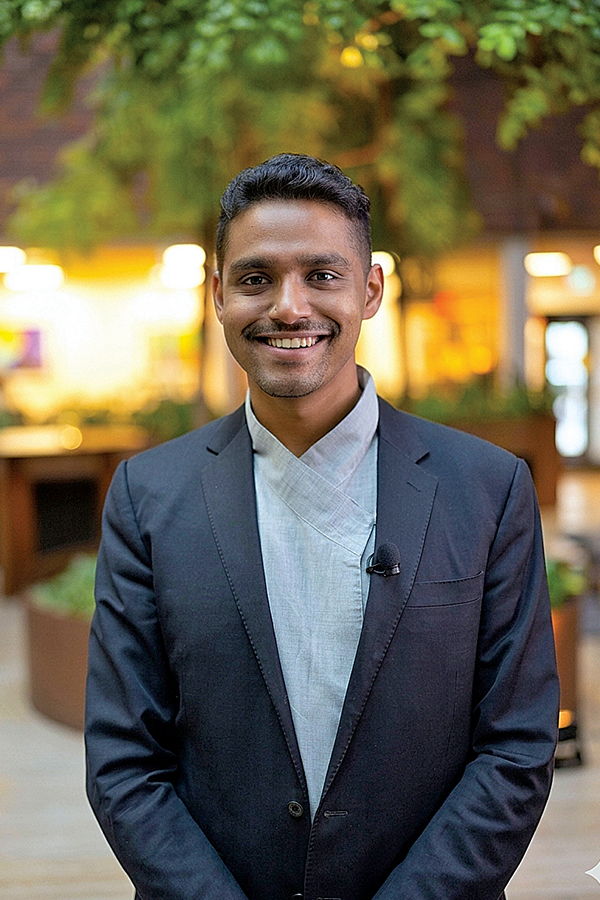
Mohit Rauniyar Founder & Chairperson Canopy Nepal
Mohit Rauniyar: I believe artificial intelligence will have the greatest impact over the next decade, not because it will replace everything, but because it will change how every sector works. For organisations like ours, AI is not just a technology trend. It can change how we understand learning gaps, personalise student support, improve teacher training, measure impact and scale solutions more efficiently. However, it also brings challenges around access, as not all students and communities have digital tools, reliable internet or the skills needed to benefit from these technologies. Through our Katha Bunaun workbook and digital app, we are exploring how technology can help children learn effectively without losing the human, creative heart of storytelling.
At the same time, AI will also widen inequality if access, ethics and local context are ignored. For countries like Nepal, the challenge is not simply to use AI, but to use it responsibly and build solutions that respond to our own realities. The organisations that succeed will be those that combine technology with trust, human judgement and a deep understanding of the communities they serve.
Sameer Maskey: AI will have the greatest impact over the next decade but its influence will not be separate from the other forces. It will amplify and reshape all of them.
For most of the last century, global commerce was structured around access to labour, capital, logistics and natural resources. Over the next decade, it will increasingly be structured around access to intelligence: who builds it, who deploys it at scale, who controls the underlying data, and who owns the compute. The International Energy Agency (IEA) projects that global electricity consumption from data centres will more than double by 2030. That is not a technology trend. That is an infrastructure reality on the scale of the industrial grid. McKinsey estimates AI could deliver an additional $13 trillion in global economic activity by that point. The countries and companies positioned to capture that value are those building the infrastructure, not just consuming it.
Nepal has a specific and underappreciated advantage here. AI compute is energy-intensive and energy cost is a direct determinant of infrastructure economics. Nepal currently has 3,000+ MW of installed electricity capacity against an estimated technically feasible hydropower potential of 40,000+ MW, of which less than 10% has been developed. The government's Energy Development Roadmap targets 28,000+ MW by 2035. If Nepal connects that clean, cost-competitive energy asset to AI compute infrastructure, it moves beyond exporting kilowatts to potentially exporting digital processing capacity. That is a fundamentally different economic position and one worth designing policy around now.
You have succeeded in an ecosystem very different from Nepal's. What specific lessons from global markets could Nepal adopt to create more companies capable of competing internationally rather than remaining domestically focused?
Vedant Agrawal: Nepal has a lot of potential but we need better infrastructure, more business-friendly government policies, and a much stronger export mindset.
A lot of businesses here are built only for the local market. There is nothing wrong with that but I think we should also be asking, ‘Can someone in another country buy what we are building?’ If more founders started thinking globally from day one, we would see many more Nepali companies competing internationally.
Mohit Rauniyar: Through Canopy’s chapters in France and the US, one lesson has been clear: global growth requires more than a good idea. It requires trust, systems, communication and credibility. What Nepal can learn from global markets is the importance of building organisations that are transparent, well-documented and partnership-ready. In France and the US, people ask sharper questions about governance, impact, sustainability and long-term plans. That pushes an organisation to become clearer and more accountable.
For Nepali companies and organisations to compete internationally, we need to think beyond local delivery. We need stronger storytelling, better data, clearer systems and products that can adapt across contexts. At the same time, we should not lose what makes our work original. For us, the goal has been to take something rooted in Nepal, like Katha Bunaun, and make it strong enough to be understood, trusted and supported globally. As a non-profit, this also means building meaningful connections with the Nepali diaspora, who can play a vital role in amplifying impact, sharing resources and bridging local work with global communities.
Sameer Maskey: One clear lesson from global markets is that ambition has to be designed into the company from the beginning. Many Nepali businesses build for the domestic market first and think about international expansion later, but global companies often start by asking: what problem are we solving, who is it valuable for and can this scale beyond our immediate geography?
For a budding AI company, Silicon Valley is both an opportunity and a pressure test. You are surrounded by capital, talent, customers and ideas, but you are also competing with some of the fastest-moving companies in the world. The market does not reward you for simply being technically capable; it rewards speed, clarity, customer obsession and the ability to turn technology into measurable business value.
Nepal needs to strengthen a few things if we want more globally competitive companies: better access to growth capital, stronger mentorship from people who have actually scaled internationally, clearer policy support for exports and technology businesses, and more exposure to global customers early in the founder journey. We also need to become much stronger at sales, positioning, governance, compliance and execution discipline. Technical talent is not the main issue, turning that talent into globally trusted companies is the bigger challenge.
The candid point is that Nepali founders cannot compete globally with only passion and resilience. Those are important but they must be matched with capital, world-class standards, customer understanding and the confidence to build for markets much bigger than Nepal. The lesson from successful global AI companies is clear: technology alone is not enough. You need talent, capital, market access, trust and discipline to build a company that can compete at global speed.
Having built a business on the global stage, do you believe there is a distinct 'Nepali advantage' in entrepreneurship and leadership? If so, what characteristics make Nepali founders uniquely equipped, or uniquely challenged, to compete internationally?
Vedant Agrawal: There is a Nepali advantage. We are generally very adaptable, cost-conscious and good at building relationships. Those qualities really help when you are starting with limited resources.
One challenge, though, is that many of us think too small. We often build businesses only for Nepal instead of asking how we can compete internationally. I also think we are sometimes hesitant to take bigger risks or invest heavily in growth. If we can become more ambitious while keeping the resilience and adaptability we are known for, I think Nepali entrepreneurs can do really well on the global stage.
Mohit Rauniyar: Yes, I do believe there is a distinct Nepali advantage but it comes with both strengths and challenges. Nepali founders are often deeply resilient. We learn to build with limited resources, uncertain systems and many constraints. That makes us creative, adaptive and grounded. We are also used to working across languages, cultures, communities and geographies. For an organisation like Canopy, this matters because our work depends on trust, relationships and deep understanding of local realities. There is also a strong sense of community in Nepali leadership. Many founders are not only thinking about profit or growth, but about family, society and country. That gives Nepali ideas depth and purpose.
At the same time, we sometimes underestimate ourselves internationally. To compete globally, Nepali founders need to keep the resilience and originality, but add stronger documentation, clearer storytelling, better data and more confidence in taking our work to the world.

Sameer Maskey Founder & CEO Fusemachines
Sameer Maskey: There is definitely a distinct Nepali advantage. It just has to be understood on its own terms. The advantage does not come from a favourable entrepreneurial environment. It comes from what founders develop by building in an unfavourable one. Nepal's geographic complexity, limited infrastructure, constrained capital markets, and small domestic demand create a particular kind of entrepreneur: resource-disciplined, contextually adaptive and persistent in ways that cannot be manufactured by a comfortable operating environment. Building across Nepal's geographic, linguistic and economic diversity teaches founders to operate across complexity, a skill that becomes directly relevant when entering markets with heterogeneous customers and conditions.
-1788157009.jpg)
-1792068242.jpg)