
FFTF holds national dialogue on AI awareness for Nepali students

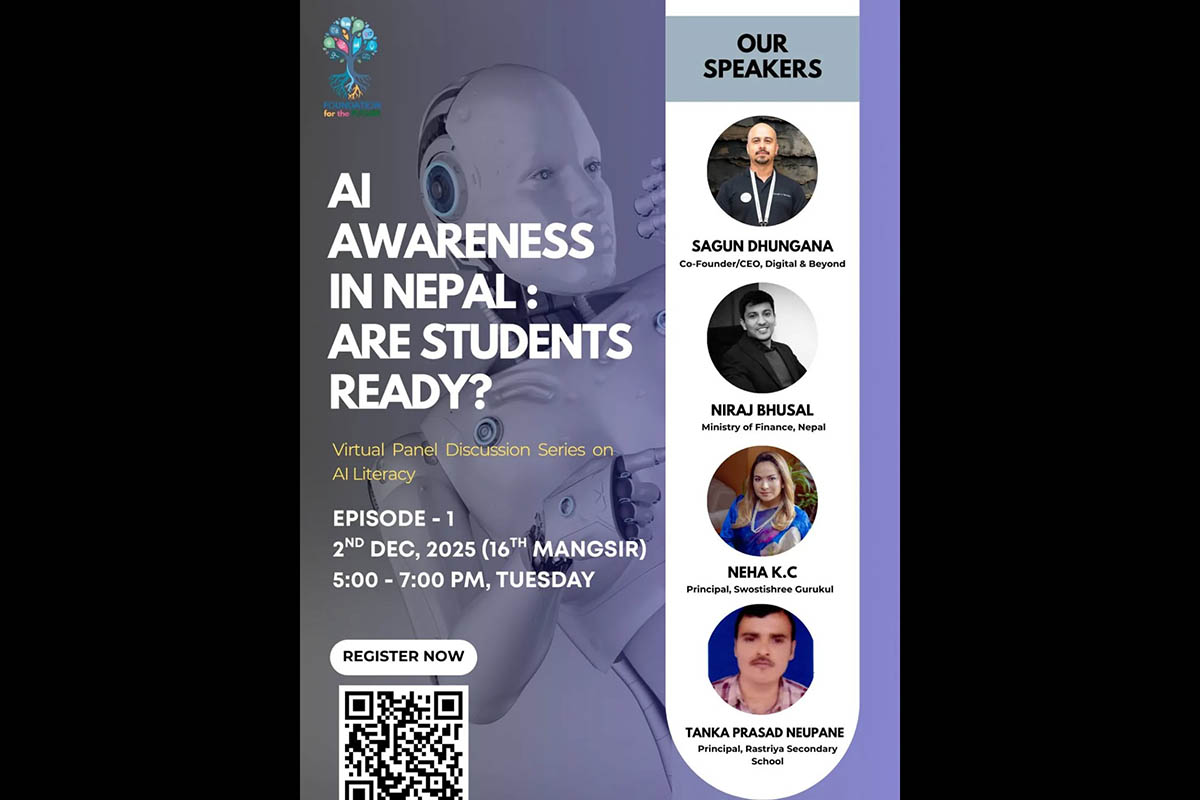
KATHMANDU: The Foundation for the Future (FFTF) organised the first‑ever national dialogue on the theme “AI Awareness in Nepal: Are students ready?” The virtual event brought together leading educators, technologists and policymakers to examine whether Nepali students are prepared for an AI‑powered world.
Project lead Diya Gurung emphasised that Nepal’s youth stand at the edge of a technological turning point during two panel discussions held at the event. The panels featured Sagun Dhungana, co‑founder and CEO of Digital & Beyond; Bhaskar Bhatt, CEO of Dignep Group; Neha KC, principal of Swostishree Gurukul IB Continuum School; and Tanka Prasad Neupane, Headmaster of Rastriya Secondary School, Chitwan.
The first round, centred on “AI Literacy: The Divide Beyond Devices”, examined students’ readiness and the limits of device ownership as a proxy for understanding AI. Speaking at the discussion, Digital & Beyond CEO Dhungana warned, “Owning a device doesn’t mean understanding AI,” explaining that students often use AI for quick outputs rather than deeper learning.
Bhatt raised concerns about digital safety, saying students enter the AI world with enthusiasm but without sufficient awareness. “We must protect students from unintentionally sharing sensitive data,” he urged. KC highlighted the value of curiosity, adding, “Their curiosity is their superpower, but it must be guided toward ethics, analysis and responsibility.” From a public‑school perspective, Neupane described the digital divide, citing limited infrastructure, insufficient ICT‑trained teachers and unreliable power supply as barriers to equal access.
The second round, under the theme “Creativity, Curriculum and Responsible Innovation”, explored how AI can support creativity and confidence when used intentionally. Panellists agreed that AI should be treated as a creative companion that can strengthen language learning, research and imaginative thinking, not as a shortcut. They cited examples from UNESCO, Australia, Pakistan and China and urged Nepal to develop a context‑sensitive, forward‑looking AI curriculum.
Speakers also highlighted a misalignment between students’ growing digital interests and outdated examination systems that leave little room for practical learning. The governance discussion pushed the conversation towards long‑term strategy. “Countries like China and the Maldives are already implementing structured AI education. Nepal must move with intention and urgency,” said Dhungana.
Bhatt called for stronger collaboration among the government, the private sector and educational institutions to bridge the gap between the job market and academic structures. KC urged a unified national agenda for AI literacy supported by teacher training, AI fellowships and sustained policy attention. Neupane recommended introducing ICT from early grades and building support mechanisms that reflect Nepal’s ground realities, including slow internet speeds and limited digital access.
During the Q&A, participants raised concerns about the absence of the Nepali language in global AI systems. Panellists proposed developing local mini‑language models to make AI more relevant and accessible to Nepali learners. They also emphasised that students must be taught how to think, not simply how to use tools, cultivating the ability to analyse, question and evaluate AI‑generated content.
Closing the session, FFTF Executive Director Sophie Sangat said Nepal is at a defining moment and preparing young people for an AI‑driven world requires collective effort and long‑term commitment. “This panel is only our beginning,” she said. “AI literacy must become ethical, inclusive and accessible for every learner, and that will take all of us working together.”
FFTF announced that the AI Literacy Panel Series will continue with upcoming episodes focused on AI in governance, women’s entrepreneurship, teacher development and youth‑led innovation, aiming to build a future where Nepali students are leaders, innovators and responsible creators in the AI era.



-1789136854.jpg)