DEFYING GRAVITY: A man’s quest to bring water to the hills for farmers

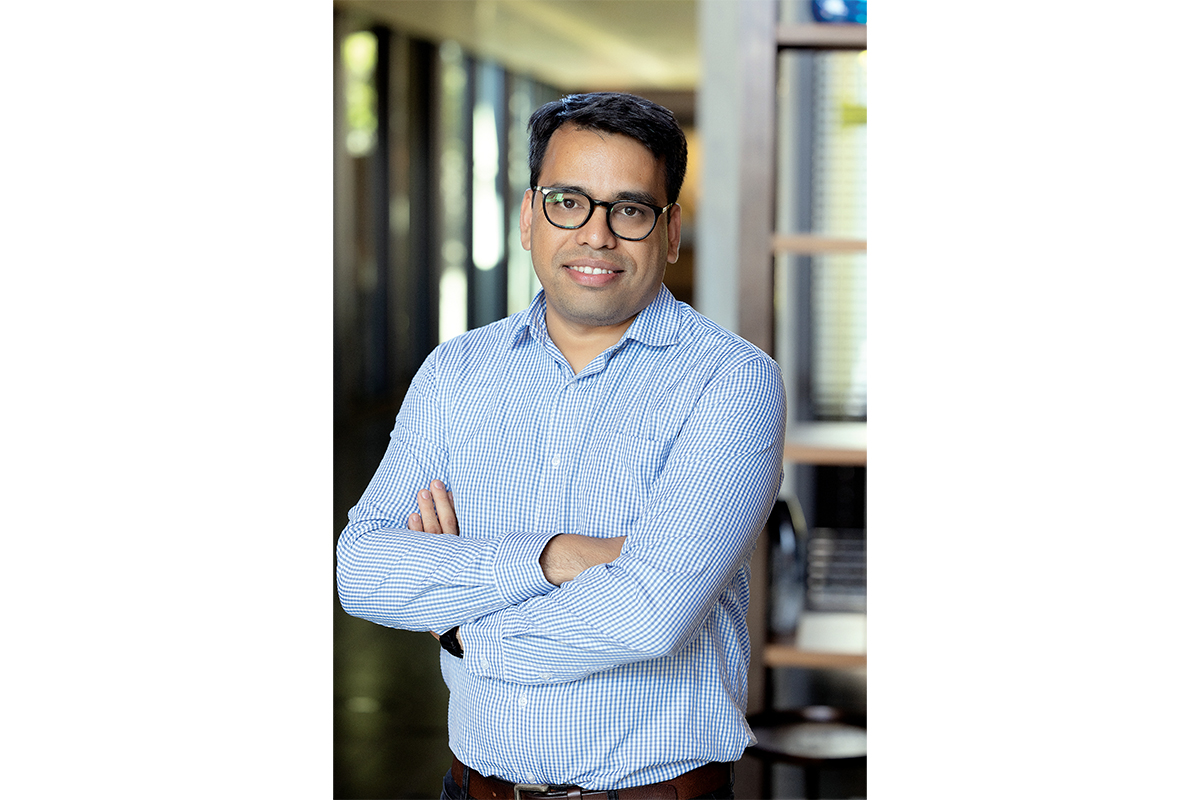
PRATAP THAPA
FOUNDER & CEO, AQYSTA
AQysta started in 2013, conceived as a ‘quest’ for ‘aqua’ for the farmlands in hilly regions where local communities relied solely on monsoon rains for irrigation. Initially focused on the Barsha water pump technology, the company has since broadened its portfolio to include multiple innovations such as solar dryers, bio char and an agri-value chain that connects farmers directly with the market.
Pratap Thapa, Founder and Chief Executive Officer of aQysta, recalls the universal joy the monsoon brought to his community in Lele, enabling them to irrigate their fields. After completing his engineering degree and while teaching entrepreneurship in Nepal, he assigned his students, all engineers, a business plan project focused on technology-based solutions. Thapa reflected, “Although my family’s farm was close to a river, we always had to wait for the rains because of the terrain - there were a lot of hills and we couldn’t access the river to water our paddies. So why not use technology to harness this energy, I asked myself.”
This inquiry became the inception point. The concept for the Barsha pump began to solidify during his Master’s course at IOE, Pulchowk Campus. However, Thapa accepted a scholarship to pursue his degree in the Netherlands. “I continued to work on the idea with other students at the university, who later became co-founders. Further development of the concept and the first prototype was built at Delft University of Technology, the Netherlands,” he shares.
The initial prototype of the Barsha water pump was a simple hand-rotated wheel with a spiral tube. The first fully functional, full-scale prototype was later constructed and tested in the Delft lab. The very first field prototype was then flown from the Netherlands to Nepal. “We took it to my parents’ farm but it did not work as it was too big for the river. We iterated the design multiple times to fit the diverse river and farm conditions of Nepal and had different versions of the technology,” he says, adding, “We had pumps that could float in the water for deeper rivers, and had versions that could use small streams of water as well.”
These design iterations, informed by feedback, eventually led the team to create and implement much larger-scale pumps capable of serving an entire community, which are now installed in Syangja, Kaski and Lamjung.
The Barsha pump, which uses the flow of water to lift some of that water to higher farmlands without using any fuel or electricity, is unique and well-suited for rural communities. The pump is built on a patented technology and is designed to be simple for maintenance and repair. Immediately following aQysta’s founding, Thapa, along with Lennart Budelmann (Co-founder) and Fred Henny (a Dutch friend), travelled to Nepal to hold many meetings and speak with local farmers.
The initial reactions were very positive, confirming the necessity of the pump. “Of course, some people had wild imaginations about what the pump would look like. For example, the person who took us around to the farmers said he had expected it to be a 30 kg tool that would be easy to carry around. Our prototype was big and weighed around 160 kg,” Thapa shares. Despite this, the founders took the feedback seriously, working to develop a machine with a lighter weight. They also received comments on how to handle flooding and how to ensure the pump’s affordability. The key takeaway, however, was that everyone they spoke with saw the potential benefits but needed to see the pump in action with their own eyes first.
The Barsha pump utilises true renewable energy technology for irrigation. The cost reduction is calculated in comparison to using a diesel-powered pump, factoring in the necessary fuel and maintenance expenses. An estimated 50% cost saving is achievable, also due to reduced water consumption and agro-forestry methods, and by using a pipe distribution system rather than flood irrigation. One of the more recent communities to adopt the large-scale Barsha Pump is in Labarkot, Syangja. The pump is currently lifting water more than one kilometre away from the source to a height of 80 metres. Farmers in this area, who could not irrigate their land previously, are now able to farm year-round.
The primary SDG (Sustainable Development Goal) this innovation supports is SDG2 on ‘zero hunger’ through sustainable agriculture, which helps to increase the income and climate resilience for roughly 50,000 farmers.
The estimation of the CO2 emissions saved by the Barsha pump can be done by estimating the CO2 emissions emitted by a diesel pump to provide similar power. As per aQysta’s latest data compiled by Sujan Dulal, Country Manager of aQysta Nepal, the company aims to mitigate 3,000 tonnes of CO2 this year. Besides, aQysta also aims to mitigate 49,600 tonnes of CO2 in five years with renewable energy and regenerative agriculture.
One inherent limitation of the Barsha pump is that it only serves farms located close to rivers meaning its functionality is restricted to specific geographical areas. Another significant hurdle was earning the trust of the farmers because an irrigation device is merely a tool. “You promise to farmers that you can increase their income and improve their livelihoods but there is no guarantee that this approach will work. If the smallholder farm is not profitable, it simply cannot afford to buy the pump. This is why we realised that we have to tackle the problem more holistically,” states Thapa.
Consequently, Thapa recognised the need for aQysta to go beyond being a simple technology provider, instead becoming integrated into the value chain and helping farmers become profitable. Following internal reflection, aQysta announced in 2021 that selling pumps would no longer be its primary revenue source and the company would instead position itself as a holistic service provider for smallholder farmers.
Innovations designed for smallholder farmers, such as the Barsha pump, often face an affordability challenge. “Farmers struggle to meet the upfront costs for the technology. Therefore, we initially worked through government and non-government organisations that would cover part of the costs of the technology to provide to farmers,” shares Thapa. However, this approach proved difficult to scale because it involved extensive lobbying and did not always achieve the desired impact. “Farmers do not always take ownership of something that they received for free.” This conclusion was drawn from aQysta’s experience both in Nepal and with smallholder farmers across 27 countries where the Barsha pump technology had been deployed. Instead of continuing down this path, the company chose to change the business model.
“We pivoted the business model to expand into the agriculture value chain where we now provide market access for farmers’ produce. Wherever farmers require technology, we provide it with zero upfront costs and recover the investment from the subsequent sales of the harvest,” says Thapa, adding, “We then sell the produce to food companies. In this manner, we have developed a scalable model that resolves the affordability problem, where farmers act as our partners and suppliers, and the food companies are the paying customers.”
Today, aQysta engages with communities through a permanent partnership model. In this approach, one staff member is stationed within the community, interacting with farmers daily to provide training and extension services. This is a fundamental shift from merely installing technology, allowing the company to build a lasting relationship and generate a lasting impact with the farmers.
Climate-smart technologies like the Barsha pump are crucial for countries such as Nepal, which is ranked as the fourth most vulnerable nation to climate change, making smallholder farmers the most susceptible group. However, based on their experience, Thapa believes that technology alone is insufficient. It must be integrated with better access to markets and other essential resources to deliver a holistic service that enables farmers to farm commercially and earn a living income from farming activities alone. The company currently operates in Nepal, the Netherlands, Malawi and India.