India's Union Budget poses opportunities and challenges for Nepal-India economic ties: NICCI president

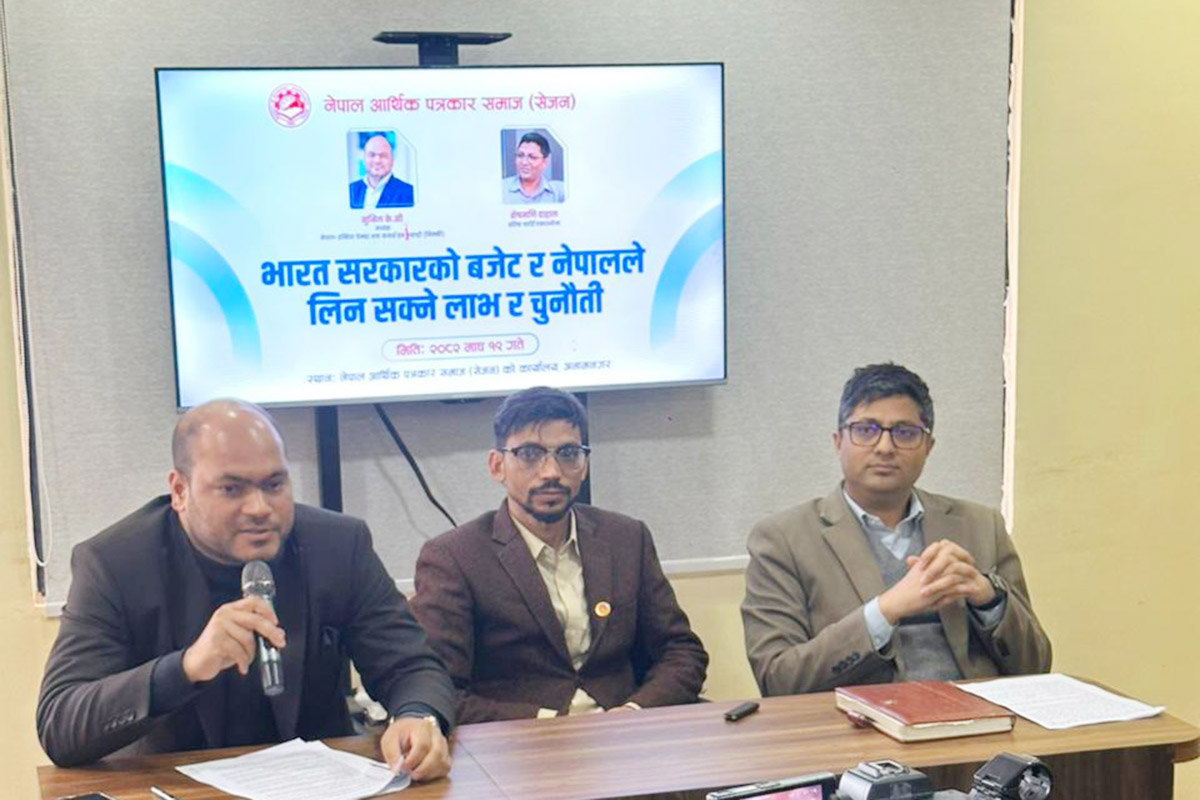
KATHMANDU: The Union Budget presented by the Government of India for fiscal year 2026–27 will have significant implications for Nepal–India economic relations, President of Nepal–India Chamber of Commerce and Industry (NICCI), Sunil KC, said.
Speaking at a programme titled ‘The Indian Government’s Budget and the Benefits and Challenges for Nepal’, organised by the Society of Economic Journalists – Nepal (SEJON), KC said the budget — the 12th under Prime Minister Narendra Modi and the ninth consecutive budget presented by Finance Minister Nirmala Sitharaman — signals continuity, policy stability and a long‑term vision in India’s financial system.
India’s total budget has reached INR 53.5 trillion, making it the largest in the country’s history. KC said the scale of the budget and India’s position as the world’s fourth‑largest economy mean its direct and indirect effects are likely to extend to neighbouring countries, including Nepal.
KC noted that India remains Nepal’s largest trading partner despite Kathmandu’s trade links with more than 150 countries. He said Nepal’s exports to India rose sharply in recent years, with nearly 81% of Nepal’s total exports destined for India in fiscal year 2025–26, and that share increasing to about 82% in the first five months of the current fiscal year.
On imports, KC said the value of goods coming from India has continued to rise but India’s share of Nepal’s total imports has gradually declined, a trend he described as an improvement in the bilateral trade deficit. He added that India is also the largest source of foreign direct investment into Nepal, accounting for nearly one‑third of total FDI inflows, although Nepal’s share of India’s outward investment remains very low because of policy uncertainty and political instability.
KC highlighted India’s importance to Nepal’s tourism sector, saying Indian visitors account for roughly one‑third of international arrivals each year. He said NICCI recently organised a tourism roadshow in Varanasi under the theme “From Kashi to Kathmandu” and that, if successful, the initiative could substantially increase annual tourist numbers.
He said India’s budget, which targets economic growth of around 7%, should provide a stable and expanding market for Nepali exporters. KC emphasised that India’s focus on infrastructure development, customs reform and digital processes will make trade more efficient and competitive, and that measures to simplify customs procedures, reduce transit times and improve payment systems are likely to benefit Nepali exporters.
At the same time, KC warned that India’s Atmanirbhar Bharat initiative, which promotes domestic production, could intensify competition for Nepali products in the Indian market. He also noted that India’s growing attractiveness for investment may increase competition for regional capital flows.
India has increased development assistance to Nepal for the new fiscal year to INR 8 billion, KC said, signalling the continuation of India’s strategic priority towards its neighbour. He concluded that the federal budget 2026–27 presents both opportunities and challenges for Nepal and urged prioritising policy stability, strategic dialogue and effective monitoring to turn indirect benefits into tangible gains.
-1791630230.jpeg)
-1791623099.JPG)