
Consumer price inflation eases to 3.25 pc in mid-February 2026: NRB

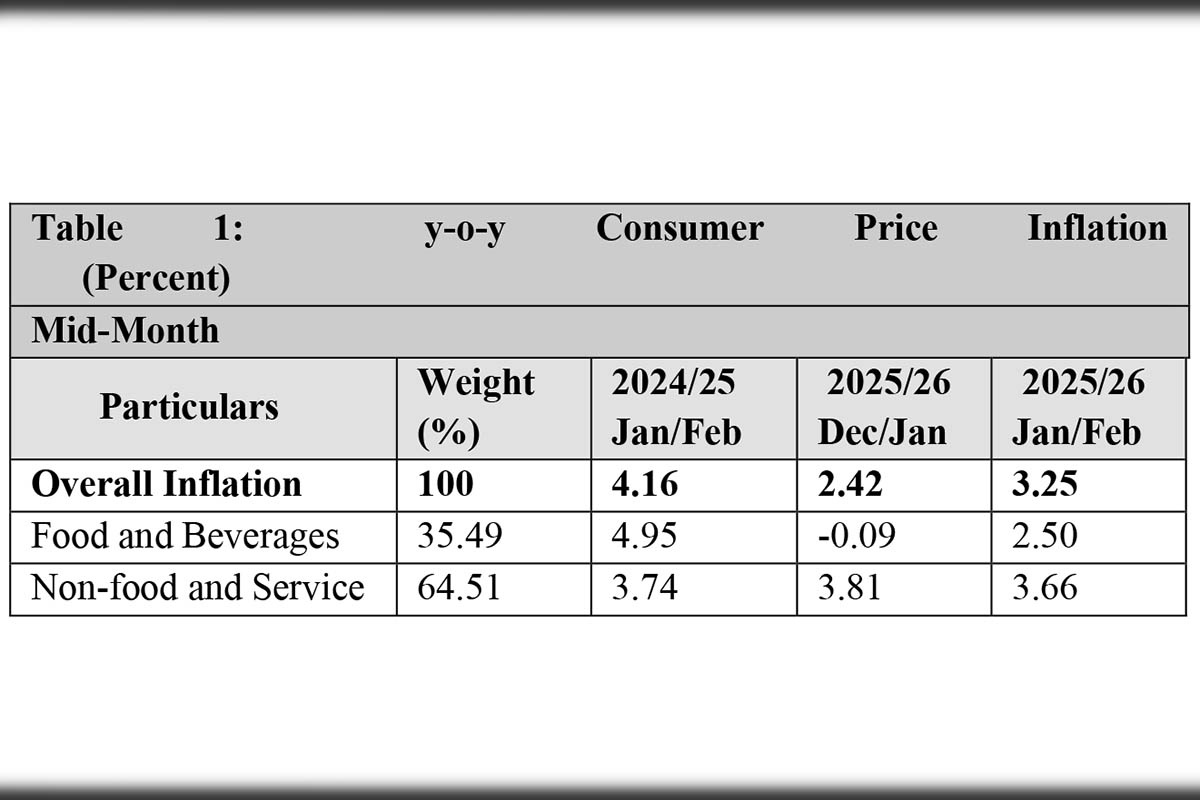
KATHMANDU: Nepal Rastra Bank (NRB) on Wednesday released its latest macroeconomic and financial situation report, revealing that year-on-year consumer price inflation moderated to 3.25% in mid-February 2026, down from 4.16% in the same period a year earlier.
The report, based on seven months of data from fiscal year 2025/26, shows average inflation for the review period at 1.92%, compared with 4.86% a year ago.
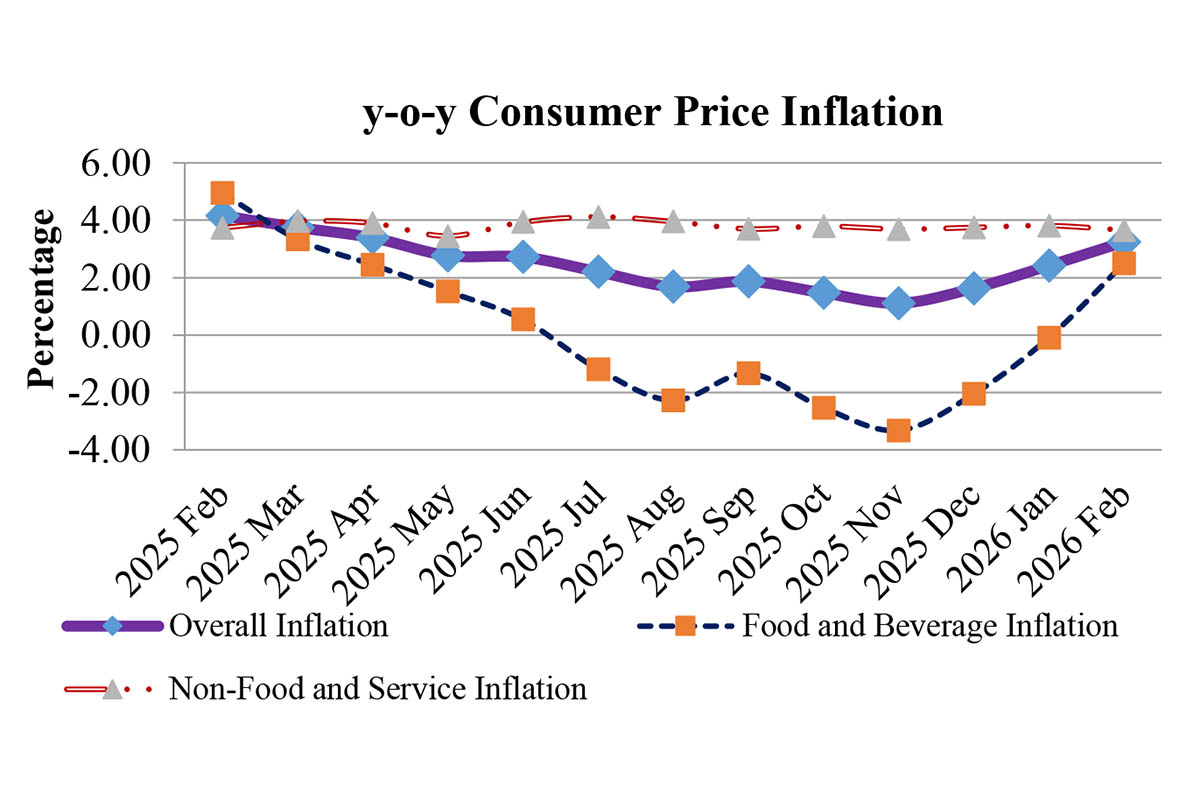
During the review month, food and beverage inflation was recorded at 2.50%, while non-food and services inflation reached 3.66%. In the corresponding period last year, these categories rose by 4.95% and 3.74% respectively.
Within the food and beverage category, the price index for vegetables rose by 11.63%, ghee and oil by 7.61%, and fruit by 7.41%. Prices for pulses and legumes fell by 5.19%, cereal grains and their products by 2.97%, and spices by 2.61%.
In the non-food and services category, miscellaneous goods and services experienced a sharp rise of 21.98%. Other increases were recorded in education (7.46%), clothes and footwear (5.28%), tobacco products (4.15%) and alcoholic drinks (3.85%). The communication sub-category saw a slight decrease of 0.08%.
The report highlights geographical disparities, with urban areas experiencing 3.51% inflation compared with 2.52% in rural areas. Regionally, Tarai recorded the highest inflation at 3.66%, followed by Kathmandu Valley at 3.48%, Hill region at 2.68%, and Mountain region at 2.58%.
At the provincial level, Madhesh Province recorded the highest inflation at 5.14%. Koshi Province followed with 3.53%, while Lumbini stood at 3.29% and Bagmati at 3.10%. Gandaki, Sudurpashchim and Karnali provinces recorded lower rates of 2.42%, 1.64% and 1.62%, respectively.
Likewise, year-on-year wholesale price inflation stood at 6.21% in mid-February 2026, compared with 3.47% a year earlier. Wholesale prices for consumption goods rose by 0.72%, while intermediate and capital goods increased by 9.83% and 3.21%, respectively. Construction material prices rose by 2.04%.
A regional comparison shows Nepal’s consumer price inflation of 3.25% in mid-February remains higher than India’s, where consumer price inflation was 2.75% in January 2026.
-1789811728.jpeg)
-1789744950.jpg)
-1789743604.jpg)
-1789742914.jpg)