THE 7% IMPERATIVE REFORMING NEPAL FOR SUSTAINED GROWTH

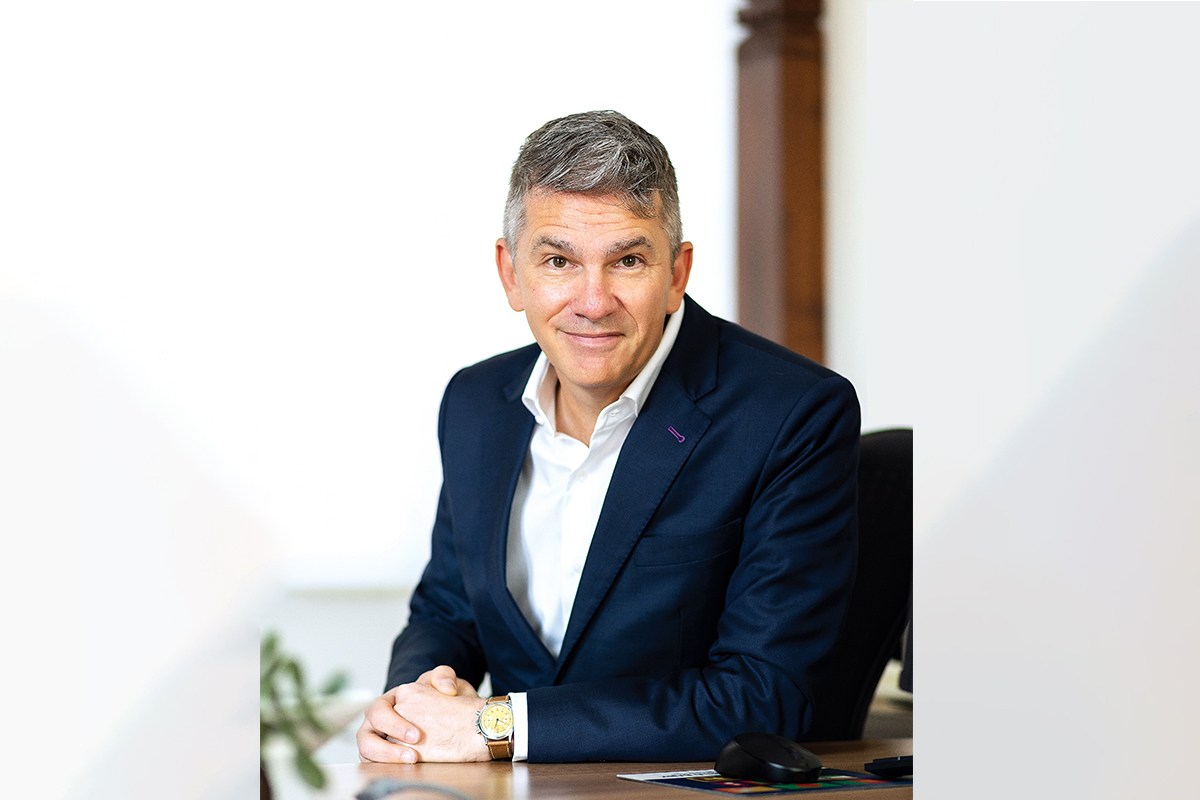
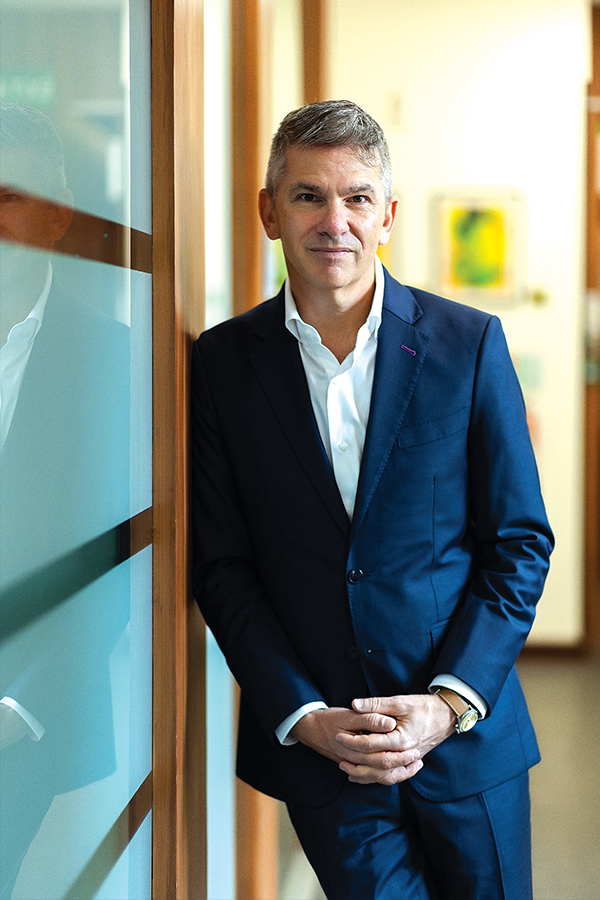
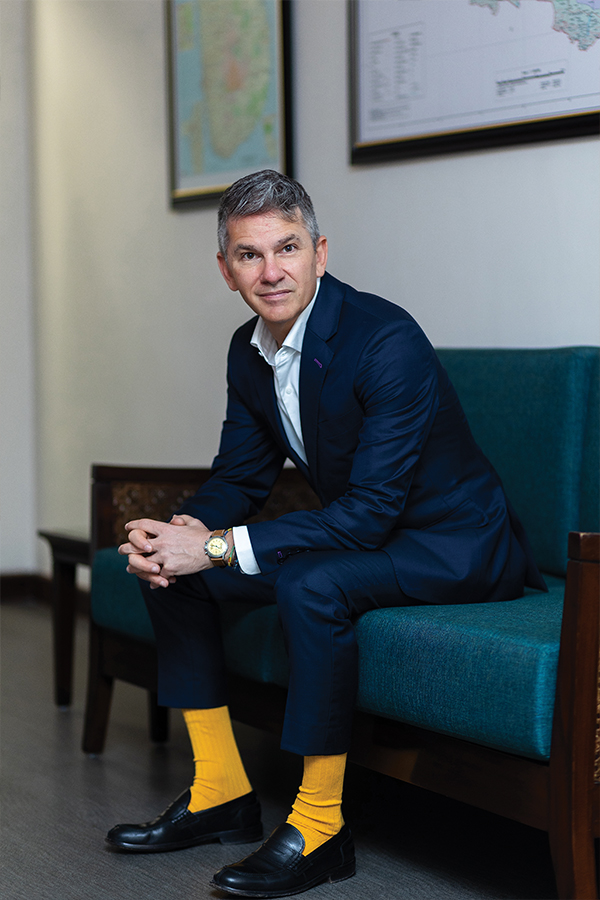
DAVID SISLEN, COUNTRY DIVISION DIRECTOR FOR MALDIVES, NEPAL, AND SRI LANKA, WORLD BANK
NEPAL’S NEXT CHAPTER WILL NOT BE WRITTEN BY REMITTANCES OR POLITICAL CHANGE ALONE, DAVID SISLEN SAYS, BUT BY SUSTAINED 7–8% GROWTH DRIVEN BY STRUCTURAL REFORM AND INVESTOR CONFIDENCE.
David Sislen serves as the Country Division Director for Maldives, Nepal and Sri Lanka at the World Bank, overseeing a multi-billion-dollar portfolio focused on jobs, infrastructure and long-term economic transformation. With decades of experience in development finance, he has worked closely with governments navigating political transitions, fiscal pressures and structural reform.
During his time in Nepal, Sislen has been outspoken about the country’s central economic challenge: translating political progress and poverty reduction into sustained, investment-led growth that creates jobs. He argues that while Nepal has made historic gains in reducing extreme poverty and expanding access to basic services like education and health, it now faces a different test. Weak capital spending, the infrastructure deficit, bureaucratic bottlenecks and policy uncertainty are holding back private investment and job creation at a critical moment.
In a conversation with Business 360, Sislen reflects on political instability, the urgency of restoring investor confidence, the risks of low growth, and why achieving sustained 7% to 8% GDP growth must become Nepal’s overriding economic priority. Excerpts:
Nepal has experienced frequent changes in government. At what point does political instability begin to materially undermine economic growth and investor confidence?
First, I think Nepalis should take pride in the democracy they have built over the last two decades. It is a remarkable achievement and it has gone hand in hand with a reduction in poverty that is virtually unmatched in human history. That progress should not be overlooked.
However, we are already at a stage where persistent political change is affecting investor confidence. According to the 2023 World Bank Enterprise Survey, 41.2% of firms in Nepal identified political instability as their number one concern. In comparison, only about 12% of firms across the rest of South Asia reported the same concern. That gap is striking. Frequent changes in leadership and shifting party dynamics undermine policy certainty and certainty is what the private sector values most.
Businesses can adapt to many challenges, but they need clarity and predictability in policy. Recent developments, including decisions around double taxation and tax treaties, have created complications for investors at a time when Nepal really cannot afford it. Moving forward, Nepal really needs to make legal and process reforms that attract investment – both domestic and international – and address issues like the double taxation treaty or the application of retroactive taxes, just as two examples.
The outcome is visible in the data. Nepal received an average of around 0.1-0.2% of GDP annually in foreign direct investment over the last two decades, placing it among the lowest recipients globally. If Nepal wants to accelerate growth and create jobs, restoring investor confidence and attracting FDI will be essential.
With elections approaching, is Nepal at risk of falling into an ‘election-spending-debt’ cycle? Do you see the upcoming elections primarily as a fiscal risk or a reform opportunity?
I see the elections much more as an opportunity than as a fiscal risk. When we consider Nepal’s broader fiscal challenges, elections rank relatively low on the list of concerns; the cost of elections is very small (about 2% of the total budgeted spending for the year). On the other hand, they offer a chance for the country to demonstrate yet another peaceful democratic transition and to send a clear signal to the world that Nepal is serious about reform and growth.
And this is the most important point – over the past 15 years, Nepal’s economy has grown at an average rate of around 4% to 4.2%. For a country at Nepal’s stage of development, that is simply not enough. To truly shift trajectory as the country moves towards middle-income status, economic growth needs to reach 7% to 8%. Elections can serve as a moment for meaningful policy shifts that help achieve that higher growth path. On this front I remain hopeful, although current signals are mixed.
On the fiscal side, I think there is bit of a common perception amongst Nepalis that the government borrows and spends excessively. In reality, the issue is not that Nepal spends too much but that it does not spend enough in the right areas. A large share of expenditure goes toward recurrent costs such as salaries and routine operations, rather than capital investment.
If there is one fiscal priority, it is to increase and improve capital spending. Nepal needs to invest more effectively in infrastructure and productive assets that can boost growth and crowd in private investment. The challenge is not simply spending more but converting that expenditure into improved services and infrastructure.
Given frequent changes in administration, how does the World Bank ensure continuity and protect long-term commitments from policy reversals?
It is important to begin by clarifying what the World Bank is and what it is not. The World Bank is not an NGO, not a bilateral agency, and not a charity. It finances government priorities, policy programmes and investment plans. That is the foundation of our engagement.
Last April, we presented to our Board a seven-year Country Partnership Framework for Nepal. This builds on more than 50 years of partnership and sets out a long-term commitment centred on one clear objective: jobs. Globally, the World Bank has sharpened its focus on jobs, and there may be no country on earth where that focus is more relevant than Nepal.
Nepal’s most pressing challenge is building an economy that creates jobs, especially for young people. Around 2,000 people leave the country every day. Remittances have been a lifeline and have contributed significantly to poverty reduction, but this model is not sustainable in the long term and has costs in the immediate term, as we know. Over the next 20 years, Nepal must shift toward an economy driven by investment and private sector-led job creation.
Two additional points are worth noting. First, this Country Partnership Framework was prepared jointly with the Asian Development Bank. As the two largest development partners in Nepal, we felt it was important to align our efforts for greater impact. Second, our framework is anchored in Nepal’s own 16th National Development Plan. Our role is not to dictate priorities but to support and finance the priorities that Nepalis themselves identify.
Critics argue that development finance often looks impressive on paper but is slow to reach ordinary citizens. Where does Nepal underperform most in converting financing into tangible results?
I think it is important to approach this question with both optimism and realism.
Let me begin with the optimistic view. The first sentence of our Country Partnership Framework states that Nepal has reduced extreme poverty faster than any country in modern history. When I joined the World Bank in 1995, extreme poverty in Nepal stood at 55%. That meant 550 out of every 1,000 Nepalis were living in extreme poverty. Today, within my professional lifetime, that number has fallen to about 0.37%. Fewer than four out of 1,000 Nepalis now live in extreme poverty. That is a remarkable achievement by any standard.
It is not the end of the story. There is still poverty in Nepal and many households remain vulnerable. But the progress is extraordinary. What makes Nepal’s case unique is that this reduction happened without large-scale domestic job creation. Much of it was driven by remittances, by exporting labour rather than generating employment at home.
There are other genuine successes. Access to and enrollment in primary education are now nearly universal. That is a major achievement, even if we must now confront the serious issue of quality. A child born in Nepal today can expect to live roughly 25 years longer than a child born in 1970. These are real, measurable improvements in people’s lives.
Now to the more realistic side of your question. The concern about converting financing into results is valid. We have simply seen too little progress on critical issues like improving the way that government works or in making real sectoral reforms that will unlock growth. Infrastructure gaps are enormous. The public sector has not been modernised. And the point I raised already – the inability to effectively execute the capital investment budget – is really nearing a crisis level.
Over the past 20 years, the share of the budget allocated to capital expenditure such as infrastructure, roads, airports, schools, hospitals and sewer systems has declined. At the same time, the government’s ability to spend even the allocated amount has weakened. Last year, less than 60% of the capital budget was executed. This year, performance appears even worse. That is entirely within the government’s control.
To be frank, it is unacceptable that in 2026 the main highway connecting Kathmandu and Pokhara remains in its current condition. The state of civil aviation infrastructure – and the civil aviation sector more broadly – is also deeply concerning. National Pride Projects, as designated by the National Planning Commission, are progressing so slowly that at the current pace many would take 35 to 40 years to complete.
This is not a marginal issue. It is close to a national emergency. There are bureaucratic bottlenecks that must be addressed. For example, after completing an environmental impact assessment, it can take up to two years to receive tree-cutting clearance for a road project. Land acquisition for critical infrastructure is often so cumbersome that it becomes nearly impossible. Procurement processes take too long and systemically under-weigh quality over price.
And the challenge extends beyond roads. Urban infrastructure, particularly in Kathmandu and across the Terai, demands urgent attention. Air pollution is killing 26,000 Nepalis per year and reduces life expectancy by 3.4 years. It is not only a public health imperative; improving air quality, especially in Kathmandu, is really critical to enhancing the competitiveness of the country. I did a search for ‘Kathmandu’ this morning before coming to this interview – and not surprising, in global news coverage, Kathmandu’s air pollution was, quite literally, the first headline. That shapes how investors and the world perceive Nepal.
If the goal is jobs and growth, infrastructure and urban livability are not side issues. They are central to competitiveness and to building an economy of the future that can realistically get to that 7% GDP growth rate.
What proportion of World Bank-supported programmes directly benefit rural and low-income populations?
Let me answer this in two ways.
The straightforward response is that the bulk of our nearly $3 billion portfolio is designed to benefit rural and low-income populations. We support major investments in national highways and provincial roads, water and sanitation systems, off-grid energy, livelihoods programmes, skills development and social inclusion initiatives. These interventions are explicitly aimed at improving access, incomes and services for vulnerable communities.
But I would also challenge the framing slightly. There is no such thing as a ‘World Bank project’ in isolation. We finance government programmes and national priorities. So, the more important question is whether national policy and public investment are structured in a way that both protect the poor and expand opportunity.
Supporting the poor is essential. At the same time, growing the economic pie is equally as important. Nepal’s long-term challenge is to generate higher growth and more formal employment. Today, roughly 80% of jobs are in the informal sector. Creating an environment where the private sector is confident enough to invest and create better-quality jobs is fundamental to reducing poverty sustainably.
I would also return to the rural dimension of your question. Nepal today does not look like the country many people imagine. It is far more urban and peri-urban than it was a generation ago. Around two-thirds of the population now lives in urban or peri-urban areas, particularly in Kathmandu, other provincial capitals, and the Terai belt.
As people move to cities or leave the country altogether, poverty itself is becoming increasingly urban. When we think about where jobs will be created and where poverty reduction will take place over the next decade, I don’t think that looking at it through a simplistic urban versus rural lens is helpful. A better question is to understand where the dynamic jobs of the future can be created and how.
So, while many programmes directly target rural and low-income households, future policy must also recognise Nepal’s changing demographics. Being guided by data rather than outdated assumptions about what the country looks like will be one of the most important challenges for the next generation of policymakers.
Are bureaucratic bottlenecks the main constraint to delivery or are deeper structural weaknesses within Nepal’s economy the bigger concern?
I think most of us would agree that it is a combination of both. Bureaucratic delays are a very real obstacle to getting things done in Nepal. Whether it is acquiring land to build an irrigation system or a highway, or obtaining a permit to cut trees so that a road can be expanded, these process-related hurdles significantly slow down implementation. I am not aware of any other country on earth where a simple permit to cut a few trees to widen a road requires a cabinet level approval. And actually, I don’t think that Nepalis want to see their most senior policy makers focused on processes like these. So yes, there are technocratic and procedural reforms that can and should be introduced to address these inefficiencies. Streamlining approvals, reducing duplication and improving coordination across agencies would make a tangible difference.
That said, there are deeper structural challenges that go beyond paperwork. Nepal’s macroeconomic management has actually been quite strong. The country maintains sufficient months of import cover in foreign exchange reserves, and the exchange rate arrangement has provided stability. These are real strengths.
But moving toward an economy that generates more investment and more jobs will require structural reforms that are generational in nature. Some of these are technocratic and legal. They involve simplifying tax policy, improving the business environment, allowing more flexibility in foreign exchange flows, ensuring that taxation rules are predictable and transparent, and resolving uncertainties such as those surrounding double taxation treaties. Others are sector-specific, like the civil aviation sector that is so critical to unlocking the potential of tourism.
Equally important is the issue of foundational education. Learning poverty in the public school system is alarmingly high. While private schools have been an important solution for the families that can afford it, the public education system is struggling. It cannot be acceptable that around 90% of third graders in public schools are unable to read a basic paragraph in Nepali. If Nepal is to build a competitive workforce for the future, this challenge must be confronted directly.
Finally, structural reform is not only about laws and regulations. It also requires a cultural shift in how policymakers and citizens view the private sector. Legal changes alone will not be enough. There needs to be a broader recognition that the private sector is not merely an entity to be taxed or viewed with suspicion, but a central partner in growth and job creation. Without that change in mindset, technical reforms may win small battles but fail to transform the broader economic trajectory. This kind of mindset shift was critical in the successful growth accelerations we have seen over the last few decades, including in China, India and Vietnam.
Does Nepal rely too heavily on external aid? What can be done to build a strong and resilient domestic growth engine?
That is a very important question, and it needs to be considered in context. Nepal is currently at very low risk of debt distress. This challenges some of the conventional narratives. The country does not have a debt crisis. Rather, it has a challenge in converting revenue – both borrowed funds and domestic resources – into productive investments that drive growth.
The composition of Nepal’s debt also matters. Most external borrowing comes from highly concessional sources such as the World Bank and Asian Development Bank. These loans contain significant grant elements and carry favourable terms. So, both the total debt burden and its debt profile put Nepal in a relatively strong position.
The real issue, therefore, is not excessive reliance on aid, but whether policies and public spending are effectively fostering growth. One area that requires attention is governance. Nepal ranks around 109th on the Corruption Perceptions Index, alongside countries such as Malawi and Sierra Leone. Many citizens believe more can be done to reduce corruption in everyday public administration. Being candid about this is essential.
There are useful lessons to draw from elsewhere. Sri Lanka, for example, has placed anti-corruption reforms at the centre of its policy agenda following its own crisis and subsequent elections. Nepal can similarly elevate governance reform as a core national priority.
At the same time, it may be appropriate to begin a serious and informed discussion about foundational economic policies. The current monetary policy framework, with the fixed exchange rate with the Indian rupee as an anchor, has provided stability. However, with strong foreign exchange reserves in place, it may be worth assessing whether the current arrangement remains optimal or whether some degree of flexibility could be gradually introduced to better support competitiveness.
Related to this is the question of capital mobility. If foreign investors are uncertain about their ability to repatriate profits, they will hesitate to invest. Nepal needs foreign direct investment not only for capital but also for technology and expertise. No country on earth has achieved the kind of growth that we all aspire for Nepal without a significant element of FDI. And ensuring greater clarity and confidence and a streamlined process around capital flows could strengthen the domestic growth engine. And now, at a time of strength in the macroeconomic landscape, is probably the best time to have these policy discussions.
That said, there are immediate concerns. This year’s growth is likely to be somewhere around 3%, and maybe even lower. This is simply too low. Even the historical average of around 4% is insufficient. If I could offer one piece of advice to policymakers, it would be this, ‘achieving sustained growth of 7% to 8% must become the overriding economic priority’. Without that acceleration, Nepal will struggle to build the resilient, self-sustaining growth engine it aspires to create.
From an investor’s perspective, what signals currently discourage private capital from entering Nepal, and what reforms would change that perception?
I want to reiterate a few themes we have already discussed because they are central to this question. If we step back, I see two overarching challenges. The first is recalibrating the relationship between the state and the private sector. There needs to be a constructive dialogue in which the private sector is genuinely viewed by both policymakers and the public as part of the solution to Nepal’s development challenges. Without that shift in mindset, even well-designed reforms will have limited impact.
The second is having an honest and forward-looking conversation about where growth and jobs will actually come from. With great respect, I sometimes feel that policymakers are still imagining the Nepal of their childhood, expecting growth to be driven primarily by agriculture or through a manufacturing boom. That may not reflect present realities. Nepal’s geography, infrastructure gaps and regional dynamics suggest that some traditional assumptions deserve to be reconsidered.
At the World Bank, we see that Nepal’s future is in value-added services, with strong potential in sectors such as tourism and information technology. The IT sector, in particular, is already showing exciting momentum, with exports of somewhere around $800 million. There is also some room for high-value agribusiness. But we must be realistic. Around 28% of agricultural production is lost in transit due to logistics and infrastructure weaknesses. That is an enormous inefficiency.
Tourism is another example. The issue is not about pushing visitor numbers from 1.5 million to 3 million. The focus should be on moving up the value chain. Nepal has extraordinary natural and cultural assets, yet average daily tourist spending remains very low. Shifting toward higher-value tourism would generate far greater economic returns without necessarily increasing pressure on infrastructure.
Now, in terms of specific reforms, attracting foreign direct investment must be a priority. Nepal’s FDI inflows remain among the lowest globally. Legal reforms are essential, including amendments to the Foreign Investment and Technology Transfer Act to make profit repatriation more predictable and straightforward. Ensuring that investors can bring capital in and repatriate it with confidence is fundamental. Tax policy also requires clarity and stability. Investors cannot operate in an environment where tax rules are changed retroactively and liabilities are imposed for past years under laws that did not exist at the time. Broader issues driving up the cost of capital need to be addressed. For instance, Nepal needs to take all the necessary steps to quickly exit the FATF grey list.
Exchange rate policy and capital mobility deserve thoughtful discussion as well. And finally, infrastructure delivery must improve dramatically. If tourism is to be a growth pillar, the condition of international gateways and aviation safety standards must meet global expectations. Remaining on international aviation blacklists and lacking direct connectivity to major markets undermine credibility.
Taken together, these reforms would send a strong signal that Nepal is serious about creating a predictable and competitive investment climate.
-1773652874.jpg)
Are current growth projections sufficient to absorb Nepal’s young workforce, or does the country risk prolonged underemployment and outward migration?
This requires a nuanced answer. No one should suggest that young Nepalis should not have the opportunity to work abroad. Mobility can be empowering and it has played a crucial role in reducing poverty. The real objective should be to ensure that young people have a genuine choice, the option to build a meaningful life and career in Nepal if they wish.
That said, the numbers are sobering. Around 2,000 people leave Nepal each day. Over the two years I have lived here, roughly 850,000 to 900,000 Nepalis have departed. That is an extraordinary figure. Today, about 7% to 8% of the population lives abroad. At the same time, Nepal needs to create roughly 6.5 million new jobs over the next 30 years just to keep pace with demographic trends. At the current rate of growth, it is clear that domestic job creation is insufficient.
There is also a long-term sustainability issue. Nepal’s demographic dividend will not last indefinitely. As the country urbanises, fertility rates decline. Over time, the pool of young workers available to migrate will shrink. Continuing to rely on exporting labour and importing remittances is not a durable growth strategy.
Currently, around 80% of jobs are in the informal sector. Moving toward a more formal, productive economy requires sustained growth in the range of 7% to 9%. That, in turn, depends on improving the business environment, reducing political instability, addressing the education and skills crisis, tackling corruption, and making cities more livable and competitive.
Kathmandu and other urban centres must become places where firms want to invest and skilled workers want to stay. That means addressing air pollution, water scarcity, sanitation and environmental degradation. It is difficult to envision a thriving, job-creating city when air quality is hazardous, water supplies are unreliable and major river systems function as open sewers.
Ultimately, the question is about opportunity. If Nepal can create a dynamic, investment-friendly economy with vibrant urban centres, young people will not feel compelled to leave. They will choose to stay, innovate and build their futures at home.
Looking ahead, what should be the top three economic priorities for the next government? And what kind of reform or sectoral shift could realistically transform Nepal’s economy over the next decade?
If I could whisper one sentence into the ears of the next government, it would be this: get to seven or eight percent growth.
To many people, the difference between 3% growth and 7% growth may not sound dramatic. But over time, that gap determines whether a country’s trajectory looks like Nepal’s or Vietnam’s. In 1995 Vietnam and Nepal had almost the same GDP per capita, yet over the past 30 years, Nepal has grown at roughly 4% annually, while Vietnam has grown at a little over 6%. Today, Nepal’s GDP per capita is around $1,400 to $1,500. Vietnam’s is roughly four times that. That is the power of sustained higher growth.
And timing matters. Achieving 7% or 8% growth sooner rather than later makes an enormous difference. Waiting three or five years to accelerate only compounds the lost opportunity.
But this must be sustainable growth, not consumption-driven or speculative real estate expansion. It must be rooted in investment in productive sectors. That means building competitive industries such as IT and higher-value tourism, and not simply constructing office towers or fuelling asset bubbles. Investment should generate exports, jobs and productivity gains.
Beyond that headline target, there are three broad priorities. First, improve the overall business environment so that domestic and foreign investors feel confident. Second, focus relentlessly on critical infrastructure. This includes connective infrastructure such as roads, transmission lines and energy systems. Nepal still has significant untapped hydropower potential and while climate change poses long-term risks, there remains a window of opportunity to harness this resource effectively. Third, strengthen urban infrastructure. If cities are to drive growth and employment, they must be livable, efficient and competitive.
If these priorities are pursued seriously, Nepal could shift from modest growth to a fundamentally different economic trajectory over the next decade.
As Nepal prepares to graduate from Least Developed Country status, is the country truly ready for that transition? How should policymakers think about life beyond LDC status?
I genuinely hope this answer is published because I think the entire debate around LDC graduation has consumed far more attention than it deserves. What has LDC status actually delivered? The primary tangible benefit has been limited preferential trade access to certain markets. But Nepal’s export base remains extremely narrow. In reality, the country has not meaningfully leveraged those trade preferences. Exports as a share of GDP have fallen sharply from around 25% of GDP in the early 2000s to around 7-8% of GDP now. Beyond some grant funding from the UN system and bilateral partners, the economic impact of LDC status has been modest.
So, the real issue is not whether Nepal is ready to graduate. The more important question is whether Nepal is ready to operate like the lower middle-income country it already is.
That means shifting the mindset from seeking bilateral aid toward building a growth-oriented, investment-driven economy. It means engaging capital markets, strengthening fiscal credibility and improving policy certainty. It means using the development partners in the way that middle income countries do, as the financiers of critical priorities and as the kind of knowledge institutions which they are. I was very encouraged to see Nepal receive its first sovereign credit rating last year and it was a solid one. That is the direction of travel that matters.
The international conversation should move away from labels and toward fundamentals. The focus should be on creating an economy that attracts investment, generates jobs and delivers sustained growth. If Nepal does that, the question of LDC graduation becomes largely symbolic. What will truly define the country’s future is whether it embraces the responsibilities and opportunities of being a confident, competitive lower middle-income economy.