Nepal’s LDC Graduation

READINESS MATTERS MORE THAN SPEED
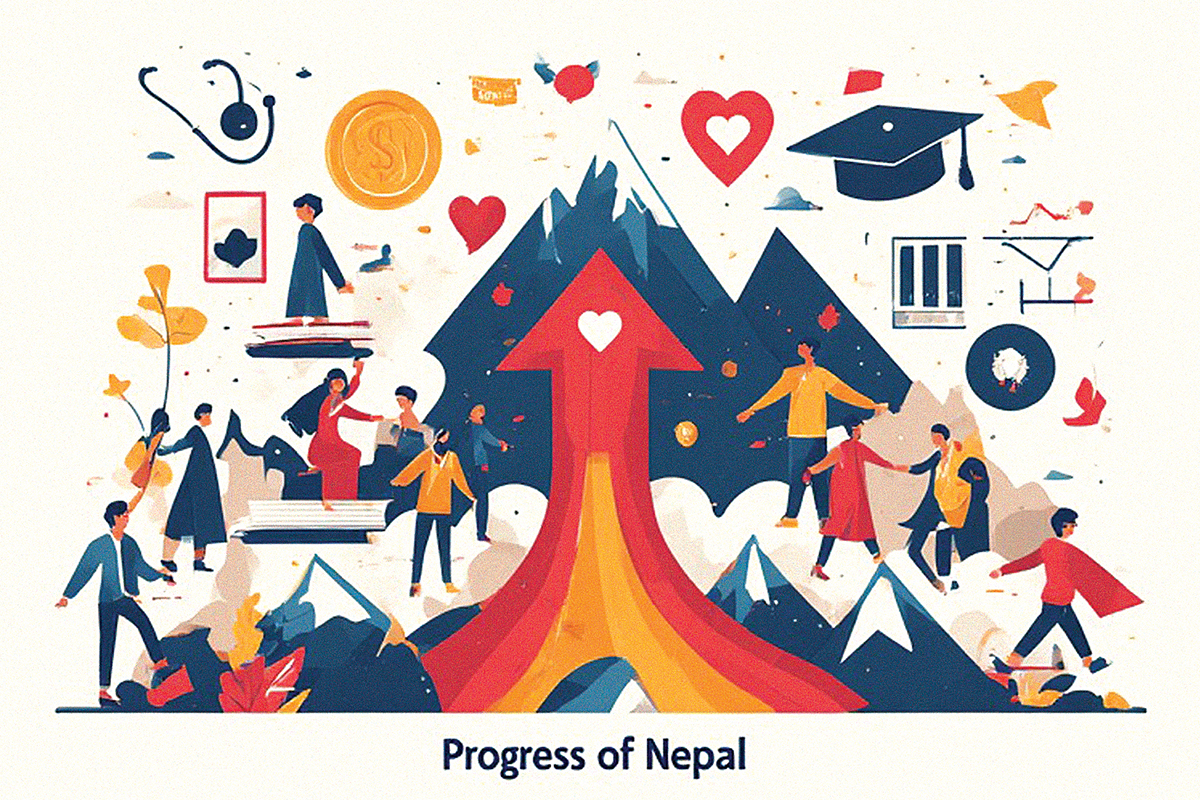
Nepal is on the path to graduate from the category of Least Developed Countries (LDCs), a milestone that reflects years of progress in health, education and social development. Graduation is something the country should be proud of. However, it is also a turning point that must be handled carefully. For students, small businesses and exporters, the real question is not whether Nepal should graduate but how prepared the country is for life after graduation.
Over the past decade, Nepal has made visible progress in human development. Life expectancy has increased, more children are attending school and literacy rates have improved. These gains helped Nepal meet the United Nations’ criteria for LDC graduation, even after facing major shocks such as the 2015 earthquake and the Covid 19 pandemic. From a social perspective, Nepal has clearly moved forward.
Yet, economic progress tells a different story. Economic growth remains slow and unstable. Income growth per person is limited and the economy depends heavily on remittances from workers abroad rather than strong domestic production. Graduation should therefore not be treated as a statistical achievement alone. It must represent real and lasting development, supported by strong institutions, a diversified economy and competitive businesses.
Political stability matters. While LDC graduation decisions should be based on objective development criteria, politics plays a major role in how the transition is managed. Nepal has experienced long-term political instability, which weakens policy continuity and coordination. For the private sector, this creates uncertainty. Businesses worry that weak institutions and frequent policy changes could weaken Nepal’s position in future trade negotiations and slow post-graduation reforms.
Nepal’s overall readiness for graduation is mixed. Social indicators are strong but economic foundations remain fragile. Growth is low and volatile, exports are narrow and dependent on special trade preferences, manufacturing has not expanded sufficiently, productivity is modest, and most businesses operate informally. While this imbalance does not block graduation under UN rules, it creates serious risks for sustainability after graduation.
Nepal does have real strengths. Human development has improved, vulnerability has declined and several export sectors show promise. These include readymade garments, carpets and handicrafts, agro-based products such as tea, cardamom, ginger and herbs, as well as emerging IT and service exports. These sectors provide jobs and foreign exchange, especially for micro, small and medium enterprises.
However, most of these sectors depend heavily on LDC-specific trade preferences, such as duty-free access to markets like the European Union under the Everything But Arms (EBA) scheme. Exporters are not resisting reform; they are resisting sudden shocks. A rushed graduation without preparation could shrink exports, harm MSMEs and increase unemployment, outcomes that would contradict the very purpose of graduation.
This is why a short, time-bound deferral of two to three years deserves serious consideration. Such a deferral would not question Nepal’s eligibility for graduation. Instead, it would provide time to convert structural strengths into real competitiveness. It would allow exporters to adjust, institutions to strengthen and policies to be implemented properly.
At present, Nepal’s policy, institutional and financing arrangements are sufficient to manage the formal graduation decision, but not the economic adjustment that follows. The most serious gaps lie in export transition preparedness, weak institutional ownership and lack of transition financing. Without addressing these gaps, graduation could become disruptive rather than developmental.
The private sector is beginning to prepare but it cannot manage the transition alone. MSMEs, in particular, need coordinated policy support, access to finance and technical assistance. Without government leadership and shared ownership, private-sector efforts will remain fragmented.
Trade preferences remain a critical issue. Nepal relies heavily on LDC-specific schemes, especially in Europe. Use of regional and bilateral trade arrangements is limited due to high logistics costs, non-tariff barriers and weak competitiveness. Losing these preferences without alternatives in place would seriously affect exports.
Several sectors are particularly vulnerable after graduation: garments, carpets, handicrafts, agro-products, pharmaceuticals, leather, footwear and light manufacturing. These sectors operate on thin margins and cannot easily absorb higher tariffs or stricter rules.
Another challenge is the phasing out of flexibilities under international intellectual property rules (TRIPS). This will raise costs and reduce flexibility for domestic producers, especially in pharmaceuticals, agro-processing, ICT and light manufacturing. For an economy still learning and adapting, this loss of policy space matters.
Compliance with stricter global standards is another concern. Many Nepali exporters, especially MSMEs, are only partly prepared to meet tougher rules on origin, food safety, product standards, labour and environmental requirements. Testing facilities, certification systems and enforcement capacity remain limited. Without targeted support and time, many exporters risk losing market access.
Nepal’s Smooth Transition Strategy was developed to address these challenges, but awareness among MSMEs is low, consultation was limited and implementation capacity remains weak. The strategy also needs updating to reflect recent economic shifts, new trade rules, rising global standards and climate risks.
Graduating in 2026 without deferral carries real risks, particularly for small businesses and workers. At the same time, graduation can create long-term opportunities like greater credibility, more investment and economic modernization, if the transition is managed well.
The way forward is clear. Nepal must prioritise economic diversification, skills development, MSME support, strong institutions, better coordination and resilient infrastructure. Graduation should be a step toward sustainable growth, not a shock to the economy.
In the end, the success of Nepal’s LDC graduation will not be judged by the date it happens but by whether it creates jobs, protects small businesses and builds a more resilient economy. Readiness matters more than speed.