
Govt has prioritised institutional capacity development: Minister Timilsina

-1775228861.jpg)
KATHMANDU: Minister for Communication and Information Technology Dr Bikram Timilsina has said the government is prioritising institutional capacity development to ensure citizens receive prompt, efficient and effective services.
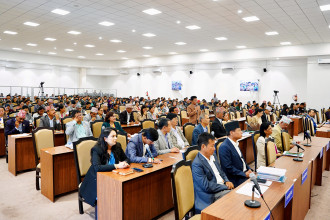
Speaking on the 76th anniversary of public service broadcaster Radio Nepal, Dr Timilsina said the ministry had moved forward with new energy to make institutions stronger, more accountable and results-oriented. “Only when government bodies are strong can citizens receive convenient and quality services. Therefore, the ministry has adopted a new approach to determine how institutions can be strengthened. There is no alternative to building strong, accountable and effective institutions,” he said.
Dr Timilsina said the responsibility of running the country had fallen on the shoulders of the youth after the House of Representatives election and called for changes to negative tendencies in political and administrative structures. “Negativity has prevailed in our institutions politically. We must chart out the direction ahead for the country and make changes accordingly. Once the political source is reformed, every institution will improve and it is time for every citizen to fulfil their duty,” he said.
He said there will be no compromise on accountability and discipline. “We ourselves will not do any wrong, nor will we let off those who do. Where there is weakness, action will be taken. The ministry and the government are working to bring those who manipulate situations under the purview of law,” Dr Timilsina said.
He underlined the need for frugality in government expenditure and linked cutting unnecessary costs to better information dissemination and good governance.
Dr Timilsina said citizens will share responsibility for creating conditions within five years in which young people will not need to go abroad for work. He stressed that information is a fundamental right in a democracy and that public service broadcasters must protect it. “It is necessary to make public service broadcasting more effective, reliable and people-oriented, taking into account changing communication technology, market competition and the evolving needs of the audience,” he added.
Recalling his student days, Dr Timilsina said Radio Nepal had inspired his literary writing and that public service broadcasters can have a long-term impact on nation building.
Laxmi Kumari Basnet, secretary of the Ministry of Communication and Information Technology, said Radio Nepal has played a key role in informing citizens and promoting language, culture and identity. “Radio Nepal has preserved diversity by broadcasting news in 26 languages and programmes in 25 languages. It plays an important role in the preservation and promotion of old songs and music through its technology-friendly medium,” she said.
-1775228861.jpg "Radio-Nepal-76th-Anniversary-(1)-1775228861.jpg")
-1775228861.jpg "Radio-Nepal-76th-Anniversary-(2)-1775228861.jpg")
Dr Mahendra Bista, chairman of Public Service Broadcasting Nepal, urged broadcasters to work independently, impartially and in a people-centred manner and said an Act to improve the sector has been enacted, and progress is underway.
Radio Nepal was established on April 2, 1951, and now reaches approximately 94% of the country’s population. The broadcaster has continuously provided factual information and entertainment since the establishment of democracy, despite political changes, natural disasters and other calamities.
By RSS
-1790953895.jpeg)
-1790952398.jpeg)
-1790946272.jpeg)