NIICE hosts int'l webinar on PM Balendra Shah's leadership

-1777537975.jpeg)
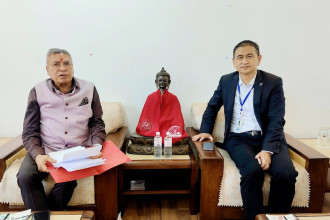
KATHMANDU: Nepal Institute for International Cooperation and Engagement (NIICE) hosted an international webinar on Wednesday to assess Prime Minister Balendra Shah's leadership and the broader political transformation underway in Nepal.
The event brought together 26 diplomats, policymakers, scholars and experts from 25 countries, including India, the United States, China, Bangladesh, Pakistan, Japan, Bhutan and Nepal, to offer international perspectives on the new government’s direction and prospects.
Bibek Dhoj Thapa, programme coordinator and research associate at NIICE, said, "In Kathmandu, there is a lot of deliberation going on about how this government will look at other countries in terms of foreign policy and diplomacy. But there were very few discussions about how other countries view this government. Keeping this in mind, we at NIICE have decided to bring together diplomats, policymakers, scholars and experts from around the world to get to know how the world is looking at Prime Minister Balen Shah’s government."
-1777537976.jpeg "NIICE-webinar,-PM-Balendra-Shah-leadership-(1)-1777537976.jpeg")
-1777537975.jpeg "NIICE-webinar,-PM-Balendra-Shah-leadership-(3)-1777537975.jpeg")
Among the speakers, Dr Shahab Eman Khan of Bangladesh said the leadership represented a departure from entrenched political structures, adding that it demonstrated how youth-driven aspirations can translate into electoral success and governance authority. He cautioned, however, that challenges remained around institutional depth, structured political engagement and the absence of a clearly defined ideological framework, which could affect long-term sustainability.
From the United States, Dr Rob York stressed that political stability remained a central priority even as growing public dissatisfaction signalled strong demand for reform. He noted Nepal’s young demographic profile made youth-oriented policy-making critical, and warned that reform efforts must be balanced to avoid political volatility. He also observed that Nepal’s strategic balancing between China and India was being closely monitored as a pragmatic approach.
Dr Zhang Jiadong of China characterised Nepal’s leadership as pragmatic, anti-corruption-oriented and people-centred, with a governance style that resonated strongly with younger citizens and reflected a shift towards more direct and responsive administration.
-1777538789.jpeg "NIICE-webinar,-PM-Balendra-Shah-leadership-(5)-1777538789.jpeg")
-1777538789.jpeg "NIICE-webinar,-PM-Balendra-Shah-leadership-(6)-1777538789.jpeg")
-1777538789.jpeg "NIICE-webinar,-PM-Balendra-Shah-leadership-(7)-1777538789.jpeg")
-1777538789.jpeg "NIICE-webinar,-PM-Balendra-Shah-leadership-(4)-1777538789.jpeg")
Former Indian ambassador Manjeev Singh Puri said Nepal’s transformation was deeply influenced by globalisation, migration, social media and rising societal aspirations. He emphasised that relations between India and Nepal were grounded in shared civilisation, geography and deep people-to-people ties, and urged that future bilateral cooperation focus on economic ties, connectivity and mutual benefit beyond short-term political narratives.
Pankaj Saran said the developments represented a continuing political evolution driven by new-generation leadership. He warned that while expectations were high, the real test would be institutional capacity to deliver results amid economic pressures, and he called the moment an opportunity to redefine and strengthen India–Nepal cooperation through forward-looking engagement.
Joëlle Hivonnet of the European Union framed Nepal’s recent changes as a notable example of democratic transition with global relevance, rooted in frustration over corruption, unemployment and exclusionary political practices. She highlighted the mobilising role of social media and cautioned that Nepal’s reliance on remittances, while stabilising, raised concerns about long-term sustainability. She said the transition from protest to effective governance was complex and that the government’s ability to implement its reform agenda would be crucial to maintaining public trust.
Dr Aamna Khan from Pakistan said Nepal was viewed internationally as a peaceful, independent and diplomatically balanced nation, respected for maintaining relations with major regional powers. She highlighted Nepal’s potential as a model for regional cooperation and encouraged stronger bilateral engagement through education partnerships, cultural exchanges, diplomatic dialogue and improved connectivity, including direct transport links.
NIICE said the discussion underscored a common theme among participants: Nepal’s political transformation had generated considerable international interest and was being viewed with optimism, but its long-term success would depend on the government’s ability to translate public expectations into tangible outcomes, strengthen institutional frameworks and maintain economic and political stability.