
UNESCAP, NICCI, MoPIT hold workshop on sustainable transport corridors in Nepal

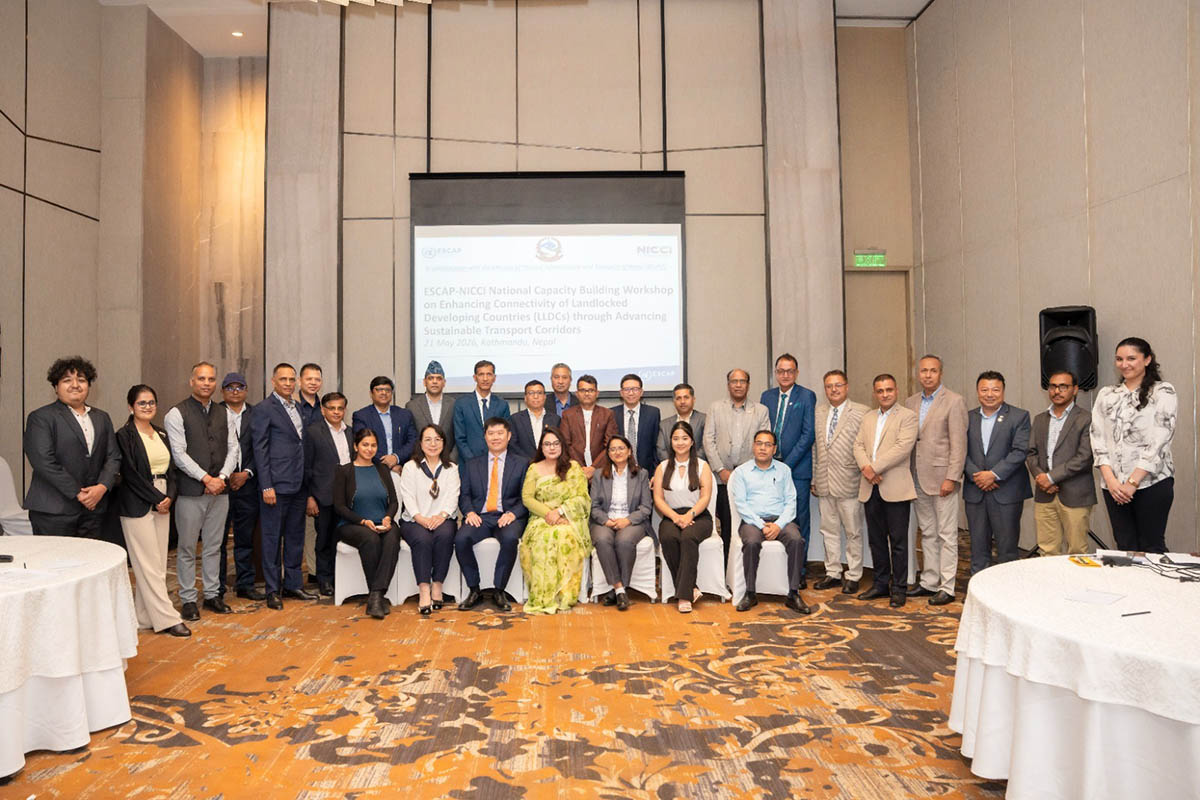
KATHMANDU: The United Nations Economic and Social Commission for Asia and the Pacific (UNESCAP), together with the Nepal-India Chamber of Commerce and Industry (NICCI) and the Ministry of Physical Infrastructure and Transport (MoPIT), held a national workshop on advancing sustainable transport corridors for landlocked developing countries on Thursday.
The one-day capacity-building event in Kathmandu brought together policymakers, transport economists, trade facilitation specialists, logistics professionals and regional stakeholders to examine structural challenges and opportunities for landlocked developing countries, with a particular focus on Nepal.
Organisers said the workshop aimed to strengthen national and institutional capacity to develop seamless, sustainable and digitally enabled connectivity. This agenda is of particular relevance for Nepal given its status as a landlocked nation and its reliance on robust transport and transit infrastructure for participation in regional and global value chains.
Technical sessions covered sustainable transport corridors, regional connectivity frameworks, paperless trade, green port protocols, sustainable shipping practices and digital logistics systems. Discussions explored ways to reduce trade costs, minimise transit delays and lower carbon emissions, placing climate-responsible logistics and digital transformation at the centre of connectivity governance.
Edouard Chong of UNESCAP presented international frameworks and best practices for LLDC connectivity. Meanwhile, Bhimarjun Adhikary, Joint Secretary of MoPIT, and Gaurav Tayal, Vice-President of NICCI, outlined Nepal’s institutional context and the policy imperatives for transport sector reform. Speakers from regional research institutions and other LLDCs, including Dr Prabir De of RIS, India, and Dr Delgernasan Mishig of Mongolia, offered comparative perspectives on cross-border cooperation and regional integration.
Former Secretary Madhu Kumar Marasani, Alex Tran and Umesh Bindu Shrestha, Joint Secretary of the Ministry of Industry, Commerce and Supplies, contributed technical expertise on logistics modernisation, interoperability of transport systems and the institutional arrangements needed to support regional cooperation.
Organisers said the workshop has direct relevance to Nepal’s efforts to strengthen trade competitiveness, develop climate-resilient infrastructure and deepen integration into regional economic architecture. Consequently, participants called for sustained policy coordination, investment in green and digital logistics capacity and closer engagement with regional frameworks to convert technical findings into actionable reforms.
The event underlined the importance of public-private collaboration, bringing together intergovernmental bodies, national ministries, chambers of commerce and specialised research institutions to advance a shared connectivity agenda for landlocked developing countries.

-1788413020.jpg)