
Beed’s take on the market : March 12 to April 10, 2026

The Nepal Stock Exchange (NEPSE) index increased slightly by 17.34 points (0.61%) to close at 2,837.78 points during the period from March 12 to April 10. The review period started with an uptrend, reaching an intraday high of 2,969.50 points on March 25. However, after that the stock market started falling significantly, reaching an intraday low of 2,669.70 points on April
6. The market ultimately closed at 2,837.78 points on April 10. Market turnover increased by 69.24% compared to the previous review period, which had recorded a 14.03% decline.
Despite a substantial selloff by investors, leading the market to reach 2,669.70 points, the market managed to crawl back to 2,837.78 points. This, coupled with the increase in market turnover, signals that there is a positive sentiment in the market.(Figure 1)

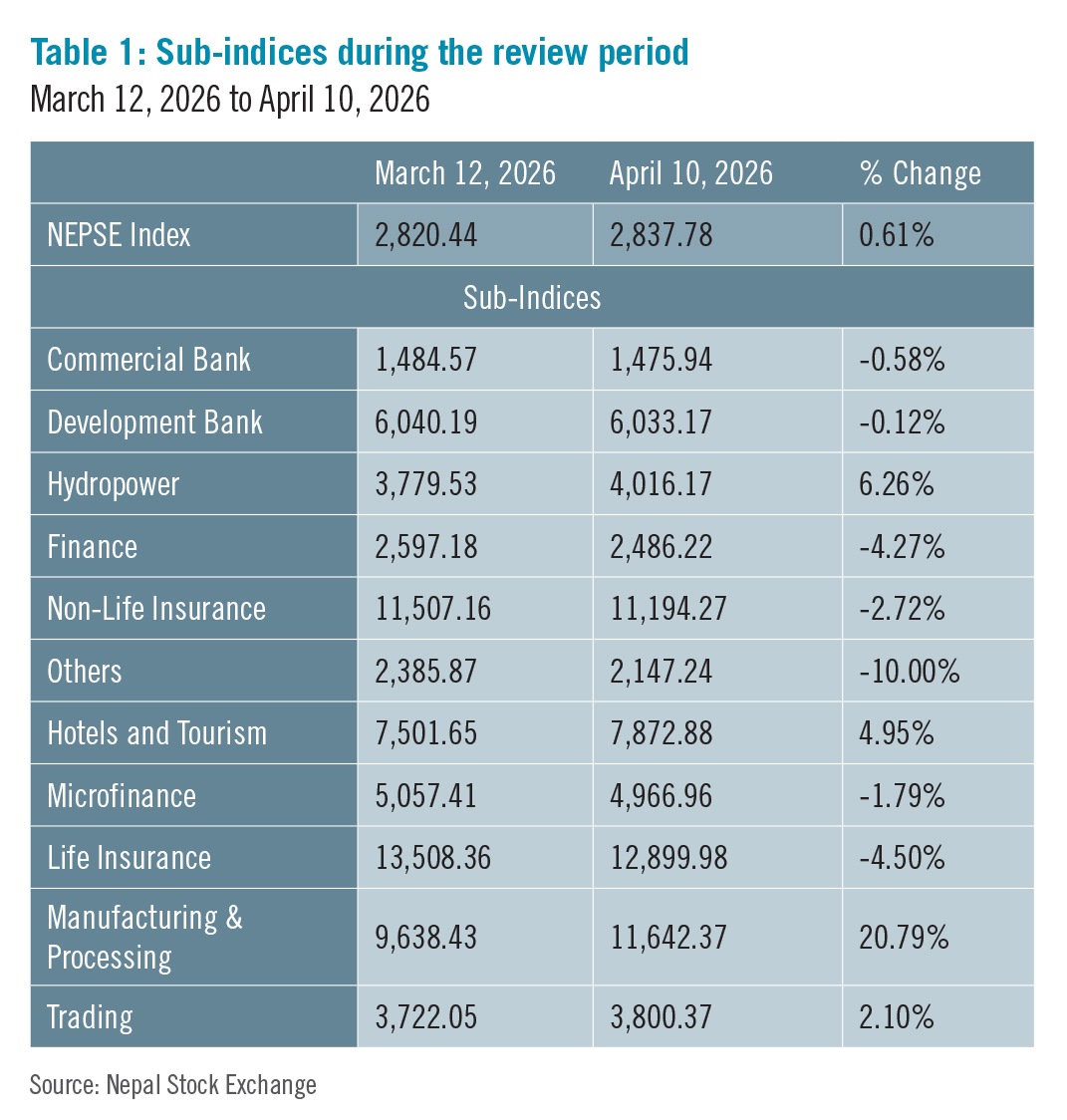
During the review period, only four sub-indices recorded gains. Manufacturing and Processing, Hydropower, and Hotels and Tourism sub-indices recorded the strongest gains during the period, whereas, Others, Life Insurance and Finance sub-indices faced considerable decline.
The Manufacturing and Processing sub-index recorded the highest gain of 20.79% driven by strong price appreciation in Reliance Spinning Mills (+Rs 3,797.7), Unilever Nepal (+Rs 800) and the newly listed company, Palpa Cement Industries (+Rs 330). Hydropower sub-index ranked second with a gain of 6.26% supported by increases in the share prices of three recently listed hydropower companies: Bhujung Hydropower (+Rs 1,191.8), Super Khudi Hydropower (+Rs 1,035.1) and Ridge Line Energy (+Rs 855.5). Similarly, Hotels and Tourism sub-index rose by 4.95% led by the newly listed security of Hotel Forest Inn (+Rs 637.5). Trading sub-index increased by 2.10%, supported by gains in Bishal Bazar Company (+Rs 131).
The remaining sub-indices faced decline during the review period. The Development Bank sub-index decreased by 0.12%, with declines observed in the share prices of Narayani Development Bank (-Rs 375.4), Miteri Development Bank (-Rs 43) and Excel Development Bank (-Rs 20.2). In addition, Commercial Bank sub-index decreased by 0.58%, with decrease in price of Standard Chartered Bank (-Rs 12.5), Nepal SBI Bank (-Rs 12) and Everest Bank (-Rs 7).
Similarly, Microfinance sub-index edged down by 1.79%, with decline in the share price of Unique Nepal Laghubitta Bittiya Sanstha (-Rs 308), Upakar Laghubitta Bittiya Sanstha (-Rs 200) and Swastik Laghubitta Bittiya Sanstha (-Rs 192.4).
Non-Life Insurance sub-index decreased by 2.72%, with declines observed in the share prices of Nepal Micro Insurance Company (-Rs 170), Rastriya Beema Company (-Rs 86) and Prabhu Insurance (-Rs 70.6). The Finance sub-index decreased by 4.27%, with decrease in the share prices of Shree Investment Finance (-Rs 40.1), Nepal Finance (-Rs 39.3) and Gurkhas Finance (-Rs 36). Life Insurance sub-index decreased by 4.50%, with decline in the prices of Guardian Micro Life Insurance (-Rs 203.2), Crest Micro Life Insurance (-Rs 113.1) and Life Insurance Corporation Nepal (Rs -48.7).
Finally, the sub-index that suffered the highest decline was Others, with a substantial decline of 10%, due to the decline in share prices of Nepal Reinsurance Company (-Rs 211), Jhapa Energy (-Rs 144) and Himalayan Reinsurance (-Rs 132). (Table 1)
News and Highlights
During the review period, Securities Board of Nepal (SEBON) introduced several reforms aimed at improving market efficiency, transparency and investor participation in NEPSE.
On April 6, a SEBON board meeting approved amendments to the circuit breaker mechanism in NEPSE. Under the existing provisions, trading is halted for 20 minutes if the market moves by 4% within the first hour. If the market changes by 5% within the second hour, trading is halted for 40 minutes, and if the market moves by 6% within the third hour, trading is suspended for the remainder of the day. Under the revised provisions, trading will be halted for 15 minutes if the index moves by 5% within the first hour of regular trading. If the index subsequently moves by 8%, the market will be closed for the entire day. Further, the board proposed increasing the maximum daily price fluctuation limit for individual companies from the current 10% to 15%. Similarly, for the special pre-opening session, where prices are currently allowed to fluctuate by up to 2%, the board has decided to increase the limit to 3%.
In addition, SEBON approved After Market Order (AMO) system that will allow investors to place buy and sell orders outside regular trading hours. At present, orders can only be placed from 10:30 am, when the special pre-opening session begins. This session runs from 10:30 am to 11 am, followed by the regular trading session from 11 am to 3 pm. Under the revised provisions, investors will be able to place orders from 6 pm to 6 am the following day. These orders must be based on the closing prices of companies after each regular session.
Additionally, SEBON enforced a mandatory review of financial statements for companies applying for an Initial Public Offering (IPO) by independent auditors under certain conditions.
Generally, this review covers audited financial statements from the past three fiscal years, the latest audited statement, and interim unaudited statements. Under the newly enforced provision, a review will be triggered if more than 75% of a company’s sales revenue in recent statements is recorded as trade receivables or similar items. SEBON may also require a review if taxes, fees or other government dues remain as potential liabilities, or if adjusting these obligations causes the company to fall short of IPO eligibility criteria such as net worth or profitability. Moreover, SEBON can mandate a review if these financial benchmarks are met primarily through non-operating income, reserve funds, or a combination of both.
Further, SEBON added five companies to the IPO pipeline. National Bio Tech plans to raise Rs 100 million with NIMB Ace Capital as issue manager; Sabhapokhari Hydropower intends to raise Rs 107.5 million with RBB Merchant Banking as issue manager; Eastern Sahara Company intends to raise Rs 275 million with Global IME Capital as issue manager; Budhanilkantha
Heritage aims to raise Rs 495 million with Global IME Capital as issue manager; and Pashupati Renewables aims to raise Rs 144 million with NMB Capital as issue manager.
Outlook
SEBON’s recent reforms - including relaxed circuit breakers, wider daily price fluctuation limits and an expanded session with the AMO system - are set to enhance price discovery, trading flexibility and market accessibility for all investors, including Non-Resident Nepalis. Stricter financial scrutiny for IPO applicants further strengthens market credibility by shielding investors from weak listings, which can support long-term stability.
This is an analysis from beed Management. No expressed or implied warranty is made for the usefulness or completeness of this information, and no liability will be accepted for the consequences of actions taken based on this analysis.


-1789367956.jpg)

-1784800098.jpg)