
February 5 to March 12, 2026 : beed’s take on the market

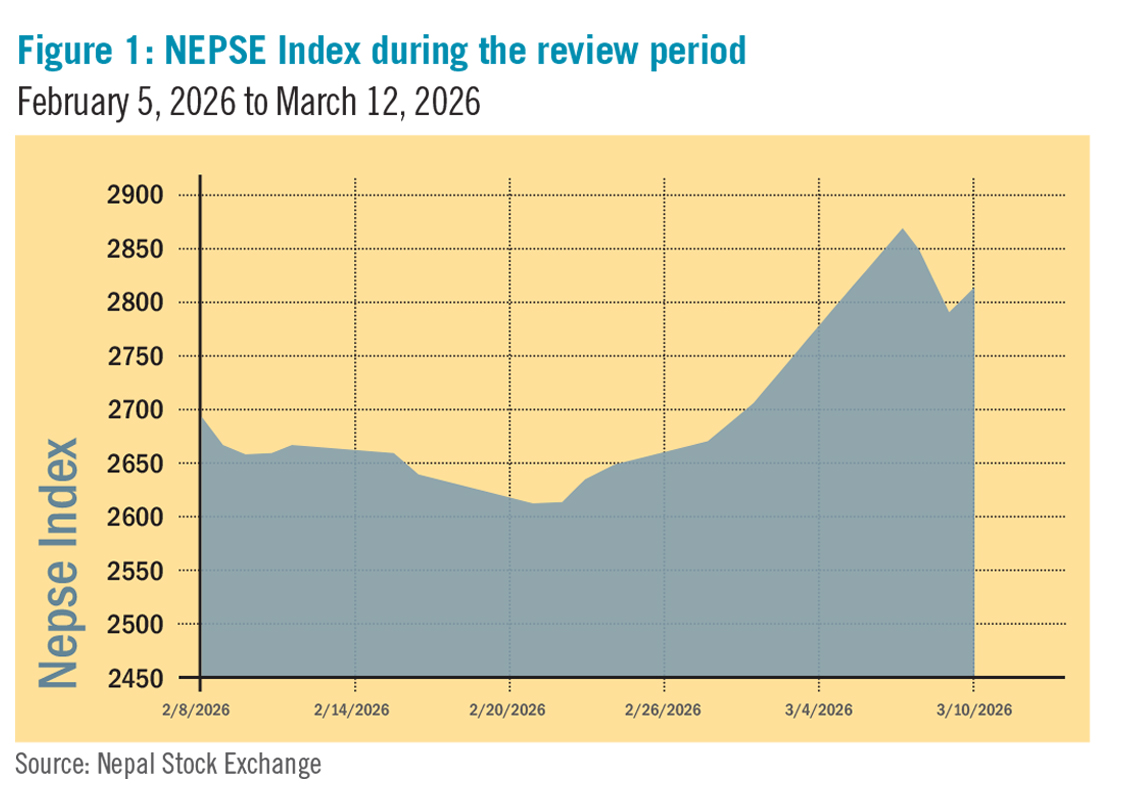
The Nepal Stock Exchange (NEPSE) index increased significantly by 111.74 points (4.13%) to close at 2,820.44 pints during the period from February 5 to March 12. The review period started with a downtrend, reaching an intraday low of 2,608.95 on February 23. However, after that, the market started rising significantly, reaching an intraday high of 2,911.36 on March 10. The market ultimately closed at 2,820.44 on March 12. Market turnover declined by 14.03% compared to the previous review period, which had recorded a 136% increase. Despite a decline in turnover, the sustained upward movement in the index indicates increased investor confidence. (Figure 1)
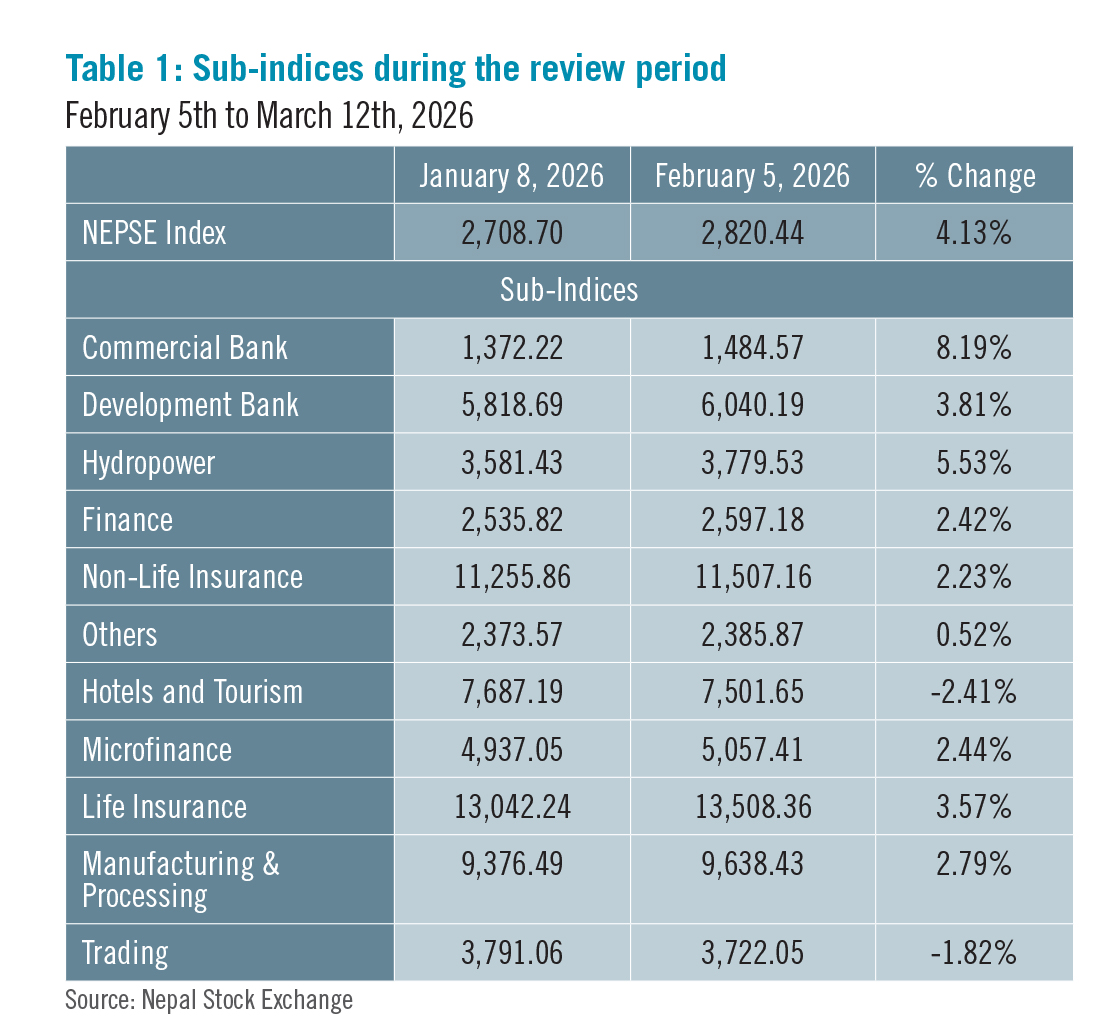
During the review period, all sub-indices recorded gains except the Hotels and Tourism and Trading sub-indices, which declined considerably. The Commercial Bank, Hydropower and Development Bank sub-indices recorded the strongest gains during the period.
The Commercial Bank sub-index recorded the highest gain of 8.19%, driven by strong price appreciation in Kumari Bank (+Rs 37.8), Everest Bank (+Rs 37) and Nabil Bank (+Rs 29.7). The Hydropower sub-index ranked second with a gain of 5.53%, supported by increases in the share prices of Ridi Power Company (+Rs 86.4), National Hydro Power Company (+Rs 74.3) and Sikles Hydropower (+Rs 72.7).
Similarly, Development Bank sub-index rose by 5.53%, led by the newly listed security of Salapa Bikas Bank (+Rs 948.6), Kamana Sewa Bikas Bank (+Rs 26) and Shangrila Development Bank (+Rs 25). The Life Insurance sub-index increased by 3.57%, supported by gains in Nepal Life Insurance Company (+Rs 41.9), Reliable Nepal Life Insurance (+Rs 31.9) and Life Insurance Corporation (Nepal) (+Rs 26.7). Manufacturing and Processing sub-index also rose by 2.79%, driven by price increases in the newly listed Reliance Spinning Mills (+Rs 893.3), as well as Himalayan Distillery (+Rs 59) and Shivam Cements (+Rs 43.9).
In addition, Microfinance sub-index gained 2.44%, supported by price appreciation in Aatmanirbhar Laghubitta Bittiya Sanstha (+Rs 380.1), Aviyan Laghubitta Bittiya Sanstha (+Rs 77) and National Laghubitta Bittiya Sanstha (+Rs 76.4). The Finance sub-index also increased by 2.42%, with gains in Manjushree Finance (+Rs 43), Multipurpose Finance Company (+Rs 34) and Goodwill Finance (+Rs 25).
The Non-Life Insurance sub-index rose by 2.23% with price appreciation in Rastriya Beema Company (+Rs 427), Shikhar Insurance Company (+Rs 32) and Prabhu Insurance (+Rs 27.1). Similarly, the Others sub-index posted a modest gain of 0.52%, with price appreciation in Nepal Doorsanchar Company (+Rs 34), Jhapa Energy (+Rs 28) and Himalayan Reinsurance (+Rs 18).
Meanwhile, two sub-indices recorded declines during the review period. The Hotels and Tourism sub-index decreased by 2.41%, with declines observed in the share prices of Kalinchowk Darshan (-Rs 160.1), Bandipur Cablecar and Tourism (-Rs 142) and Chandragiri Hills (-Rs 5). Similarly, Trading sub-index edged down by 1.82%, with a decline recorded in the share price of Bishal Bazar Company (-Rs 139). (Table 1)
News and Highlights
During the review period, Securities Board of Nepal (SEBON) implemented the Margin Trading Facility Directive, 2026, effective February 13, 2026. The directive required brokerage firms to maintain a minimum paid-up capital of Rs 200 million to provide margin trading facilities. It allowed brokers to extend margin trading facilities up to five times their certified net worth, an increase from the previous limit of two times. However, the existing cap limiting margin exposure to a single client and their immediate family members to a maximum of 10% of the broker’s net worth remained unchanged.
Previously, brokers could mobilise funds only from internal sources or commercial bank loans. The new directive permits funding through brokers’ own capital, loans from banks and financial institutions, and unsecured loans from shareholders or directors, provided the combined amount does not exceed 4.5 times the broker’s net worth. It has further introduced risk management provisions, including a requirement for brokers to collect an initial margin of at least 30% of the prevailing market value of listed securities when extending facilities, and for investors to maintain a minimum 20% maintenance margin during the facility tenure, subject to market conditions and risk assessment. The directive has also set the maximum tenure of a margin trading facility at one year.
On February 24, Nepal Rastra Bank (NRB) rolled out the midterm review of the Monetary Policy for Fiscal Year 2025/26. The central bank kept key monetary tools, including the interest rate corridor, bank rate, cash reserve ratio (CRR), and statutory liquidity ratio (SLR), unchanged in its review. However, it amended the working capital loan guidelines. Under the revised arrangement, banks and financial institutions are allowed to determine the maturity period of such loans based on an analysis of the borrower’s cash flow and financial statements.
Likewise, the existing provision requiring borrowers to reduce at least 10% of their outstanding working capital loan for a minimum of seven consecutive days each year was revised, now requiring borrowers to reduce the outstanding amount to below 30% during that period.
On March 5, Nepal successfully completed a snap election. On the first trading day after the election, on March 9, Nepal Stock Exchange rose by 6%, triggering the third circuit breaker, after which share trading was closed for the rest of the day.
Similarly, SEBON approved Initial Public Offerings (IPOs) for five hydropower companies and one manufacturing and processing company. The approved issues include Beni Hydropower Project (Rs 208 million) with NMB Capital as issue manager, Taksar Pikhuwa Khola Hydropower (Rs 423.07 million) with Prabhu Capital as issue manager, Yambaling Hydropower (Rs 280 million) with Muktinath Capital as issue manager, Kalanga Hydro (Rs 490 million) with Sanima Capital as issue manager, Sanigad Hydro (Rs 855 million) with Laxmi Sunrise Capital as issue manager, and Sopan Pharmaceuticals (Rs 429 million) with NMB Capital as issue manager.
Furthermore, SEBON added three companies to the IPO pipeline. Hotel Park Land plans to raise Rs 150 million with Citizens Capital as issue manager, Samyukta Urja intends to raise Rs 416 million with Laxmi Sunrise Capital as issue manager, and Athiti Resort & Spa intends to raise Rs 162.5 million with Prabhu Capital as issue manager.
Outlook
The implementation of the Margin Trading Facility Directive, 2026 can enhance liquidity, leverage and funding flexibility. While this could boost market activity and trading volumes in NEPSE, it may also increase volatility, requiring investor caution. Stable interest rates and more flexible working capital loan provisions introduced through NRB’s mid-term review may ease liquidity conditions and support investor confidence. However, the limited monetary easing may restrict stronger market stimulus. The sharp rise in the NEPSE index following the 2026 Nepal snap election reflects renewed investor sentiment, though it also indicates speculative momentum and potential short-term volatility rather than purely fundamentals-driven growth. Meanwhile, rising crude oil prices due to tensions in West Asia may increase inflation and import costs, potentially dampening investor sentiment.
This is an analysis from beed Management. No expressed or implied warranty is made for the usefulness or completeness of this information, and no liability will be accepted for the consequences of actions taken based on this analysis.

-1784800098.jpg)
-1782731467.jpg)
-1781680952.jpg)