
January 8 to February 5, 2026 : beed’s take on the market

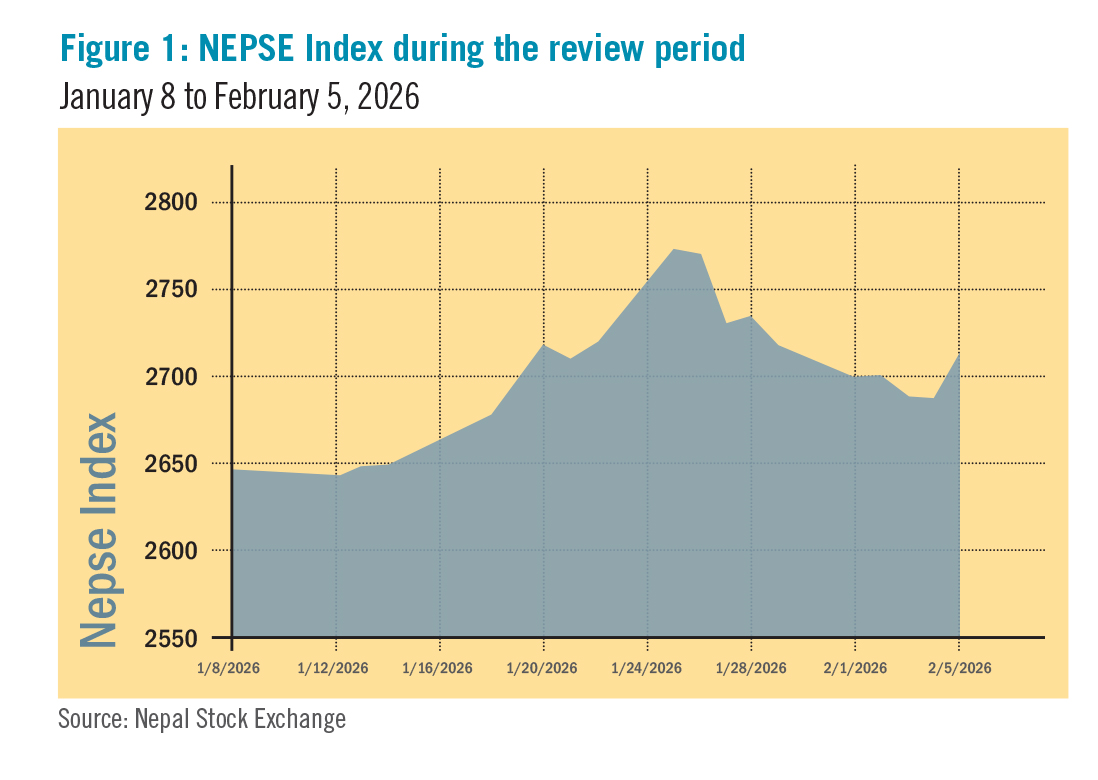
The Nepal Stock Exchange (NEPSE) index increased by 68.16 points (2.58%) to close at 2,708.70 points during the period from January 8 to February 5. At the beginning of the review period, the index moved upward after a phase of sideways movement, gaining momentum and reaching an intraday high of 2,788.09 on January 26. However, the market was unable to sustain this upward trend, and the index gradually declined thereafter, ultimately closing at 2,708.70 points on February 5. Market turnover rose significantly by 136% compared to the previous review period, which had recorded a 1% decline. The increase in the index, along with the sharp rise in turnover, indicates heightened market activity and reflects improved investor optimism during the review period. See Figure 1
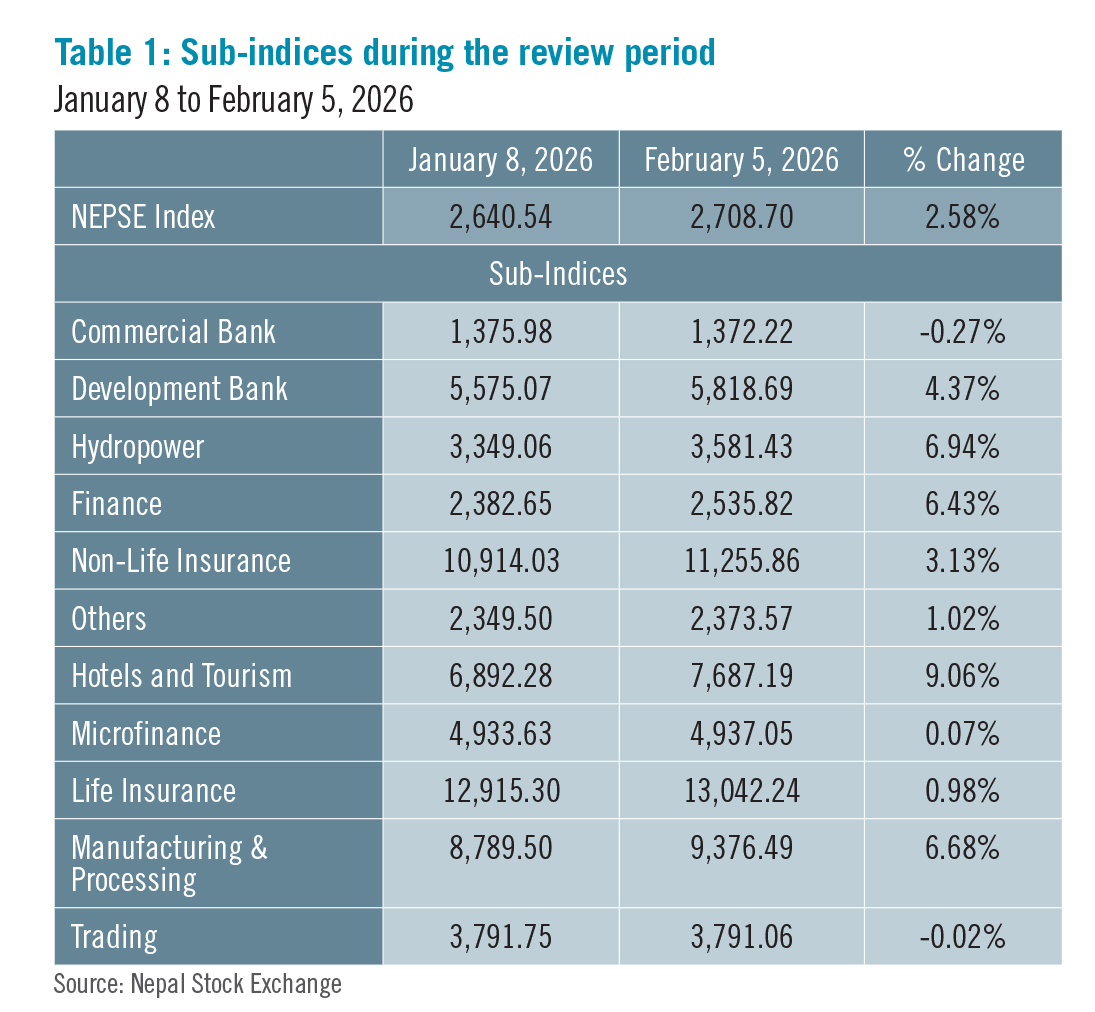
During the review period, all sub-indices recorded gains except the Commercial Banks and Trading sub-indices, which posted marginal declines. The Hotels and Tourism, Hydropower, and Manufacturing and Processing sub-indices recorded the strongest gains during the period.
The Hotels and Tourism sub-index recorded the highest gain of 9.06%, driven by strong price appreciation in Kalinchowk Darshan (+Rs 280.2), Bandipur Cable Car and Tourism (+Rs 274) and Taragaon Regency Hotel (+Rs 41). The Hydropower sub-index ranked second with a gain of 6.94%, supported by increases in the share prices of Trishuli Jal Vidhyut Company (+Rs 187.1), Ankhu Khola Jalvidhyut Company (+Rs 146.9) and Super Mai Hydropower (+Rs 119).
Similarly, the Manufacturing and Processing sub-index rose by 6.68%, led by SY Panel Nepal (+Rs 857), Unilever Nepal (+Rs 799.9) and Shreenagar Agritech Industries (+Rs 486.4). The Finance sub-index increased by 6.43%, supported by gains in Shree Investment Finance (+Rs 122.9), Gurkhas Finance (+Rs 67.1) and Central Finance (+Rs 58.1). The Development Bank sub-index also rose by 4.37%, driven by price increases in Narayani Development Bank (+Rs 387.9), Corporate Development Bank (+Rs 355) and Sindhu Bikash Bank (+Rs 111).
In addition, Non-Life Insurance sub-index gained 3.13%, supported by price appreciation in Nepal Micro Insurance (+Rs 231), Prabhu Insurance (+Rs 41.8) and NLG Insurance (+Rs 38).
The Others sub-index also increased by 1.02%, with gains in Trade Tower (+Rs 133.1), Nepal Warehousing Company (+Rs 107.9) and Pure Energy (+Rs 58.1).
The remaining sub-indices posted modest gains of less than 1%. Among them, Life Insurance sub-index rose by 0.98%, with price appreciation in Crest Micro Life Insurance (+Rs 273.8), Guardian Micro Life Insurance (+Rs 121.9) and Prabhu Mahalaxmi Life Insurance (+Rs 24.8). Similarly, Microfinance sub-index posted gain of 0.07%, with price appreciation in Support
Microfinance Bittiya Sanstha (+Rs 113), Swastik Laghubitta Bittiya Sanstha (+Rs 101) and Shrijanshil Laghubitta Bittiya Sanstha (+Rs 67.3).
Meanwhile, two sub-indices recorded marginal declines during the review period. The Commercial Bank sub-index decreased by 0.27%, with declines observed in the share prices of NIC Asia Bank (-Rs 18.2), Siddhartha Bank (-Rs 13.1) and Sanima Bank (-Rs 7). Similarly, Trading sub-index edged down by 0.02%, with a decline recorded in the share price of Salt Trading Corporation (-Rs 12). See Table 1
News and Highlights
During the review period, Securities Board of Nepal (SEBON) amended the Mutual Fund Regulations, 2010. Under the revised provisions, fund managers or sponsors that meet SEBON’s specified criteria related to experience, fund size, NAV performance, rating, and compliance are allowed to maintain reduced seed capital of 10% or 5%, compared to the earlier requirement of 15%. Entities that do not meet these criteria are required to continue maintaining seed capital at 15%.
The amendment also set a maximum scheme size limit of Rs 10 billion for funds operating under the revised framework. In addition, open-ended schemes are permitted to adjust previously maintained seed capital when increasing the size of their schemes. The amendment further strengthens risk management and governance requirements by mandating SEBON-approved risk management policies, semi-annual stress testing, and enhanced regulatory reporting to SEBON.
Similarly, SEBON approved Initial Public Offerings (IPOs) for three hydropower companies. The approved issues include Snow Rivers (Rs 187.50 million) with Sanima Capital as issue manager, Kalinchowk Hydropower (Rs 137.50 million) with RBB Merchant Banking as issue manager, and Appolo Hydropower (Rs 141 million) with Himalayan Capital as issue manager.
Furthermore, SEBON added three companies to the IPO pipeline. Supreme Healthcare plans to raise Rs 140 million with Global IME Capital as issue manager, Hulas Iron Industries aims to raise Rs 2.49 billion with Kumari Capital as issue manager, and Hotel Ichchha intends to raise Rs 350 million with Himalayan Capital as issue manager.
Outlook
SEBON’s amendment of Mutual Fund Regulations, 2010, represents a significant step toward sustainable growth in Nepal’s mutual fund industry by shifting to a merit-based seed capital framework that rewards experienced, well-performing, and compliant fund managers, while the introduction of structured risk management policies and semi-annual stress testing further strengthens investor protection and fosters greater confidence among mutual fund investors. Likewise, the surge in market turnover during the review period reflects investor anticipation of regulatory reforms and political stability following the upcoming federal election.
This is an analysis from beed Management. No expressed or implied warranty is made for the usefulness or completeness of this information, and no liability will be accepted for the consequences of actions taken based on this analysis.
-1789367956.jpg)
-1784800098.jpg)
-1782731467.jpg)