AIDIA, CII bring Nepali, Indian business leaders together in Siliguri to strengthen economic ties

-1781617172.JPG)
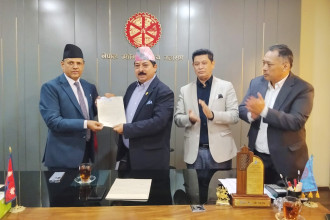
SILIGURI: Business leaders and policymakers from Nepal and India met in Siliguri on Saturday for a high-level bilateral dialogue aimed at strengthening economic cooperation and promoting shared prosperity across the region.
The event, held under the theme 'Strengthening Nepal-India Economic Partnership for Shared Prosperity,' was jointly organised by the Asian Institute of Diplomacy and International Affairs (AIDIA) and the Confederation of Indian Industry (CII) North Bengal Zonal Council. Discussions centred on practical policy measures to expand trade and investment between eastern Nepal and the Indian state of West Bengal.
Kunal Kayal, vice president of Nepal-India Chamber of Commerce and Industry (NICCI), highlighted the long-standing economic and people-to-people ties between the two countries and called for stronger institutional collaboration to unlock the bilateral relationship’s full potential.
Satish Mitruka, chairman of CII North Bengal Zonal Council, urged that such dialogues be held regularly in both Kathmandu and Siliguri at the same time to turn the region’s potential into concrete results. Speakers, including Amal Mandal, Supratim (Raj) Basu of Rural Heritage Conservation Tourism, and Sumit Sinhal, founder of Kins Hospital, pointed to opportunities in tourism, healthcare and medical education.
Representatives from the education sector — Shailaja Adhikari, managing director of IEC Group Nepal; Dr KV Rajendran Nair, principal of IIAS School of Management; and Ashish Thakur, chairman of Glocal Pvt Ltd — outlined prospects for collaboration between West Bengal and Nepal. Anil Kumar Shah, senior vice president of Morang Merchant Association, shared insights on boosting trade and tourism across the eastern Nepal-West Bengal corridor.
Moderating the session, Laxmi Limbu Kaushal, chair of the Real Estate and Logistics Panel at CII North Bengal Zonal Council, said the joint initiative marks a beginning. “It will help bring the business leaders together, where they can share and grow together,” she said.
Member of Parliament Parash Mani Gelal, delivering closing remarks, outlined his party’s and the Government of Nepal’s role in promoting trade and economic relations. He highlighted recent government initiatives to facilitate investment, provide policy support and strengthen cooperation, and encouraged Indian entrepreneurs to consider investment opportunities in Nepal.
-1781617172.JPG "AIDIA,-CII,-Nepal-India-economic-ties-(2)-1781617172.JPG")
-1781617172.JPG "AIDIA,-CII,-Nepal-India-economic-ties-(4)-1781617172.JPG")
-1781617172.JPG "AIDIA,-CII,-Nepal-India-economic-ties-(1)-1781617172.JPG")
Participants emphasised the growing importance of the Nepal-West Bengal Economic Corridor and called for increased investment in hydropower, tourism, agriculture, manufacturing and special economic zones. Education, hospitality and healthcare were identified as priority sectors for deeper economic and trade links. Delegates also urged practical measures to ease trade facilitation and closer partnerships among private-sector stakeholders.
The strategic role of Siliguri as a gateway connecting Nepal, India’s northeast, Bhutan and Bangladesh was a recurring theme, with attendees exploring ways to use the region’s geographic advantages to expand trade, investment and cross-border economic integration.
AIDIA Founder Sunil KC said the forum is part of a series of international events organised by the institute to promote economic diplomacy. He pointed to West Bengal’s historical role as an early and committed source of Indian investment in Nepal, citing companies such as Surya Nepal, Asian Paints Nepal, Berger Paints Nepal and Dabur Nepal as examples of long-standing commercial ties. He added that the recently established foreign direct investment (FDI) project Obeetee Nepal is backed by a company headquartered in West Bengal, underscoring the state’s ongoing contribution to economic cooperation between the two countries.
The dialogue concluded with a commitment from participants to convert discussions into practical partnerships and investment projects aimed at sustainable growth and regional prosperity.
-1789625607.jpeg)
-1789622920.jpg)