How GarudX Is Building Nepal’s First High-Altitude Drone Technology Ecosystem

By engineering a battery architecture optimised for these environments, GarudX enabled its drones to operate reliably at elevations exceeding 6,000 metres. This advancement not only validated its engineering capabilities but also shifted its identity from a service provider to a serious aerospace technology manufacturer.
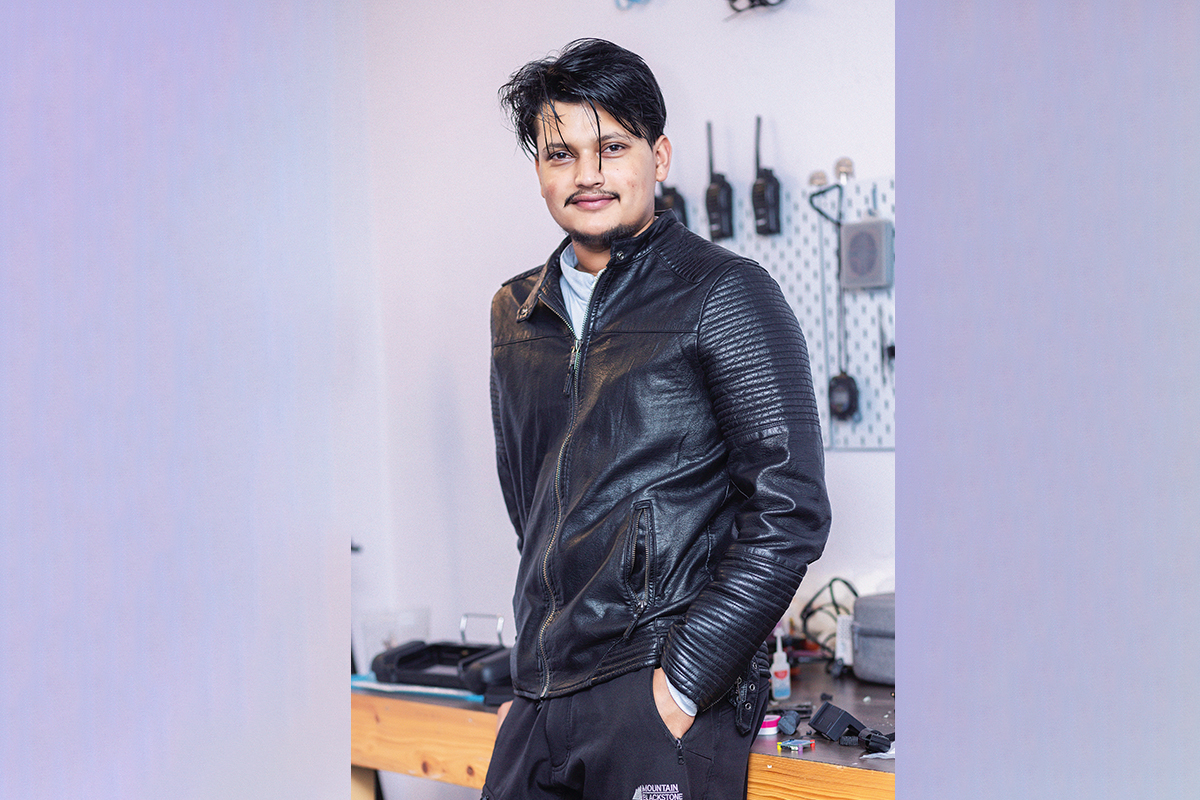
Adarsha Raj Bhusal, Founder & Managing Director, GarudX Drones
In a modest yet determined effort to redefine Nepal’s technological capabilities, GarudX Multipurpose is emerging as a pioneering force in homegrown drone manufacturing. Founded by Adarsha Raj Bhusal, a 23-year-old UAV designer and entrepreneur from Gulmi, the company represents a rare blend of grassroots innovation, engineering resilience and mission-driven problem solving aimed at addressing Nepal’s most persistent geographic challenges.
Bhusal’s journey into drones began not with a business plan, but with curiosity. As a teenager, he dismantled electronic devices simply to understand how they worked.“I was 13 years old, watching YouTube videos, fascinated by how these machines could fly. I was the kind of kid who opened up every electronic device in the house just to understand how it worked,” says Bhusal. “When I moved to Butwal for education, I started ordering parts from India and building drones on wooden frames. The inspiration was pure curiosity.”
By the age of 14, he had built and flown his first drone using wooden frames and imported components sourced from India. What began as experimentation quickly evolved into a defining passion. Over the next eight years, Bhusal gained hands-on experience in UAV (unmanned aerial vehicle) design, piloting, manufacturing and aerial cinematography.
His early professional work placed him at the forefront of Nepal’s film industry. Bhusal introduced FPV (first-person view) drone cinematography to Nepali cinema, contributing to music videos and films including Bato: Road to Death, the first Nepali movie to incorporate FPV drone footage. His aerial work has since appeared in more than 15 films, including Aktor, Hari Bahadur Ko Jutta, Hwarsa and Dhirgha. Yet, while cinematography sustained the business financially, it also exposed him to the broader potential of drone technology.
Through collaborations with professionals and organisations, including Nepal Flying Labs, Bhusal observed how drones were being used globally for disaster mapping, search and rescue, and humanitarian logistics.
“I participated in drone meetups and saw the real-world impact these machines could have. Then during the floods, we got the chance to help Nepal Police by building a lifejacket-dropping mechanism for our drone. That was when curiosity turned into purpose. GarudX was born from the realisation that Nepal needs its own drone technology designed for our altitudes, terrain and emergencies.”
GarudX was officially registered in 2024, though its foundation had been years in the making. Headquartered in Bhaisepati, Lalitpur, the company designs and manufactures UAV systems tailored to Nepal’s unique geography. Its platforms serve sectors including defence, law enforcement, disaster response and professional cinematography.
The company’s mission is deeply personal. Growing up in Gulmi, Bhusal witnessed firsthand the consequences of isolation in remote communities, where limited infrastructure meant medical emergencies often required hours of travel on foot. For many, help arrived too late. That experience continues to shape GarudX’s focus on accessibility. Whether delivering medicine to villages cut off by landslides or providing aerial surveillance during floods, the company’s work centres on bridging the gap between difficult terrain and essential services.
“Nepal’s geography creates isolation and isolation costs lives. ATLAX, our high-altitude delivery drone, was built for exactly this.”
Among GarudX’s flagship technologies is ATLAX, a high-altitude delivery drone tested above 6,000 metres in the Himalayas, including on Lobuche Peak in the Everest region. The company has also developed SkyReaper, a tactical surveillance quadcopter designed for security forces, and SkyDrop, a system built for search-and-rescue missions. Together, these innovations reflect GarudX’s ambition to position Nepal not merely as a user of drone technology, but as a creator of it.
“Nepal imports almost all its drone technology. Nothing on the market was designed for our altitudes, our weather or our terrain. After doing over 140 projects across Nepal, India and the UAE, I realised I did not just want to fly drones built by others, I wanted to build them myself, here in Nepal, for the problems only we truly understand,” says Bhusal.
A defining moment came during a flood crisis when Nepal Police approached GarudX for support. The team engineered a lifejacket-dropping mechanism and deployed its drone to assist rescue operations. For Bhusal, it was more than a technical demonstration. It was proof that locally built drones could make a tangible difference in emergencies.
“Seeing our technology in the air during a real emergency - helping locate stranded communities and deliver aid - was no longer a prototype demo or a pitch deck. It was our machine making a tangible difference,” says Bhusal. “That experience made it clear: this is not optional work. People’s lives depend on these capabilities and Nepal cannot keep waiting for foreign companies to build solutions that work in our geography.”
Despite its progress, GarudX faces significant structural challenges. Nepal lacks a dedicated drone manufacturing ecosystem, forcing the company to source critical components such as motors, flight controllers and carbon fibre materials internationally, often resulting in delays and higher costs.
“There is no drone manufacturing ecosystem in Nepal, no local suppliers for flight controllers, motors or carbon fibre. We source components globally, which means navigating customs delays, import duties and supply chain uncertainty.”
To mitigate these issues, the team recently undertook a 15-day sourcing trip across multiple Chinese cities to establish direct supplier relationships and reduce dependency on intermediaries.
More pressing, however, is the absence of a regulatory framework. Nepal currently lacks an airworthiness certification body for drones. As a result, even fully functional UAVs developed by GarudX cannot be formally registered, limiting clients’ ability to obtain flight permits and constraining commercial scalability.
“It is like what happened to Yatri - they built Nepal’s first electric motorcycle but could not get a licence plate. We are in the same situation. We build world-class drones but the system to certify them does not exist yet.”
The company is actively engaging with the Home Ministry and the Civil Aviation Authority of Nepal to help shape future regulations, while also exploring alternative certification pathways through foreign jurisdictions. The challenge highlights a broader issue confronting Nepal’s emerging technology sectors: the widening gap between innovation and policy.
One of GarudX’s most significant achievements has been the development of a custom battery system designed specifically for extreme altitudes. Standard batteries often fail in the sub-zero temperatures and low-density air conditions typical of the Himalayas.
“Building our own battery system for extreme altitude. This might not sound glamorous but it was a defining engineering challenge,” says Bhusal. “No company in the world was manufacturing batteries specifically designed for Himalayan flight conditions - the extreme cold, thin air and rapid pressure changes that cause standard battery packs to lose capacity or fail entirely.”
By engineering a battery architecture optimised for these environments, the company enabled its drones to operate reliably at elevations exceeding 6,000 metres. The breakthrough not only validated GarudX’s engineering capabilities but also repositioned the company from a service provider to a serious aerospace technology manufacturer. It also opened doors to partnerships with defence stakeholders, humanitarian organisations and international collaborators seeking solutions for extreme environments.
Financially, the company has maintained a disciplined, bootstrapped approach. Revenue from aerial cinematography continues to fund research and development.
“Aerial cinematography keeps us alive. We have shot for over 15 Nepali feature films, and that revenue directly funds our R&D. Every film shoot pays for the next prototype, the next test flight and the next iteration of our defence systems. It is not glamorous but it works.”
Additional support has come through grants and awards, including recognition from the US-Nepal Startup Weekend Challenge and funding from organisations such as One to Watch, ImpactHub and the World Bank. The strategy has allowed GarudX to retain ownership while continuing to innovate in a capital-intensive industry.
“The key is discipline. Never let the commercial work distract from the mission but never let the mission bankrupt the company. Some months, that balance is harder than others.”
Scaling operations has also brought new lessons. Beyond engineering, the company must manage supply chains, quality control, vendor relationships and logistics. Bhusal describes the China sourcing trip as a crash course in scaling and operational management.
“Scaling has also taught me the importance of building systems early. We built an internal operations platform to track projects, finances and vendor relationships. Without operational discipline, even the best technology stays in the lab.”
Looking ahead, Bhusal identifies three primary growth areas: defence and law enforcement, humanitarian logistics, and expansion into South Asian markets facing similar geographic challenges.
“We are currently the only company in Nepal that designs and builds tactical drones locally. With ATLAX, we are positioned to become the aerial delivery platform for remote health posts, disaster zones and conservation areas,” says Bhusal. “Countries like Bhutan and parts of India face identical geographic challenges. Our high-altitude expertise translates directly.”
He also emphasises the importance of community building. Through the Nepal Drone Racing League (NDRL), which now includes more than 140 active pilots, GarudX is cultivating a new generation of drone enthusiasts and future engineers.
Yet beyond commercial ambition, the company’s vision remains anchored in impact. For Bhusal, success is not defined solely by revenue or scale, but by the ability to save lives.
“Success means that no one in Nepal dies because they were too far from a hospital, too isolated for rescue teams to reach, or too invisible for anyone to notice. That is the north star. Everything else - the revenue, the scale, the international expansion - is a means to that end,” says Bhusal. “Beyond that, I want GarudX to prove something to this country and to the world: that world-class technology companies can be built in Nepal.”
GarudX stands as a testament to what is possible when local knowledge meets technical ambition. The company challenges the assumption that advanced technology must be imported and demonstrates that innovation can emerge from within Nepal’s own borders. As the country navigates its path toward technological self-reliance, GarudX’s trajectory offers both inspiration and a broader call to action.
“If we can do that,” Bhusal says, “maybe the next generation of talented Nepali engineers will think twice before leaving. Maybe they will see that someone stayed and built something here and decide to do the same.”