CESIF opens 'Bodhi Sambad' to revive Kathmandu as neutral intellectual space

-1781767086.JPG)
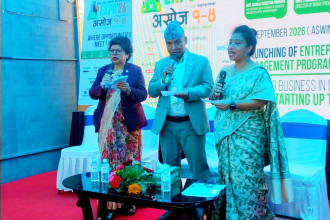
KATHMANDU: The Centre for Social Innovation and Foreign Policy (CESIF) on Tuesday opened the first day of 'Bodhi Sambad', a new initiative aimed at reviving the Kathmandu Valley’s role as a neutral intellectual space for the exchange of ideas.
The programme, inspired by the South Asian tradition of vada — an ancient method of reasoned dialogue focused on cooperative truth-seeking rather than adversarial victory — convened government officials, business leaders, economists and civil society to discuss Nepal’s economic future and governance challenges.
Speaking at the event, Finance Minister Dr Swarnim Wagle said Nepal stands at a critical juncture and needs bold decisions to overcome and called it a "national crisis of confidence." He outlined a plan to restructure the economy over the next 10-15 years and urged policymakers to capitalise on the country’s narrowing demographic window.
-1781767087.JPG "CESIF,-Bodhi-Sambad-(1)-1781767087.JPG")
-1781767087.JPG "CESIF,-Bodhi-Sambad-(4)-1781767087.JPG")
-1781767086.JPG "CESIF,-Bodhi-Sambad-(2)-1781767086.JPG")
He said there was a severe trust deficit rooted in institutional weaknesses and pledged a new development compact to make the state more capable while enabling a dynamic private sector. He warned against dependence on consumption-led growth, saying no nation has achieved prosperity by prioritising consumption over production, and identified sustainable energy and the digital economy as Nepal’s comparative advantages. He proposed linking the country’s hydropower potential with artificial intelligence and data centres to boost export value.
In the first panel, 'Reform 2.0: Is This Nepal’s Defining Economic Moment?', panellists focused on state capacity and barriers to implementation. Former finance minister Rameshore Prasad Khanal put public debt concerns in context, noting debt servicing accounts for only 1.3% of GDP compared with an average of 14% in peer countries, while criticising the central bureaucracy for retaining excessive control over human resources and underusing provincial budgets.
On the occasion, Federation of Nepalese Chambers of Commerce and Industry (FNCCI) President Anjan Shrestha said Nepal risks "growing old before growing rich" because of continued youth migration, and said capital and liquidity are currently abundant, making effective deployment the primary challenge. Former finance minister Surendra Pandey questioned efforts to revive defunct state-owned enterprises, arguing the government should not run corporations engaged in retail sales such as bedsheets.
Dr Govinda Raj Pokhrel urged Nepal to pursue long-term power purchase agreements with India rather than relying on spot markets and called for investment in international testing laboratories and the Kolkata-Kathmandu logistics corridor.
The second panel, 'Anti-Corruption and Governance: The Post-2025 Economic Catalyst', addressed structural governance challenges and bureaucratic inefficiencies. Economist Dr Shankar Sharma said capital productivity has deteriorated, with the Incremental Capital-Output Ratio rising to 6.5, and noted that 60% of bank credit is concentrated in low-productivity sectors such as real estate. He advocated greater regional supply-chain integration.
Dr Achyut Wagle highlighted how fragmentation of Nepal’s 15.7 million land plots has made agricultural commercialisation difficult and called for reforms in the law-making process rather than an exclusive focus on enforcement. Dr Sucheta Pyakuryal, director at IIDS, argued the state should not be judged solely on profit-and-loss calculations and emphasised that laws exist to protect citizens.
Newly elected National Planning Commission member Pukar Malla pointed to a structural capability trap within the central bureaucracy, while entrepreneur Manish Shrestha recounted dealing with seven separate government agencies in a month to register a start-up, illustrating administrative hurdles facing businesses.
By bringing together representatives from government, the private sector and civil society, CESIF said 'Bodhi Sambad' aims to re-establish Kathmandu as a venue for rigorous dialogue on Nepal’s long-term economic transformation.

-1789922568.jpeg)