
NCC, India's Bennett University sign MoU to boost entrepreneurship, industry-academic ties

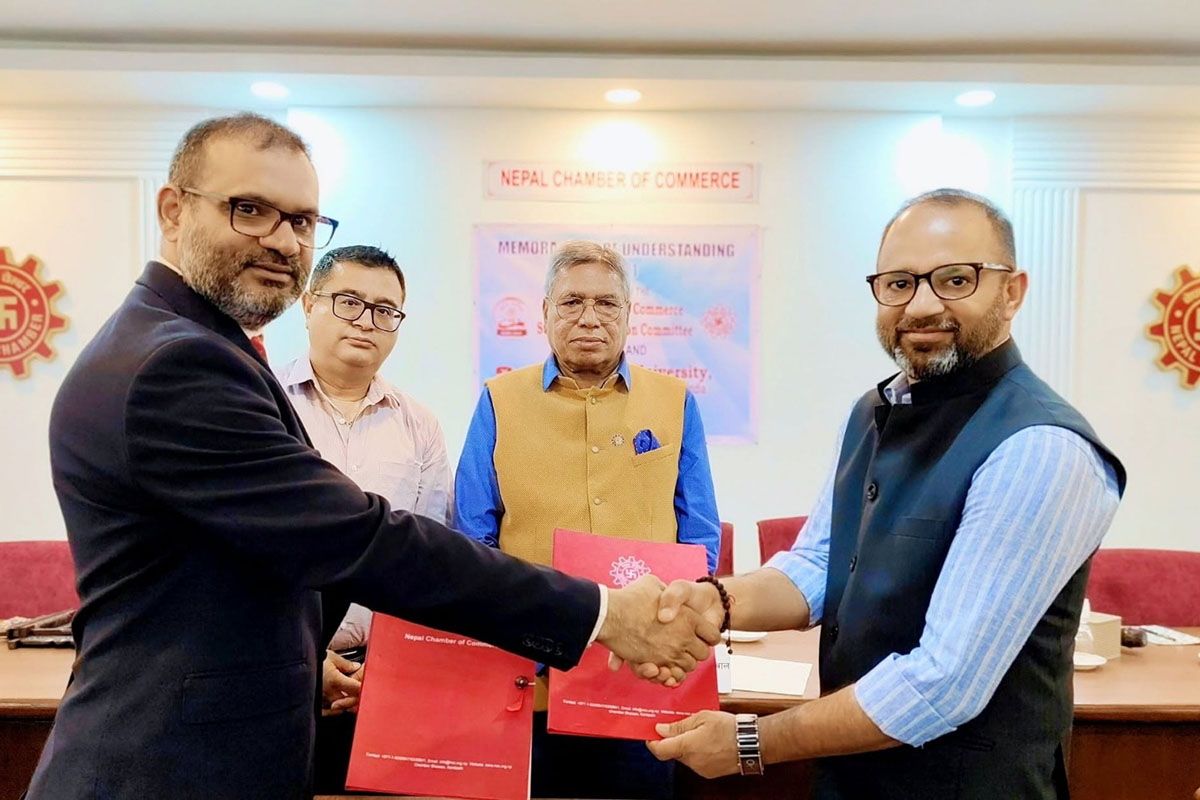
KATHMANDU: Nepal Chamber of Commerce (NCC) and India’s Bennett University signed a memorandum of understanding (MoU) on Friday to promote entrepreneurship, innovation, skill development and industry-academic collaboration. The agreement was signed at Chamber Bhawan in Jamal, Kathmandu.
Under the partnership, both institutions will establish a shared ecosystem through a long-term strategic partnership to connect education, industry, startups, the investment community and policy-making levels. The collaboration will support programmes focused on professional skill enhancement, entrepreneurship development, functional education, industry-academic cooperation, startup incubation and acceleration, leadership development, investment promotion, and research and knowledge exchange.
The agreement outlines specialised training and executive education programmes for entrepreneurs, professionals, small and medium-sized enterprises (SMEs/MSMEs) and members of NCC. These programmes will cover leadership development, digital transformation, artificial intelligence (AI), financial management, supply chain, international trade, and environmental, social and governance standards. The partnership will also extend to startup promotion, innovation mentorship, investor conferences, business dialogues, policy research and future-oriented educational tracks.
Pankaj Jalan, chairperson of NCC's Startup and Innovation Committee and NCC executive committee member, signed the agreement on behalf of the organisation. Senthil Kumar, chief operating officer (COO) of Bennett University, signed on behalf of the university. The agreement will remain active for five years and can be extended by mutual consent.
Speaking at the event, NCC President Kamlesh Kumar Agrawal said the historical, cultural and economic relations between Nepal and India are strengthening over time and expressed confidence that cooperation in education, technology, innovation and entrepreneurship will provide a new dimension to bilateral relations.
President Agrawal noted that the global economy is moving rapidly toward AI, digital transformation, innovation and knowledge-based industries. He said it is crucial to connect Nepali entrepreneurs, youth, startups and businesses with the necessary skills, technology and opportunities for global competition. He added that the partnership with Bennett University, which is promoted by India’s The Times Group, will connect modern technology, research, executive education and innovation with the private sector, expanding access to international knowledge, experience, markets and investment opportunities for Nepali entrepreneurs.
He further said AI will serve as a helpful tool for productivity, decision-making, innovation and business expansion rather than replacing human talent, and that international partnerships are essential to familiarise Nepali businesses with digital technology, data, artificial intelligence and an innovation-friendly business environment.
Sudhir Kumar Pandey, assistant vice president of international admissions and marketing at Bennett University, said the understanding will strengthen the exchange of knowledge, technology, research, investment and entrepreneurship and expressed confidence that it will contribute significantly to the startup ecosystem, youth entrepreneurship, job creation, industrial competitiveness and sustainable economic growth.
Llikewise, Jalan reiterated that international partnerships are essential to accustom Nepali businesses to digital technology, data, artificial intelligence and an innovation-friendly business environment, adding that effective coordination between human capacity and artificial intelligence will serve as the foundation for future economic growth. The ceremony was attended by the NCC’s startup committee member Yogesh Chhetri and other representatives.