
WALKING THE TIGHTROPE: POPULISM, REFORM, AND THE FY 2026/27 BUDGET

-1782637365.jpg)
The fiscal budget for 2026/27 mainly focuses on legal, procedural, institutional and tax reforms as part of the comprehensive governance overhauls promised by the new government under its popular mandate.
The budget presented by Finance Minister, Swarnim Wagle, is inflated in size despite severe resource constraints, following a conventional path of allocation. The new government has chosen a path of populism to please most constituencies and stakeholders, ultimately overlooking allocation efficiency.
The fiscal budget relies on simply unrealistic resource estimations. Out of the total Rs 2,124.34 billion earmarked for spending in FY 2026/27, the government estimates it will collect revenue worth Rs 1,405.31 billion, raise domestic debt of Rs 410 billion, and avail foreign debt worth Rs 247.28 billion along with foreign grants worth Rs 61.74 billion. (See Figure 1)

“Except for tax reforms, only the salaried class will benefit from the budget instantly,” says economist Bhim Prasad Bhurtel. “Otherwise, budget implementation, especially capital expenditure, is likely to remain as poor as in previous years.” According to Bhurtel, it will follow the familiar trend of mid-term estimate revisions because the government failed to provide any rational basis for an improvement in its implementation capacity.
Only 20% of the budget in Capex
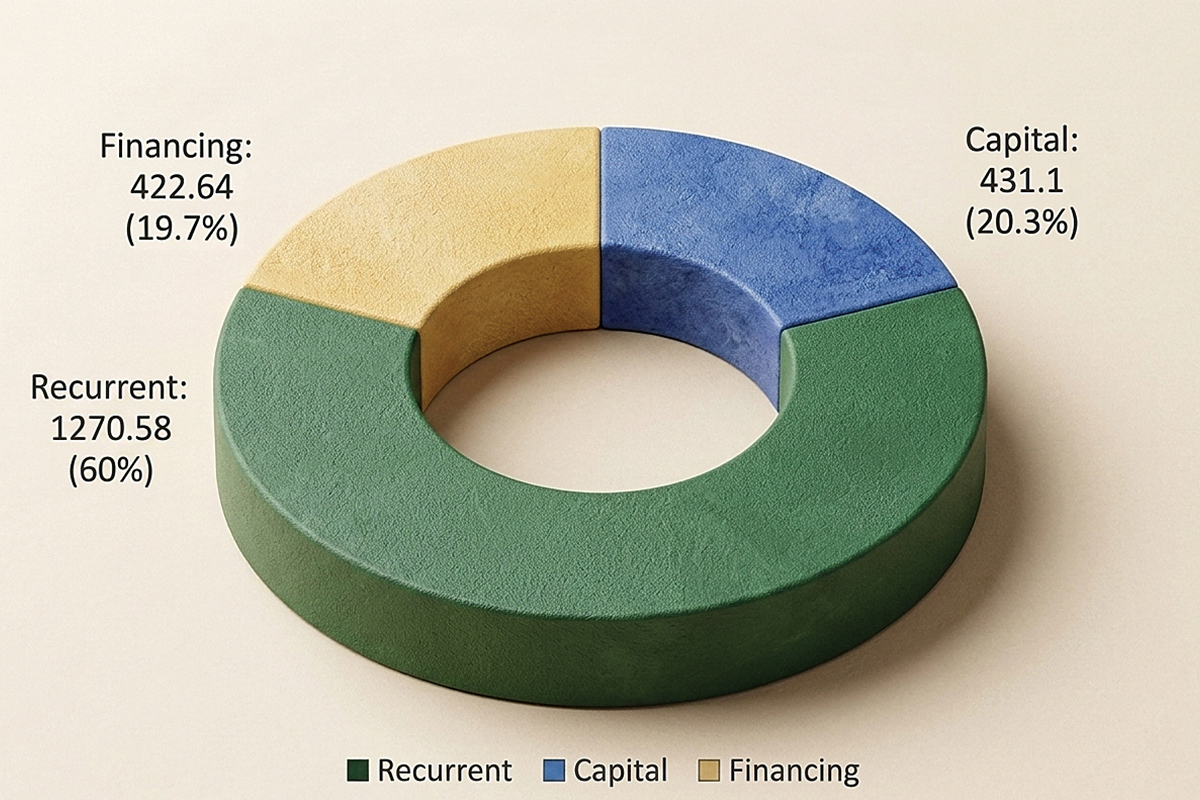
The fiscal budget allocated Rs 1,270.58 billion for recurrent expenditure, which covers salaries and perks, social security allowances, principal repayments on foreign debt, grants to various entities, and fiscal transfers to subnational governments. Meanwhile, 20.3% of the budget, or Rs 431.10 billion, was allocated for capital expenditure, and 19.9%, or Rs 422.64 billion, was set aside for financing, which includes interest repayments on foreign and domestic loans as well as investments in state-owned enterprises (SOEs). (See Figure 2)
Primarily, capital expenditure allocation remains low while the implementation of development projects continues to be weak. Although the government claims it will enhance execution through governance reforms, governance reform alone is not a sufficient condition to improve capacity and fix deeply rooted systemic inefficiencies, according to Nara Bahadur Thapa, Former Executive Director of Nepal Rastra Bank (NRB). Instead, the prerequisites for improving development project spending are project preparedness, timely preparation of bid documents, contract awards and strict contract enforcement.
Low capital expenditure over the last several years has adversely affected capital formation, prolonging the economic slowdown. Former Finance Minister, Yubaraj Khatiwada, noted that revising the income tax threshold up to one million rupees could drive up the import of consumable goods. Consequently, precious foreign exchange reserves might be depleted to fuel imports, which ultimately generates the revenue required for government spending. Unless Nepal establishes a strong domestic production base, it cannot achieve sustained growth or escape the vicious cycle of import-based consumption.
However, experts point out that the government has allocated resources to crucial connectivity infrastructure and the country will certainly gain momentum if these projects are properly implemented.
Fiscal transfers
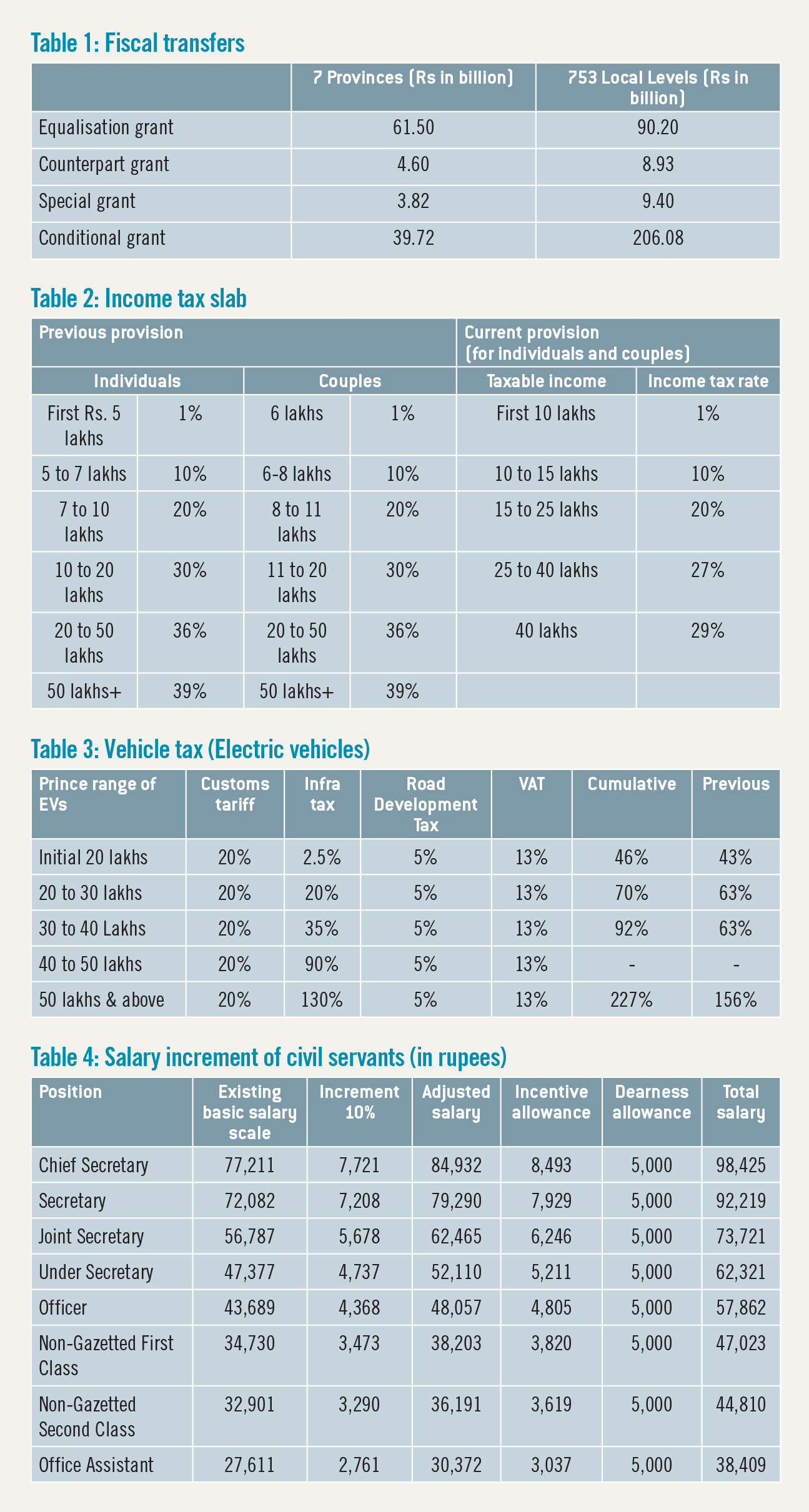
One of the major functions of the federal government’s budget is the fiscal transfer to subnational governments. The fiscal budget estimates that more than Rs 600 billion in resources will be mobilised across provinces and local levels through these fiscal transfers and revenue sharing, which includes royalties. (See Table 1)
Political economy of FY 2026/27 budget
The budget clearly outlines its political economy stance focusing on the middle class and supporting small and medium enterprises (SMEs). During his parliament speech, the Finance Minister expressed the view that while left-leaning parties have historically championed pro-poor redistributive slogans, in reality, they protected cronies and oligarchs. This budget marks the first time since the 1990s, when the economy shifted from state control toward a liberal order, that a budget has explicitly spelled out its political economy stance, according to former Chief Secretary, Bimal Koirala.
However, Govinda Raj Pokharel, Former Vice Chairperson of National Planning Commission, argued that the budget has neither scrapped social security distributions and other cash transfer schemes for the poor, nor has it fully acknowledged and facilitated the needs of the middle class. Instead, he believes it lost its direction because the 182 ruling party members of parliament likely held differing expectations and lobbied accordingly.
Technology and digitalisation
One of the major areas prioritised by the 2026/27 budget is digitalisation, aimed at improving service delivery while simultaneously strengthening governance. The development of a digital footprint is expected to transform the economy by enhancing transparency in the future. Moreover, the fiscal budget has announced plans to develop a national ‘tech hub and a sovereign AI computer centre.
Major changes in tax
The fiscal budget has substantially changed tax rates and introduced fragmented taxes, which could prove inefficient due to their administrative costs. In the past, Nepal introduced the Value Added Tax (VAT) as a single tax by scrapping sales, hotel, contract and entertainment taxes, among others, to improve enforceability and reduce tax collection costs. However, this budget introduces domestic product protection and promotion fees, clean infrastructure investment fees, skills promotion fees, and education and health equity fees, among others.
Moreover, the fiscal budget has scrapped excise duty and introduced a green tax (harit kar) on petroleum and coal imports, along with lubricants and mineral oils. Tax expert, Rup Bahadur Khadka, notes that the enforceability and efficiency of these fragmented tax headings will demand reforms in the future. Additionally, the fiscal budget has revised the income tax slab, raising the taxable income threshold from the existing amount above Rs six lakhs to one million rupees.
Newly introduced taxes in essentials goods and services
- Electricity consumption above 50 units – 5% value added tax
- Ride hailing services – 5%
- Education services (private schools) – 3%
- Health services (private healthcare facilities) – 3%.
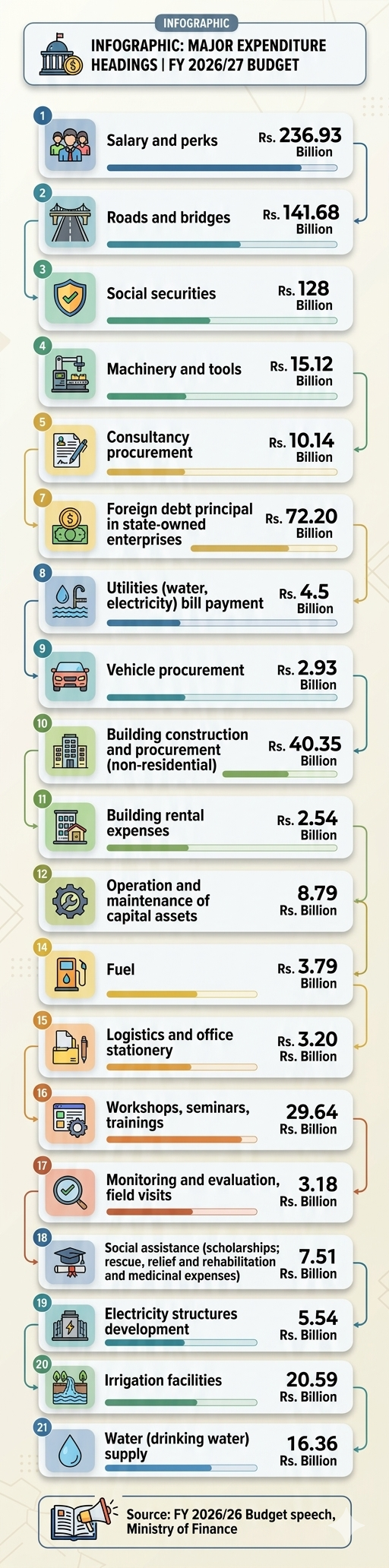
Major expenditure headings in the FY 2026/27 Budget

-1789290954.jpg)
-1786437470.jpg)
-1784716131.jpg)