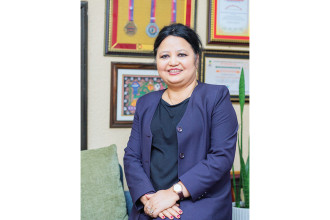
The Science of Resilience: Shanti Bhatta’s Journey from Pharmacy to Global Beauty Innovation

“Building something meaningful can be surprisingly lonely. As your ambitions evolve, your life starts moving in a different direction from many of the people around you. Some friendships naturally fade. Priorities change. You become responsible for facing problems that only you can solve. There were moments when I felt isolated but I also discovered a deeper level of self-reliance. I learned that we often become our own therapist, coach and source of motivation”
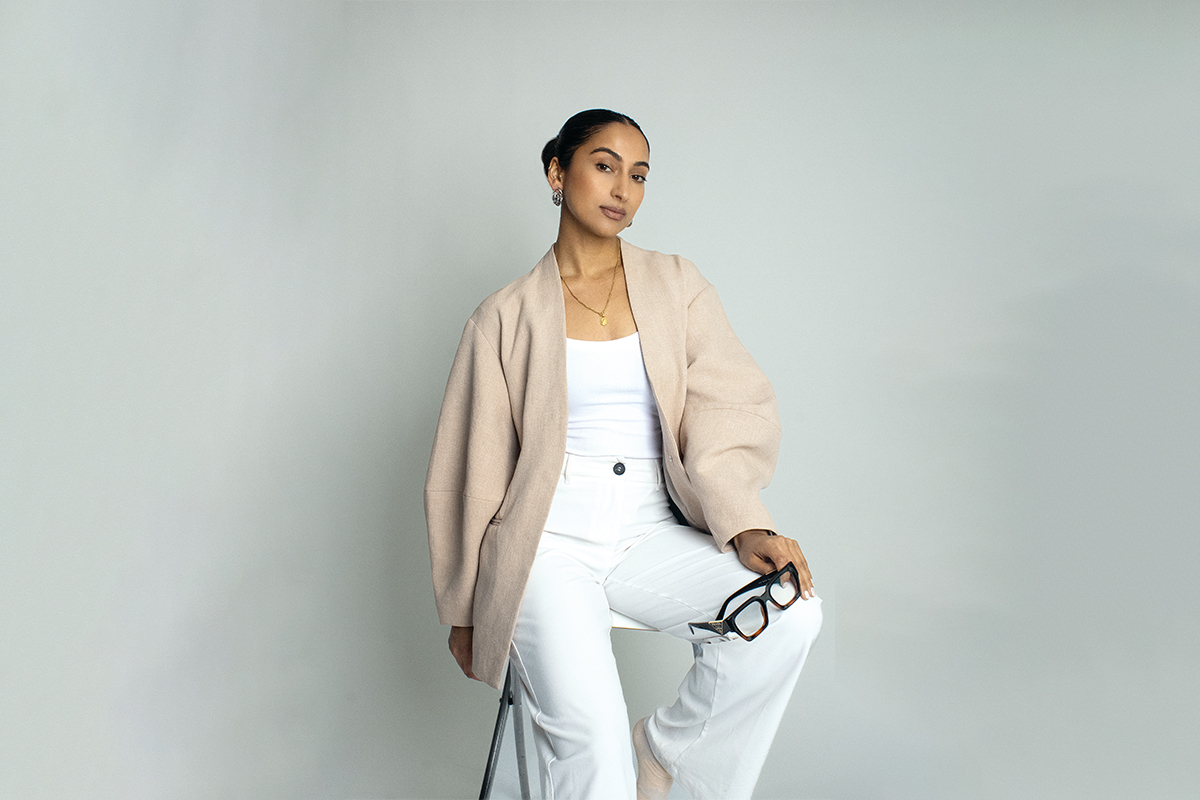
Shanti Bhatta was born in Nepal and moved to Belgium with her family while still young. It is not the typical origin story you would expect from a cosmetic chemist, but it is worth mentioning because this speaks to the kind of adaptability that seems to run through everything she has done since: first in pharmacy, then in chemistry, and eventually in building her own company, Cosprof Studio.
Her background is not conventional. Across more than 20 pharmacies, she has developed over 30 custom skincare formulations working with everyone from small independent brands to established international names.
At the same time, Bhatta holds the rank of Sub-Lieutenant in the Belgian Defence where her pharmaceutical training is used for something quite different: treating burn wounds at a military hospital. Few people move between those two worlds. Fewer still let one shape the other. But talk to her or just look at how she formulates, and you can tell there is a carefulness to her work, a refusal to cut corners just because something looks good on a label.
She is now quietly rewriting a few of her industry’s oldest assumptions. Her path has not been loud, but it has been consistent. In this edition of Business 360, Bhatta shares five things that have brought changes and impacted her life both personally and professionally.
Resilience was our family classroom
When I look back, there was not a single moment that changed everything. It was a thousand small moments at home.
My parents arrived in Belgium knowing neither the language nor the system. We faced financial and social limitations but what we never lacked was vision. I grew up watching them work relentlessly to build a life from scratch. They built restaurants and businesses without formal education or guidance, expanding into new cities, taking risks, failing sometimes and then finding the courage to start again.
What shaped me most was that we experienced entrepreneurship as a family. My siblings and I were not children watching from the sidelines. We were involved. While many of our classmates spent weekends relaxing, we were helping, observing and learning. At the time, it often felt unusual having to explain why our weekends looked different from everyone else’s.
Looking back, what felt like a sacrifice at the time became one of my greatest advantages. It was an education I could never have received in a classroom. We witnessed risk, resilience, failure, reinvention and growth in real time. Those experiences taught me adaptability, responsibility, initiative and perseverance long before I encountered those concepts professionally.
Perhaps the strongest reflection of our upbringing is that entrepreneurship has become part of all of us. Today, my sister is also a cosmetic formulator and is preparing to launch her own skincare brand. To me, that says a great deal about the environment we grew up in and the values our parents instilled in us: to be curious, take initiative and have the courage to build something of our own.
One memory stands out. I remember seeing how hard my parents worked despite uncertainty and realising that resilience is not something you talk about. It is something you practice every day. They taught me that success is rarely a single breakthrough. It is the accumulation of small actions repeated consistently over time.
Today, everything I build is, in many ways, a continuation of that lesson.
The mentor who shattered my invisible ceilings
The person who changed my trajectory was not a celebrity, a professor or even someone within my immediate circle. It was a mentor-like figure from the media and entertainment industry.
Family and friends will always support you but a mentor serves a different role. They see potential in you before you fully see it in yourself. More importantly, they challenge the limits you have unconsciously placed on your own ambitions.
I remember being encouraged to think bigger than what felt reasonable at the time. Not because I lacked ambition but because we often inherit invisible ceilings from our environment. We are surrounded by examples of what seems possible and without realising it, we start defining our own limits by what we have seen others achieve.
A mentor disrupts that pattern.
One of the most valuable lessons I received was simple: there is no fundamental difference between you and the people you admire in your industry. They are not operating under different laws of physics. They simply made different decisions, took different risks and persisted longer.
That perspective changed everything. Whenever I face a challenge today, whether building a company, entering a new market, or pursuing a goal that appears out of reach, I return to that lesson. We spend a lot of time explaining to ourselves why something cannot be done. Far fewer people ask what would happen if it could.
Sometimes all it takes is one person who genuinely believes in your potential to make you believe it too.
The loneliness and growth of trusting your own conviction
I often say that my hardest chapters are probably still ahead of me because I am building toward goals that are much larger than what I have achieved so far. But if I had to choose one difficult season, it would be the period when I was pursuing an opportunity regarding entrepreneurship that I felt deeply aligned with, yet every external signal seemed to say no. I had prepared, worked hard and genuinely believed it was the right path. Yet, I faced rejection. People around me told me perhaps it was a sign that it simply was not
meant to be.
The challenge was not the rejection itself. The challenge was continuing to trust my own conviction when reality appeared to disagree with me. What pulled me through was a belief that has stayed with me ever since: if something is truly aligned with who you are and what you are capable of becoming, then one or multiple setbacks should not be enough to make you abandon it.
That period also taught me something about entrepreneurship that nobody tells you in advance. Building something meaningful can be surprisingly lonely. As your ambitions evolve, your life starts moving in a different direction from many of the people around you. Some friendships naturally fade. Priorities change. You become responsible for facing problems that only you can solve. There were moments when I felt isolated but I also discovered a deeper level of self-reliance. I learned that we often become our own therapist, coach and source of motivation.
Two ideas carried me through. The first is that if another human being has achieved something, then it is evidence that it can be done. The second is that everything is temporary. Success, failure, setbacks, uncertainty, they are all phases. Looking back, I no longer see that season as a period of struggle. I see it as the moment I stopped waiting for external validation and started trusting my own judgement.
The evolution of Cosprof Studio from pharmacy to global strategy
Cosprof Studio was not born from a single dramatic moment. It emerged from a growing realisation after years spent working across pharmacies, research environments, formulation laboratories, and the pharmaceutical and manufacturing industry.
As a pharmacist, I had a front row seat to consumer behaviour. Every day, I saw what people were buying, what dermatologists were prescribing, what irritated their skin and which products genuinely improved their lives. At the same time, I was becoming increasingly involved in formulation development and witnessing another side of the industry. As lead formulator,
I was responsible for sourcing, formulation development, testing, scale-up and regulatory compliance. It gave me visibility into every stage of product development, far beyond the formulation itself.
What fascinated me was the gap between science and commercial reality. Many products were being built around trends, marketing narratives or ingredient buzzwords, while the real challenges were happening elsewhere: formulation stability, regulatory compliance, manufacturing feasibility, pricing strategy, supply chain resilience and consumer adherence.
I realised that brands did not simply need a formulator. They needed a partner who could understand the entire journey from concept to shelf, connecting formulation science, regulatory strategy and business objectives. That realisation became Cosprof Studio.
Starting the company was both exciting and terrifying. There is something uniquely vulnerable about building something with your own name attached to it. Every success feels personal but so does every setback. What gave me confidence was the response from clients. The more projects I completed, the more referrals arrived. Clients were not only asking for formulations; they were asking for guidance, strategy and scientific leadership.
Today, Cosprof Studio has evolved far beyond what I initially imagined. We operate internationally with our offices in Antwerp, London and Dubai, and we are increasingly selective about the projects we take on. We work alongside founders and investors as long-term partners, helping transform ideas into scalable, commercially viable brands.
Alongside my work at Cosprof Studio, I have spent the past year quietly building my own skincare brand behind the scenes. It has been one of the most humbling experiences of my career, requiring me to apply every lesson I have learned as a pharmacist, scientist, regulator and founder. More details will be shared soon.
The life-saving science and discipline of military service
Most people are surprised when they learn that, alongside being a founder and cosmetic scientist, I also serve as a Sub-Lieutenant and Military Pharmacist Reservist within the Belgian Defence.
Yet, when I reflect on my journey, it feels like a natural extension of who I am. I had been interested since I was 18 years old. My professional relationship with the military began during my Master’s in Drug Development when I became the first intern hospital pharmacist at the Military Hospital Queen Astrid. Later, during my specialised Master’s in Dermo-Cosmetic Sciences, I returned to conduct research within the burn wound care unit, studying the therapeutic applications of human skin transplantation. That experience fundamentally changed the way I view skin.
In the beauty industry, skin is often discussed through the lens of aesthetics. In the burn unit, skin becomes something else entirely. You witness how it protects life, supports healing and determines a person’s recovery after severe trauma.
During my research, I also explored ethical questions surrounding the use of human skin. As someone with Nepali roots, I was deeply affected by reports describing illegal trafficking of human tissue in vulnerable communities. It highlighted a striking contrast: the same skin that can be used to save a burn victim’s life can also become part of unethical commercial systems. That realisation reinforced the responsibility that comes with working in health and science.
Military service itself taught me lessons that no laboratory or boardroom could. People often assume the greatest lesson is discipline and while that is certainly true, the deeper lesson is adaptability. The military places you in situations where conditions are rarely perfect. Plans change. Resources are limited. Yet, the mission remains. You learn to perform under pressure, make decisions with incomplete information and continue moving forward regardless of discomfort.
It also taught me leadership. As an officer, I have worked across different linguistic and cultural environments, communicating in Dutch and French while collaborating with multidisciplinary teams. You quickly learn that leadership is not about authority. It is about trust, responsibility, leading by example and the ability to unite people around a common objective.
My current role within the Belgian Defence has evolved, and while certain aspects remain confidential, the principles have stayed with me far beyond the uniform: prepare thoroughly, lead responsibly and understand that meaningful growth rarely happens in moments of comfort. Excellence is rarely the product of ambition alone; it is built through discipline, consistency and the ability to perform when circumstances are far from ideal.