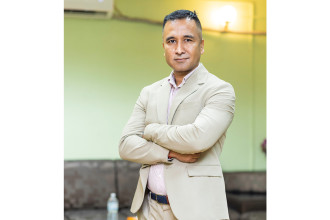
How Abhas Maskey Built Nepal’s First Private Aerospace Institution and Launched Nepal into Space.
ABHAS MASKEY
Founder, Antarikchya Pratisthan Nepal
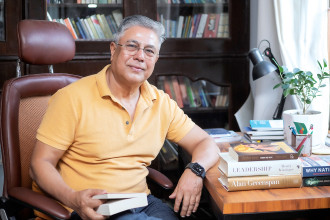
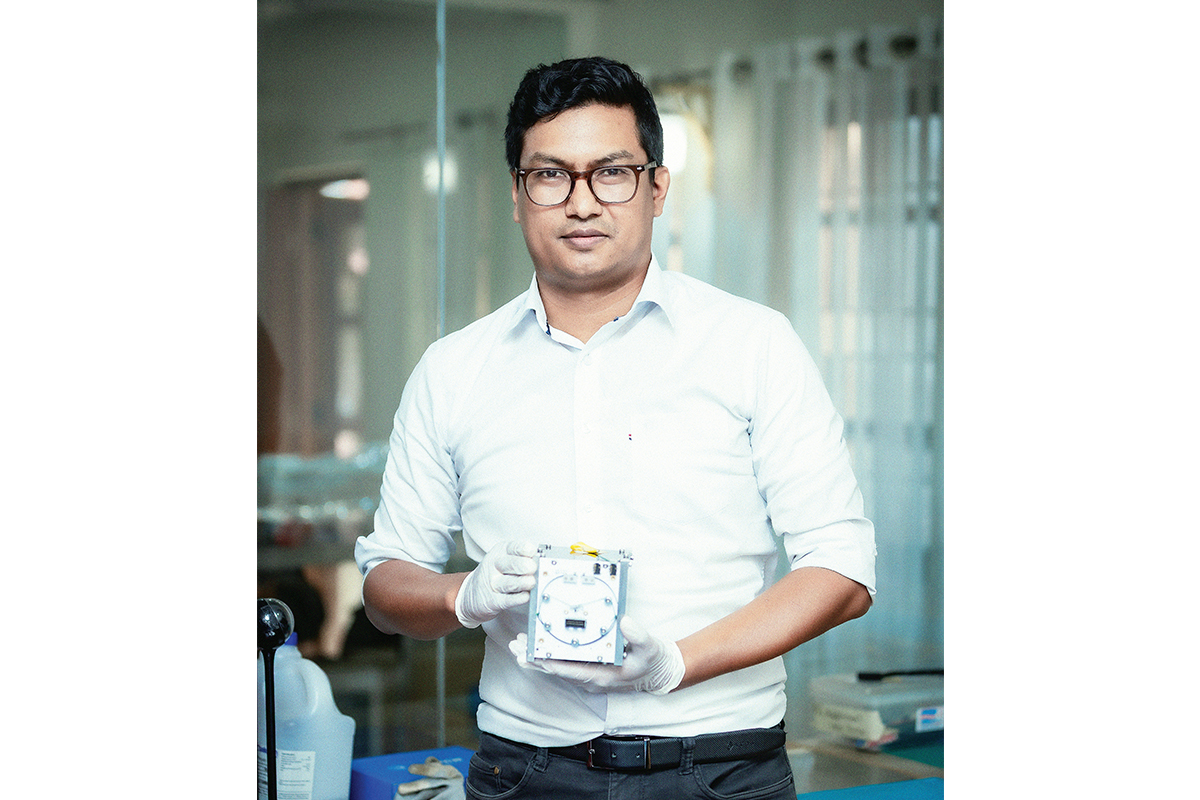
Abhas Maskey, founder of Antarikchya Pratisthan Nepal, maintains a profile as low-key as the orbit his satellites quietly circle the Earth in. He does not court headlines, rarely speaks about himself unprompted, and prefers to let his satellites do the talking. But make no mistake: his impact is monumental. Maskey has quietly achieved what many nations with far greater resources still struggle to accomplish, putting his country into space.
Maskey studied Aerospace Engineering at Seoul National University in South Korea, earning both his Bachelor’s and Master’s degrees there. He then moved to Japan, where he completed his PhD at the Kyushu Institute of Technology under Professor Mengu Cho, a leading authority in small satellite research. Returning to Kathmandu with a vision as ambitious as it was understated, Maskey founded Antarikchya Pratisthan Nepal, the nation’s first private aerospace institution.
What followed was nothing short of remarkable. His work spans education, research and infrastructure-building in a country where aerospace facilities barely existed. He has directly contributed to seven satellite projects, placing seven CubeSats into orbit, while simultaneously training the next generation of Nepali engineers through hands-on satellite programmes that reach students as young as Grade VII.
In this edition of Business 360, Maskey shares five things that have had an impact in his life personally and professionally. Excerpts:
From discipline to orbit
The first day I entered Budhanilkantha School in Class 4 was incredibly difficult for me, especially since the cardinal rule there is: we don’t cry. Adapting during those first two years was a profound personal challenge as I struggled to overcome homesickness and navigate a miniature society. Yet, the discipline I learned there ultimately helped me earn a place at Seoul National University (SNU) for both my Bachelor’s and Master’s degrees, which was a significant milestone. While Budhanilkantha School instilled foundational discipline, SNU demanded an entirely new level, competing alongside students at South Korea’s most prestigious university pushed me to sharpen my intellect and raise my standards in ways I had never anticipated. It was during my fourth year there that my path in aerospace engineering truly began to take shape.
Professor Jeung In-Seuck, who later became my Master’s advisor, was already deep into a remarkable project: QB50, a European Union initiative building a network of 50 CubeSats.
SNU’s contribution to that global effort was SNUSAT, and I was able to work hands-on across three iterations, SNUSAT-1, SNUSAT-1b and SNUSAT-2. This work even took us to Japan for satellite testing where we collaborated with Professor Mengu Cho of the Kyushu Institute of Technology (Kyutech), one of the world’s leading figures in small satellite research.
After graduating, I spent a year working at a drone company gaining valuable industry perspective before deciding to dive deeper into research. I applied to Kyutech for a PhD and completed it under Professor Cho, a mentor whose precision and commitment to excellence left a lasting impression on me. Looking back, I was incredibly fortunate to train under world-class professors across two countries. Beyond the technical expertise, however, what shaped me most was the culture that surrounded them. The military-like discipline, the deep respect embedded in the Korean hierarchy, and the quiet but firm expectations of my mentors did not just make me a better engineer, they made me a more grounded and driven individual, qualities that would prove just as vital as any technical skill in the work that followed.
Launching Nepal into space
Growing up in South Korea’s hierarchical culture where respecting elders is deeply ingrained, you simply do not say ‘No’ to a professor. So, when my advisor advised me to return to Nepal and explore the aerospace sector, I listened. I returned to Kathmandu during the pandemic. Those early days were anything but smooth. We were attempting to run several projects with support from Nepal Academy of Science and Technology (NAST), Prof Jiba Raj Pokharel, National Planning Commission, Dr Swarnim Wagle, and a frequently changing government. The bureaucracy was relentless and the paperwork endless.
A turning point came when we began working at Mahabir Pun’s National Innovation Centre which gave birth to SastoCube, anything but ‘sasto’ (cheap) despite its name, and E-Cube.
Slowly, things started falling into place. By leveraging academic and professional networks, we eventually launched two satellites, Danphe and Munal. The most rewarding part was proving that Nepali undergraduate and high school students could build satellites. We invested heavily in training young people across multiple teams, including students from Kathmandu University High School, government schools such as Ajad, Chaitanya, and Sanjiwani, and Chepang kids from Banepa. Tejendra Raj Bhandari of Kathmandu University was a key contributor, and Dr Shuv Rao from Anant Technology, an Indian Space Research Organisation (ISRO) scientist, played a crucial role in making the Munal launch possible at ‘no cost’.
Through it all, financial challenges remained a constant reality, especially overhead charges. It was Sagun Prajapti from Sanima Bank who pointed out something that now seems obvious: no one funds an individual for this kind of work. It has to come through an institution. That insight led to the establishment of Antarikchya Pratisthan Nepal, turning a passionate effort into something the world could finally take seriously.
The anchor to my orbit
I never thought I would get married. The nature of my work, the hours it demands and the singular focus it requires made it seem incompatible with building a life alongside someone else.
But then came Dr Astha Singh who changed that assumption entirely. What made the difference was not compromise but understanding. Astha genuinely grasped what my work entails and never asked me to be someone I was not. She had her own world of dedication to navigate as a Consultant Pediatrician at Om Hospital completing her studies before we took the step toward marriage. Perhaps that shared experience of putting everything into a calling is exactly why we work so well together. She knows what commitment looks like because she lives it too.
Marrying her turned out to be one of the most quietly significant decisions of my life. It did not slow me down. If anything, it steadied me. Having someone in your corner who genuinely believes in what you are building changes the texture of even the hardest days. I would be remiss not to mention how fortunate I have been on all sides. My parents have been immensely supportive and so have her parents which is not something everyone gets to say. That collective support has meant more than I can easily put into words.
As for work-life balance, I will be honest. For someone at my stage, it remains largely a myth. I am still figuring it out and I suspect I will be for some time. But having a partner who understands that, without resentment and without keeping score, makes the figuring out feel a little less daunting. That, more than anything, helps.
From ‘maknae’ to keynote speaker
During undergrad, I was the ‘maknae’ which means youngest, in my professor’s team. Giving you a little context, as per the Korean cultural practice, the maknae throws out trash, pours alcohol, cleans the lab, makes coffee, etc as a respect to the elders. Not out of malice but that is how they show you are a part of their own culture and they are receptive. They never once made me feel like an outsider and I never once resented the role. I did it all happily because I understood what it meant.
Recently, I went to In-Space Servicing, Assembly and Manufacturing (ISAM) as a keynote speaker. I had not told Prof Jeung that I would be there. Turns out, half of the people in that room were his students. The professor’s name tag was right next to mine, and when he saw me there, he was really happy. We talked for some time. My presentation was on the third or fourth day. After my presentation, he was very emotional. He came to me and said, ‘jalhaesseo’ which means well done. That was a key moment of my life.
A taste of victory
Growing up, I trained in Taekwondo and competitions were a regular part of life. My mom was always the one who took me without fail, every single time. But on one particular day, my dad had to take me to a Taekwondo competition. My dad was working in Germany. So, I had a bet with him on my way to the competition. If I won, he would buy me a can of Coke and Kinder supplies. Simple as that. I won first place. And I will be honest; it had very little to do with Taekwondo and mostly had to do with that Coke. The Kinder chocolates probably cost about one Mark, and they were the most motivating prize I could have imagined at that age.
After the competition, we went to Adi Mart together. I remember standing there, can of Coke in hand, feeling like I had won something far greater than a competition medal. It is one of the ones I hold closest from my time in Germany, not because of the trophy but because of what it felt like to have my dad there, a bet made, a promise kept, and a very happy kid with a can of Coke.