FNCCI urges govt to make labour law amendments employment- and investment-friendly

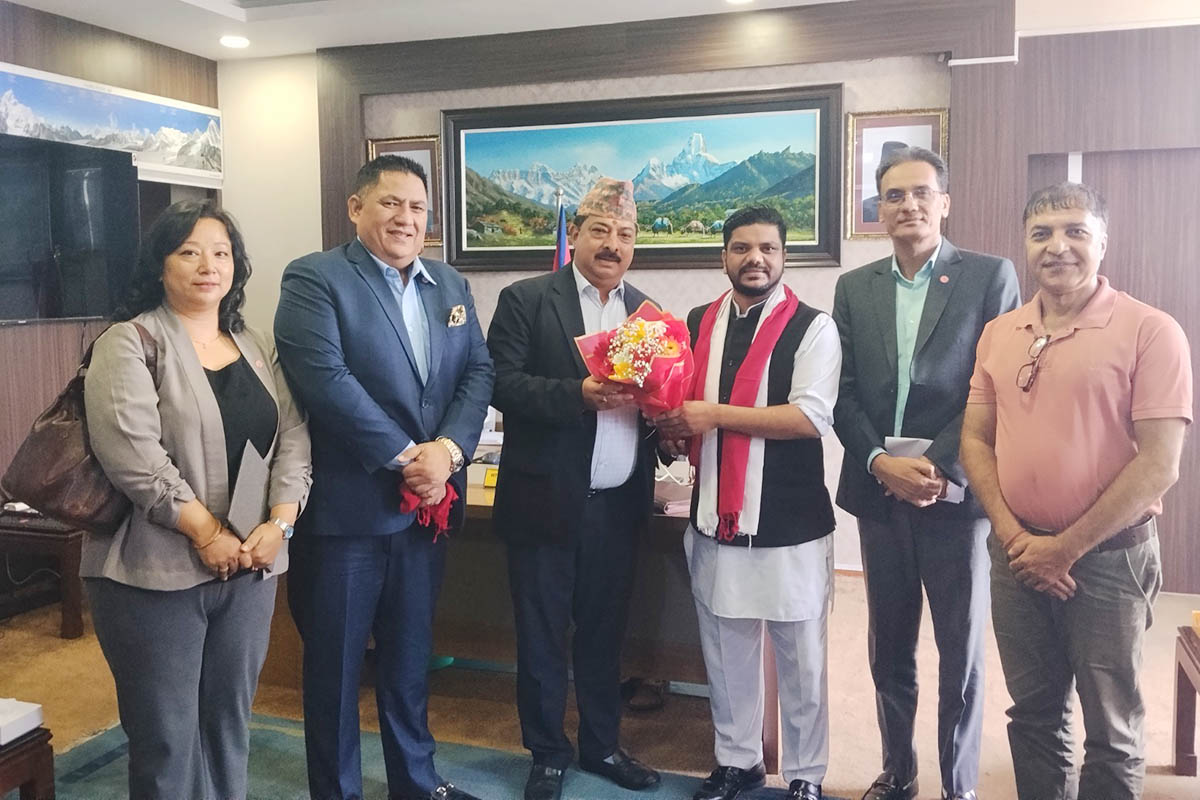
KATHMANDU: Federation of Nepalese Chambers of Commerce and Industry (FNCCI) has urged the government to ensure that upcoming amendments to the labour law are employment- and industrial investment-friendly, following a meeting with the labour minister.
A delegation led by FNCCI President Anjan Shrestha met Minister for Youth, Labour and Employment Ramjee Yadav on Friday to discuss legal reforms, promotion of domestic employment and industrial relations. The federation said the legislation should remain balanced and practical, encouraging job creation while safeguarding workers’ rights and social security.
The FNCCI delegation argued that changes to the labour law must align with the evolving labour market, industrial requirements and the broader economic transformation of the country. Highlighting the government’s transition efforts, President Shrestha said legal reforms must connect with the nation’s long-term economic needs.
"Maximising the current demographic dividend that Nepal has achieved, the issue of what the country's employment situation should be like in the next 10 years must be looked at along with the labour law amendment," President Shrestha said, "Since the government has set a target of building a $100 billion economy in the coming decade, the labour law must be made investment- and employment-friendly to encourage the necessary industrial investment, production expansion and job creation for that purpose."
In response, Minister Yadav said the ministry was in the initial phase of amending the Labour Act and indicated that, once preliminary work concluded, consultations with relevant stakeholders would proceed. He asked FNCCI to conduct parallel studies and preparations and said formal discussions will be held shortly.
President Shrestha urged that the practical experience of private sector be incorporated into the reforms, adding, "The amendment of the labour law should not merely be seen as a legal reform, but should be advanced as an economic reform linked with industrial investment, production, productivity, job creation and the long-term transformation of the labour market."
On pending parliamentary legislation on the prohibition and regulation of child labour, the FNCCI reiterated its commitment to eradicating the practice and said compliance, investigation and penalty provisions must be practical and implementable. FNCCI also emphasised the need to enforce the concept of one enterprise, one official trade union to promote stability, dialogue and productivity.
Minister Yadav highlighted the need for serious discussions on the platform economy and instructed the relevant committee to gather suggestions from employers and trade union representatives who attended the 114th International Labour Conference. FNCCI central member Juna Mathema pointed to the large number of Nepalis in the platform economy and urged legal provisions to clarify their rights and social security.
On domestic employment, President Shrestha called for a clear structure for collaboration between the government and private sector, noting a mismatch between industry needs and jobseekers and urging a demand-driven labour market with tailored skills development and training.
FNCCI Employers’ Council Chairperson Prabal Jung Pandey said an effective mechanism was necessary to test and certify the skills of returning migrant workers and that reskilling programmes for domestic workers should be advanced in collaboration with industry.
Employers’ Council Vice Chairperson Babu Kaji Karki said the recent minimum wage determination process was scientific and suggested developing a system based on regular dialogue and preparation to avoid the tensions that typically arise every two years. The delegation also raised the need for digitisation of labour administration, practical reforms to the social security system and more effective tripartite dialogue among the government, employers and workers.