PM Shah proposes Himalayan climate resilience mechanism among Nepal, India, China at UNGA

-1790314447.jpg)
KATHMANDU: Prime Minister Balendra Shah has proposed the establishment of a Himalayan Climate Resilience Mechanism among Nepal, India, and China.
During his address to the 81st Session of the United Nations General Assembly today, he argued that the Hindu Kush Himalayan region is linked to the water, ecosystems, agriculture, and livelihoods of about two billion people, adding that the region is an important part of the Earth's life system.
He stated that through the proposed mechanism, satellite data and expertise will be shared, at-risk glaciers will be monitored, a joint early warning system will be strengthened, and cross-border assistance will be co-ordinated during disasters.
Prime Minister Shah emphasised that the Himalayas should be turned into a laboratory for international cooperation rather than just a boundary of fragmented information.
-1790314448.jpg "Prime-Minister-Balendra-Shah,-81st-session-of-UNGA-(6)-1790314448.jpg")
-1790314447.jpg "Prime-Minister-Balendra-Shah,-81st-session-of-UNGA-(4)-1790314447.jpg")
-1790314447.jpg "Prime-Minister-Balendra-Shah,-81st-session-of-UNGA-(5)-1790314447.jpg")
Highlighting that Nepal is playing a global role beyond its ecological contribution, he informed the assembly that forests have been restored in nearly half of Nepal's land area.
The prime minister also shared that hydropower development is progressing to meet the need for clean energy, the use of electric vehicles is increasing, and climate adaptation is being strengthened at the local level.
Shah also expressed Nepal's commitment to making even more preparations to tackle the increasing disasters.
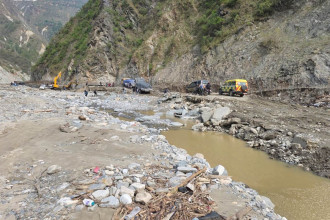
He said the flood disaster that devastatingly struck Nepal's Himalayan region a month ago is not just a tragedy limited to Nepal but a warning for the world.
(With inputs from RSS)


-1788413019.jpg)