
Nepal’s Trillion-Rupee Hydropower Bet Faces A Climate Test

-1792068242.jpg)
For two decades, Nepal has treated hydropower as more than an energy source. It has been an economic strategy.
Private capital, foreign direct investment and aggressive bank financing have helped turn the country from a power-deficit economy into a net electricity exporter. In FY 2025/26 alone, Nepal earned Rs 29.32 billion from electricity exports to India and Bangladesh, according to the Ministry of Energy, Water Resources and Irrigation.
Today, more than 347 hydropower projects with a combined capacity of 7,251 MW are either operating or under construction. Of these, 2,948 MW are operational and another 4,303 MW are being built.
The capital behind that expansion is equally significant. Independent power producers have invested approximately Rs 1,243.99 billion through equity and debt, with around 67.5% reportedly financed by banks and financial institutions.
Nepal’s banks, investors and policymakers have, in effect, made a sizeable collective bet on water. The catastrophic flood of August 26 has now forced a reassessment of the risks attached to that bet.
The Bhotekoshi-Trishuli corridor across Rasuwa and Nuwakot was one of Nepal’s increasingly important economic arteries. Hydropower projects sat alongside cross-border trade infrastructure, tourism businesses and routes used by trekkers travelling towards Langtang National Park and pilgrims heading to Gosaikunda and Lake Mansarovar.
The flood disrupted much of that ecosystem. For the energy industry in particular, the consequences could extend well beyond the physical destruction of individual projects.
With more than Rs 1.2 trillion invested in operational and under-construction hydropower projects, Nepal has built its energy ambitions around its rivers. The August 26 disaster has exposed a harder question: how resilient is that investment to a rapidly changing Himalayan risk landscape?
A Sector Built on Confidence
Nepal’s hydropower boom did not happen by accident. Government policy helped create a market for privately generated electricity through Power Purchase Agreements with Nepal Electricity Authority, the country’s principal power off-taker. Reforms to the Electricity Act in the 1990s helped strengthen investor confidence.
Nepal Rastra Bank subsequently directed financial-sector resources towards priority sectors, including hydropower. When the policy was initially introduced about a decade ago, banks were encouraged to allocate a combined 10% of their credit portfolio to hydropower and agriculture.
The result has been a powerful alignment of government policy, private developers and financial institutions behind hydropower development.
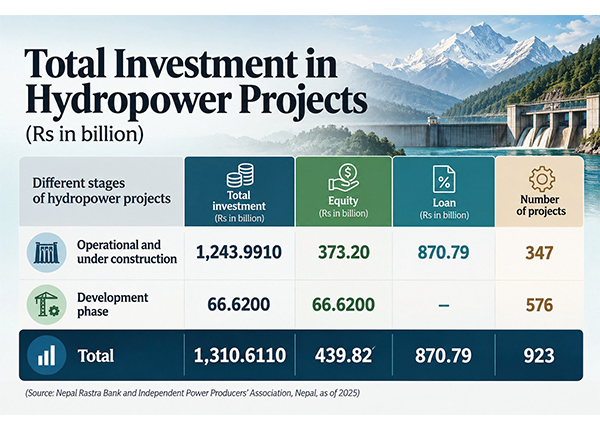
According to figures from Nepal Rastra Bank and the Independent Power Producers’ Association, Nepal (IPPAN), investment in operational and under-construction projects totals approximately Rs 1,243.99 billion: Rs 373.20 billion in equity and Rs 870.79 billion in loans.
A further Rs 66.62 billion has been invested as equity in 576 projects in the development phase, taking investment across 923 projects to approximately Rs 1,310.61 billion.
That scale of exposure makes climate resilience not simply an environmental issue, but a financial one.
Rethinking Resilience
The August flood arrives at an awkward moment for Nepal’s power ambitions. The government has laid out a roadmap to generate 28,500 MW by 2035. The question now is not whether Nepal should continue developing hydropower, but how the country protects the enormous amount of capital being committed to it.
Mohan Kumar Dangi, President of IPPAN, argues that diversification is necessary but warns against allowing disaster risk to derail hydropower development. “Disasters are inevitable. We must be prepared to build resilience but that does not mean we should abandon everything by exaggerating risk factors,” he says.
Manoj Gyawali, CEO of Nabil Bank, makes a similar case from the financial sector’s perspective. Banks, he says, generally avoid financing multiple hydropower projects within the same river basin precisely to limit concentration risk. “A disaster may hit a specific basin or project but that does not mean we should halt all ongoing efforts and reinvent the wheel,” says Gyawali. “We must harness our hydropower potential to the fullest.”
Diversification, however, is increasingly becoming part of the equation.
Nepal can supplement conventional hydropower through pumped-storage projects and grid-connected solar, while green hydrogen represents a potential longer-term opportunity. Green hydrogen uses clean electricity to power electrolysis, separating hydrogen from water and creating a potentially storable clean-energy source.
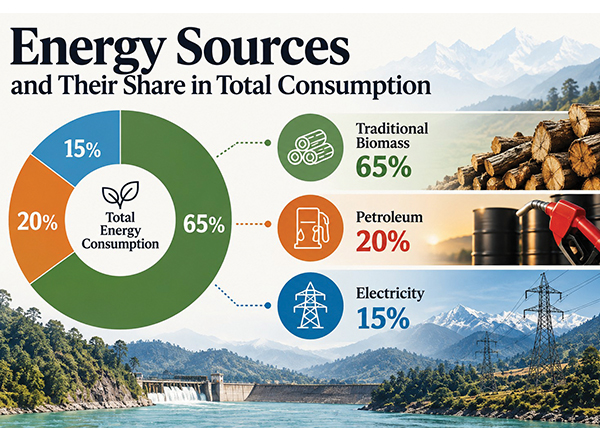
The larger challenge is that electricity itself still accounts for a relatively small share of Nepal’s total energy consumption. Traditional biomass represents around 65%, petroleum 20% and electricity only 15%.
Nepal therefore faces two interconnected challenges: expanding electricity production while simultaneously increasing domestic consumption and maintaining commercially viable export markets.
431 MW Offline
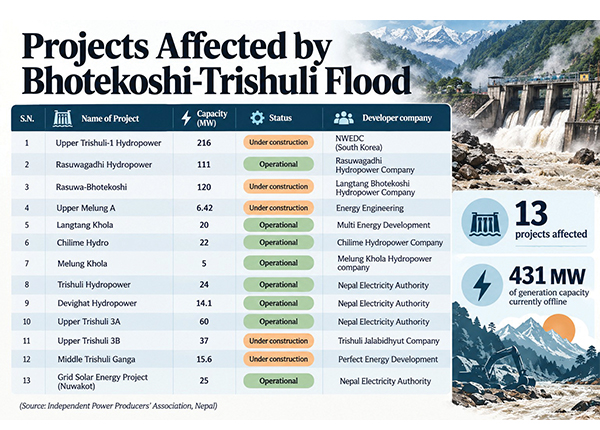
The immediate challenge is considerably more urgent. According to Dangi, approximately 431 MW of generation capacity remains offline following the flood. Of this, around 155 MW is unavailable primarily because transmission infrastructure was damaged. Restoring those transmission lines could therefore return significant generation capacity to the grid relatively quickly, including power associated with the 78 MW Sanjen Khola Hydropower Project.
Projects affected across the Bhotekoshi-Trishuli corridor include the 216 MW Upper Trishuli-1 project, the 111 MW Rasuwagadhi Hydropower Project, 120 MW Rasuwa-Bhotekoshi, 22 MW Chilime Hydro, 60 MW Upper Trishuli 3A and several smaller operational and under-construction projects.
The damage therefore raises a broader infrastructure question. Building generation capacity is only one part of energy security. Transmission infrastructure - and the ability to restore it rapidly after a disaster - is equally critical.
The Winter Risk
That vulnerability could become particularly visible during winter.
Nepal’s peak winter electricity demand reached approximately 1,650 MW last year. With 431 MW currently offline, prolonged disruption could put significant pressure on supply.
“Importing more electricity from India and quickly rehabilitating the transmission infrastructure swept away by the flood is essential,” says Dangi.
The complication is regulatory. Restoring transmission lines can require forest right-of-way approvals, and industry representatives argue that existing clearance procedures could delay reconstruction.
That bureaucratic bottleneck could have consequences beyond the electricity sector. Reliable power supply is critical for households and industry alike, while shortages of cooking gas can further increase dependence on electricity during periods of constrained fuel supply.
If the 155 MW currently stranded primarily because of transmission damage can be restored quickly, the outlook improves. Around 200 MW from new hydropower projects in other river basins is also expected to enter the system over the coming months, potentially offsetting some of the capacity lost to damaged projects.
In the interim, Nepal may need to increase electricity imports from India to maintain supply.
The Financial Cost Is Only Beginning to Emerge
The full financial impact of the disaster is still being calculated.
Insurance companies initially struggled to deploy surveyors to damaged hydropower sites because roads had been severed and terrain remained swampy and unstable. Assessments require physical access; helicopter observation alone is insufficient.
Search and rescue operations also extended into hydropower tunnels.
“In the final phase, rescue teams focused on the hydropower tunnels, and as of September 3, the clearance of all affected hydropower tunnels has been completed,” said Brigadier General Rajaram Basnet, Spokesperson for the Nepal Army.
The preliminary numbers are substantial. According to the Rapid Loss and Damage Assessment by the National Disaster Risk Reduction and Management Authority, hydropower represents Rs 11,995.56 crores, or 89.1% of assessed damage within the energy sector, which includes hydropower plants, transmission lines and solar facilities.
The assessment puts recovery needs at Rs 39,062.30 crores ($2,578.71 million), including Rs 105 crores for early recovery.
But direct reconstruction costs may be only the first layer of the economic impact.
The Price of Risk
The more consequential question for investors is what happens to the cost of capital.
As lenders, insurers and investors reassess exposure to Himalayan hazards, hydropower projects could face higher insurance premiums, more demanding environmental, social and governance requirements, tougher lending conditions and greater scrutiny of project design and location.
Those costs ultimately feed into project economics.
Higher financing and insurance expenses can lower internal rates of return. Increased perceptions of risk could also affect retail investor appetite for shares issued by hydropower companies, a financing model that has attracted substantial participation in Nepal’s capital market.
For banks, meanwhile, the issue extends beyond individual damaged projects. With roughly Rs 870.79 billion in loans already committed to operational and under-construction hydropower projects, resilience is increasingly a matter of financial-sector risk management.
Climate adaptation therefore needs to move from the margins of project planning to the centre of investment decisions. That could mean more sophisticated basin-level risk modelling, stronger engineering standards, diversified generation portfolios, resilient transmission networks, improved insurance structures and faster regulatory mechanisms for rebuilding critical infrastructure.
It could also mean reconsidering how Nepal defines energy security.
Hydropower will almost certainly remain central to the country’s economic future. Nepal possesses the resource, has already developed significant institutional and private-sector expertise, and increasingly has access to regional electricity markets.
But the August disaster has exposed the danger of equating generating capacity with energy security. A resilient energy system depends not simply on how many megawatts Nepal can build, but on whether its power plants, transmission networks, financing structures and regulatory institutions can withstand the shocks that come with operating in one of the world’s most fragile mountain environments.
Nepal’s next phase of hydropower development, therefore, may need a different measure of success.
Not simply how much power can the country generate? But how much of it can remain secure when the mountains change?


-1789290954.jpg)
-1786437470.jpg)