
beed’s take on the market: August 21 to September 18

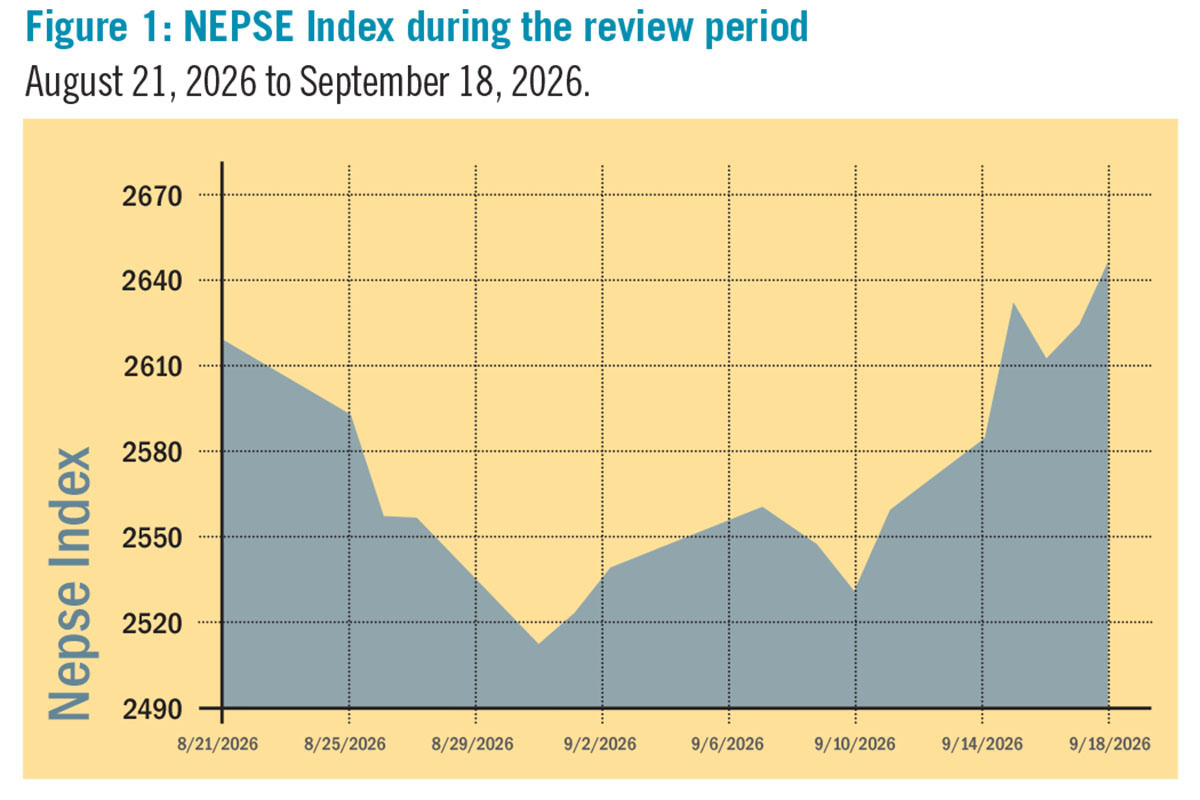
The Nepal Stock Exchange (NEPSE) index gained 28.50 points, or 1.09%, during the review period from August 21 to September 18, closing at 2,647.22. The market began the period under pressure, with the index falling to an intraday low of 2,501.49 on September 1 before staging a recovery and reaching an intraday high of 2,679.90 on September 15.
Despite the late rebound, trading activity remained subdued. Market turnover fell 10.64% to Rs 75.88 billion, reversing the 6.02% increase recorded in the previous review period. The combination of a modest index gain and weaker turnover suggests investor sentiment remained cautious through much of the period, with confidence showing signs of recovery only towards the close. (see Figure 1)
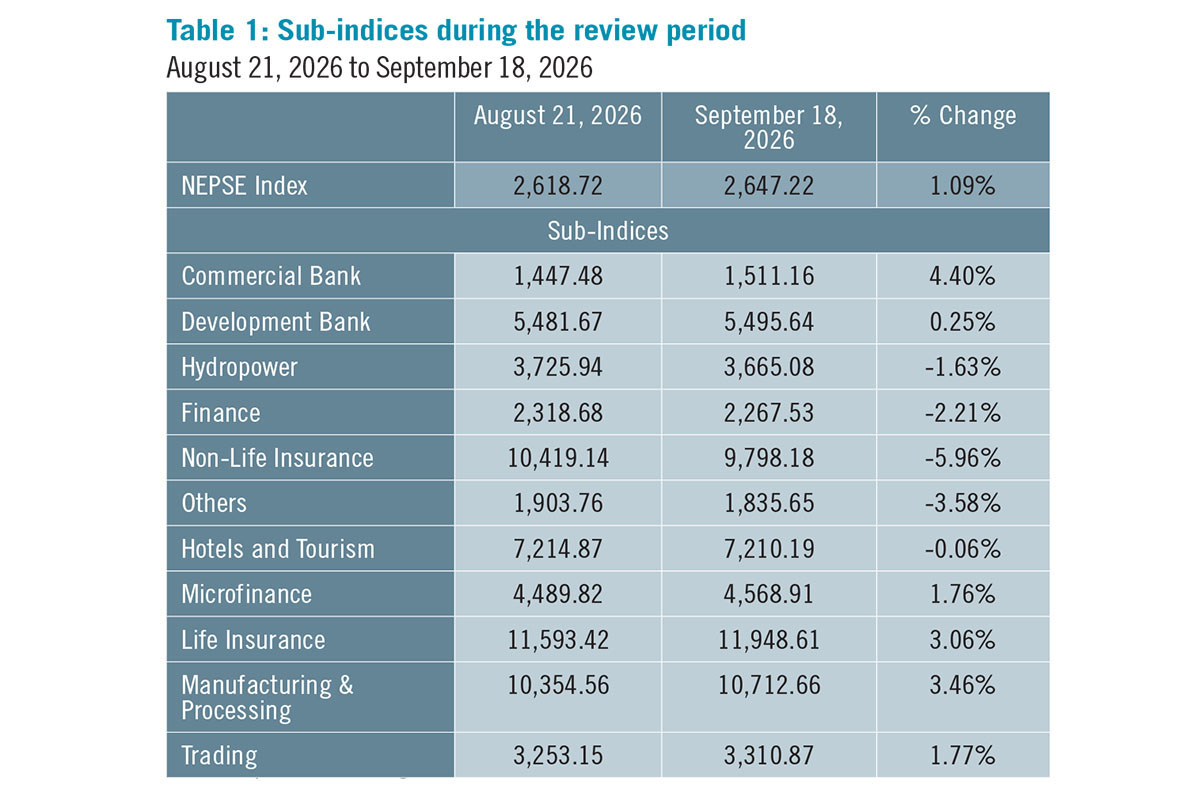
Six of the 11 sub-indices ended the review period higher, while five declined. Commercial Banks, Manufacturing and Processing, and Life Insurance led the gains, while Non-Life Insurance, Others and Finance recorded the sharpest losses.
The Commercial Bank sub-index emerged as the strongest performer, rising 4.40%, supported by gains in Siddhartha Bank (+Rs 33.9), Laxmi Sunrise Bank (+Rs 26.4) and Nepal Bank (+Rs 19.7).
Manufacturing and Processing followed with a 3.46% gain, led by Bottlers Nepal (Terai) (+Rs 700), recently listed Sarvottam Paints Industry (+Rs 589.4) and Sagar Distillery (+Rs 76.9). Life Insurance advanced 3.06%, driven by Life Insurance Corporation (Nepal) (+Rs 43), National Life Insurance (+Rs 20), and Nepal Life Insurance and Sun Nepal Life Insurance (+Rs 18 each).
Trading gained 1.77%, supported by Salt Trading Corporation (+Rs 466) and Bishal Bazar Company (+Rs 40), while Microfinance rose 1.76%, led by Infinity Laghubitta Bittiya Sanstha (+Rs 206.2), Dhaulagiri Laghubitta Bittiya Sanstha (+Rs 157) and Asha Laghubitta Bittiya Sanstha (+Rs 111).
Development Banks posted a marginal 0.25% gain, with Garima Bikas Bank (+Rs 33.2), Green Development Bank (+Rs 32) and Shine Resunga Development Bank (+Rs 21) among the notable gainers. Hotels and Tourism, meanwhile, slipped 0.06%, weighed down by Kalinchowk Darshan (-Rs 145.7), Hotel Forest Inn (-Rs 31) and Bandipur Cablecar and Tourism (-Rs 22.90).
Losses were more pronounced elsewhere. Hydropower fell 1.63%, with Ridge Line Energy (-Rs 161), Trishuli Jal Vidhyut Company (-Rs 142.1) and Chilime Hydropower (-Rs 114.7) posting the largest declines.
Finance dropped 2.21%, dragged lower by Janaki Finance Company (-Rs 90), Nepal Finance (-Rs 46.1) and Central Finance (-Rs 19). The Others sub-index declined 3.58%, led by losses in Nepal Reinsurance Company (-Rs 69.1), Himalayan Reinsurance (-Rs 45) and Muktinath Krishi Company (-Rs 41).
Non-Life Insurance was the period’s weakest performer, falling 5.96%, with all 13 listed non-life insurers closing lower. Rastriya Beema Company (-Rs 394.8), Neco Insurance (-Rs 57) and Sanima GIC Insurance (-Rs 51.1) recorded the steepest declines. (see Table 1)
News and Highlights
Two developments dominated the review period: the August 26 Bhotekoshi floods, which disrupted hydropower projects and triggered concerns over insurance exposure, and a series of September policy measures aimed at reviving Nepal’s capital market.
The Bhotekoshi River flooded parts of Rasuwa, Nuwakot and Dhading districts on August 26, damaging roads, bridges and around a dozen hydropower projects and related facilities. Listed companies affected included Rasuwagadhi Hydropower, Chilime Hydropower, Mailung Khola Hydropower and Trishuli 3B Hydropower. The disaster triggered a sharp sell-off in hydropower stocks and spilled over into insurance and reinsurance shares as investors anticipated potentially large claims, even where companies had suffered no direct physical damage.
The government moved to contain the economic fallout on September 3, approving the first phase of a recovery package for flood-affected businesses. Measures included customs duty exemptions on replacement vehicles, machinery and equipment, as well as duty waivers on replacement goods where taxes had already been paid but shipments were destroyed in transit, provided replacements arrive within six months. Affected businesses were also given until November 11, 2026, to file and settle tax obligations otherwise due in September and October, alongside relief on Value Added Tax (VAT), depreciation and income tax. Individuals directly affected by the floods received a full income tax exemption for FY 2025/26.
Financial relief extended to borrowers. Nepal Rastra Bank (NRB) was directed to allow banks to restructure or reschedule repayments for flood-affected clients, with interest capped at the base rate plus 0.5 percentage point for one year. Banks were also permitted to finance replacement vehicles, transport equipment and machinery damaged in the floods, subject to damage assessments and insurance compensation. The Insurance Authority, meanwhile, was directed to accelerate claims settlement, with insurers required to advance up to 50% of assessed losses to policyholders and reinsurers required to provide similar advances to insurers.
Capital-market reform became the second major theme of the period. On September 14, the Ministry of Finance unveiled its 21-point Capital Market Strengthening and Revival Action Plan, 2026, against the backdrop of prolonged economic weakness and the additional disruption caused by the floods.
The plan calls on the Securities Board of Nepal (SEBON) to immediately ease Initial Public Offering (IPO) eligibility requirements and introduce sector-specific listing rules by mid-January 2027. A new benchmark index, alongside the existing all-equity NEPSE index, is targeted for mid-December 2026. The roadmap also opens the door to margin lending, intraday trading and short selling, with broker-based margin trading targeted for mid-January 2027. Other measures seek to open the secondary market to non-resident Nepalis, expand participation by pension and insurance funds, and reduce the minimum holding period to 45 days.
Tax policy also shifted. The action plan reverses the FY 2026/27 increase in capital gains tax, restoring rates to 3.75% for securities held for more than 365 days and 5% for shorter-term holdings, with tax applicable only to net gains. The announcements were followed by a marked rise in both the NEPSE index and market turnover.
Implementation began quickly. On September 18, SEBON published its draft Public Offering General Eligibility Guidelines, 2026, seeking public feedback within seven days. The draft establishes general and financial eligibility criteria, corporate governance requirements, and qualification standards for promoters, directors and management of companies seeking to go public. It also addresses prospectus disclosures, due diligence, the use and monitoring of IPO proceeds, and post-issue obligations, while proposing a risk-based framework tailored to different industries.
Meanwhile, the IPO pipeline continued to expand. During the review period, SEBON added three companies: Saurya Krishi Company, which plans to raise Rs 20 crore with NIC Asia Capital as issue manager; Nexgen Management and Equity Solutions, seeking Rs 12.50 crore with Laxmi Sunrise Capital; and Baidik Investment Company, which intends to raise Rs 28.35 crore with Muktinath Capital.
Outlook
The near-term outlook for hydropower and non-life insurance remains uncertain, with damage assessments, insurance claims and reconstruction costs yet to be finalised. Until greater clarity emerges, stocks in both sectors are likely to remain sensitive to developments related to the Bhotekoshi floods.
Beyond the immediate disruption, the reduction in capital gains tax and the broader reform agenda address several long-standing concerns among investors. The bigger test, however, will be execution. Most measures are scheduled for implementation between October 2026 and March 2027, while previous reform commitments have often been slow to translate into action.
The durability of the market’s recovery will therefore depend less on policy announcements than on delivery - how quickly reforms are implemented, whether trading activity continues to strengthen, and whether institutional participation deepens. For now, execution remains the key variable.
This analysis has been prepared by beed Management Pvt. Ltd. No express or implied warranty is made as to the accuracy, completeness or usefulness of the information contained herein. beed Management Pvt. Ltd. accepts no liability for any loss or consequence arising from actions taken in reliance on this analysis.

-1789367956.jpg)
-1784800098.jpg)
-1782731467.jpg)