
NICCI holds 32nd AGM, forms new executive committee under leadership of Kunal Kayal

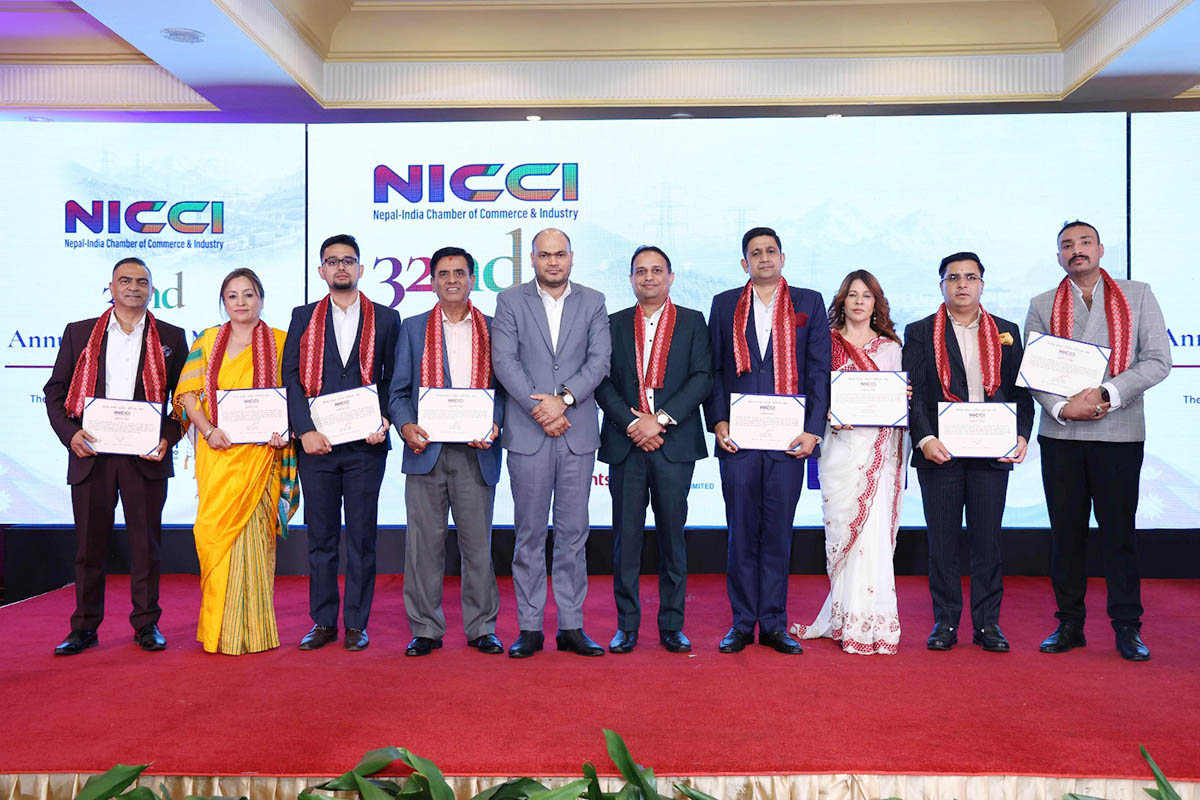
KATHMANDU: Kunal Kayal has been elected president of Nepal-India Chamber of Commerce and Industry (NICCI).
The 32nd annual general meeting (AGM) of NICCI, held in Kathmandu on Thursday, also elected a new executive committee for the 2026-2028 term.
Kayal, who has served as vice president under outgoing president Sunil KC and as treasurer during Shreejana Rana’s tenure, accepted the presidential plaque and delivered his first address as president-elect. At the initial executive committee meeting, he nominated senior office-bearers, forming a leadership team drawn from power, manufacturing, education, telecommunications, and trade.
The new executive includes vice presidents Karan Kumar Chaudhary and Gaurav Tayal, Secretary General Barnan Lamichhane, and Treasurer Shailaja Adhikary. Executive members include Sanjay Agrawal, Ramesh Sharma, Shailendra Guragain, Shashi Kant Agrawal, Susan Karmacharya, Binaya Upadhyay, Ashik Shrestha, and Chandra Tandon.
Minister for Foreign Affairs Shisir Khanal attended the inaugural session of the AGM as chief guest. Addressing the event, he said NICCI is a cornerstone of bilateral economic relations and a strategic institutional partner to the ministry. He highlighted deep people-to-people ties and an economy driven by investment and production aimed at shared prosperity.
The chamber launched two publications at the meeting: NICCI’s '3 Decades Chronicle Book' and the fourth edition (2026) of its investment handbook, 'A Handbook for Indian Investors-Investing in Nepal'.
Outgoing President Sunil KC, in his welcome remarks, urged proper institution-building alongside a joint Nepal-India economic arrangement anchored in private enterprise and economic diplomacy. He noted ongoing investor engagement and collaborative initiatives with the Embassy of India, including educational projects linked to IIT Madras and INSPAN. "Institutions must be greater than those who run them," KC said.
Keynote speaker Professor Amitabh Mattoo, dean of the School of International Studies at Jawaharlal Nehru University, set out the core architecture of bilateral ties, warned that Nepal is affected by policy choices in Delhi, and proposed five pillars for engagement. He called for a shift from a 'land locked to land linked' outlook.
Other speakers included Dr Shankar Prasad Sharma, former ambassador of Nepal to India, and Anjan Shrestha, president of the Federation of Nepalese Chambers of Commerce and Industry (FNCCI), who urged stronger investment flows and enhanced public-private dialogue.
Member of Parliament Vidushi Rana highlighted Nepal’s green advantage and urged greater joint ventures and private sector participation. Dr Rakesh Pandey, chargé d’affaires at the Embassy of India in Kathmandu, attended as guest of honour.
Kayal’s administration will focus on investor confidence, an investment framework, energy cooperation, and consultative governance under the theme 'Expanding Economic Frontiers: Catalysing Bilateral Trade, Investment and Energy Transition' for 2026-2028. The assembly presented tokens of appreciation to Outgoing President KC and Director General KM Singh.

-1792081120.jpeg)