
CNI urges public, private sector cooperation as Budget Watch finds weak implementation of budget

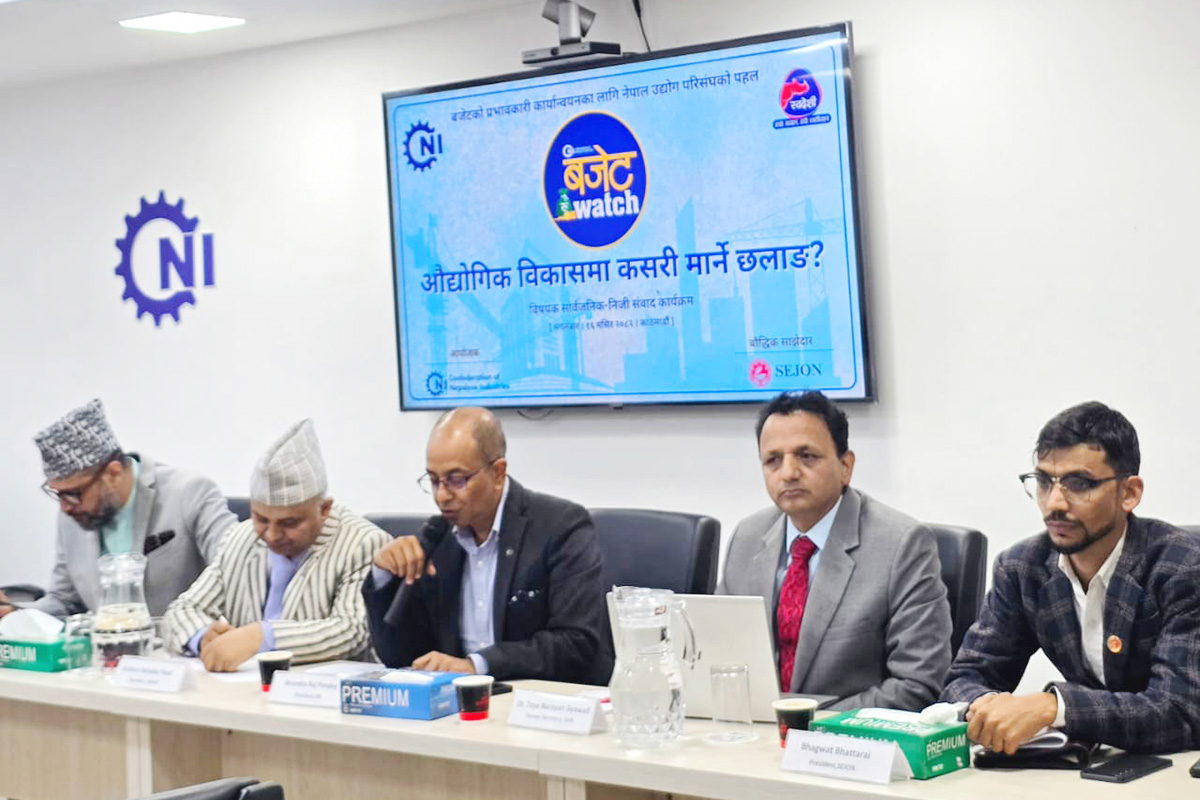
KATHMANDU: Confederation of Nepalese Industries (CNI) on Tuesday held a public‑private dialogue titled “How to leap forward in industrial development?”. At the event, CNI released a Budget Watch assessing implementation of the fiscal year 2025/26 budget in its first quarter.
At the programme, CNI President Birendra Raj Pandey urged stronger cooperation between the public and private sectors to ensure effective budget implementation and to prioritise industrial development to build a self‑reliant economy.
“The government’s fiscal policy is most important for the development of the overall economy. Other policies must become supportive to achieve the goals specified by the fiscal policy, meaning the budget,” Pandey said in welcome remarks at the event, noting that while many of CNI’s policy suggestions are included in the budget, implementation often falls short. “We have been providing policy suggestions on behalf of the private sector in the budget. Our policy suggestions are also included in the budget. That gives us enthusiasm. But when the implementation phase comes, budget implementation is very weak, which makes us disappointed.”
Pandey urged policymakers to study how comparable economies advanced and to ensure stable policies that protect and encourage manufacturing. “If policies are stable, manufacturing industries are protected, and the establishment of industries is encouraged, we can also move ahead in a short time through industrialisation,” he said.
The Budget Watch finds implementation of the budget for fiscal year 2025/26 weak in its first quarter. The report shows just 2.7% of 74 monitored measures were fully implemented, and more than half showed no progress.
The CNI monitored 74 budget points related to the private sector and the economy and reported that 51% (38 points) showed zero progress, 46% (34 points) showed partial implementation, and only 2.4% (two points) were fully implemented. The organisation described overall progress for the first quarter as weak.
The report compares the current quarter with the previous fiscal year, showing a slight improvement in zero‑progress items from 57% last year to 51% this year, while partial implementation rose from 38% to 46% and full implementation fell from 4.8% to 2.7%.
Sectoral analysis shows the industry sector carries the most weight, with 27 monitored points: 17 at zero progress, nine partially implemented, and one fully implemented. Other sectors monitored include energy, infrastructure and urban development (14 points), tourism (9), the financial sector (8), agriculture and herbs (7), IT and innovation (6), and education and jobs (3).
Key findings of the Budget Watch include stalled measures on industrial development and investment such as implementation of reduced industrial zone rents, amendments to land ceilings to allow industries and housing companies to buy land beyond existing limits, laws permitting foreign investors to lease buildings or apartments, provisions allowing 25% of export income to be invested abroad, and legal provisions on sweat equity for startups. Partial progress was recorded on the draft Company Bill 2082, a reduction in Special Economic Zone rent, and implementation of the Use of Domestic Goods directive 2081.
On fiscal and monetary matters, the report records zero progress on amending working capital loan guidelines to make them more flexible for industries. It notes full implementation of the Trusted Traders (Authorised Economic Operator) procedure 2082 and the start of its application process, and partial progress on automated customs valuation in Biratnagar and Birgunj. The CNI also flagged no study on multi‑rate VAT and no progress on data exchange with India to curb revenue leakage.
Infrastructure projects have also been affected, the report says, with construction of Integrated Check Posts stalled — attributed to recent floods and the Gen‑Z protests — while the procedure for blending bio‑ethanol in petrol has been sent to the Cabinet.
CNI attributes the weak performance to several factors, including the Gen‑Z movement, the formation of a new government with a different mandate and priorities, budget cuts for projects that were unprepared or low priority, confusion over certain programmes and the impact of recent floods.
The Budget Watch is a public‑private dialogue conducted by CNI in collaboration with the Society of Economic Journalists — Nepal (SEJON). CNI said it monitored 74 budget points specifically related to the private sector and offered to provide the detailed list of the 27 industrial points and their individual status on request.



-1789136854.jpg)