FROM PERSONAL HEALING TO PUBLIC IMPACT


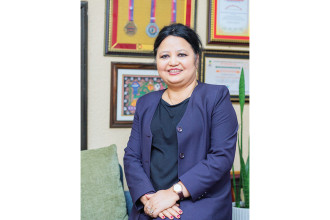
Shreeya Giri, Founder & Managing Director, Happy Minds
Shreeya Giri, Founder and Managing Director of Happy Minds, emerged into the public spotlight as a leading social entrepreneur and mental-health advocate after being recognised by Forbes. While the sudden attention was overwhelming at first, it soon transformed into a shared celebration—one she embraced as a collective victory when she saw people around her rejoicing in the recognition.
Born into a family engaged in the pashmina business, Giri was exposed to entrepreneurship early on. A distinction holder, she studied in London and gained professional experience across diverse sectors, including a US pharmaceutical company, the UK government, and market research projects for companies such as Vodafone. These experiences taught her a defining lesson that continues to shape her confidence and outlook: never take rejection personally.
She pursued a Master’s degree in International Business, with Project Management as her minor. During her studies, she was involved in a joint project with Google and Facebook, proudly referring to herself as a “pandemic graduate.” However, the pandemic also took a toll on her mental health. Feeling increasingly disconnected from home, she returned to Nepal in December 2020. Financial pressures, disrupted timelines, and the subtle experience of being treated as a “non-first-class citizen” abroad reinforced her decision.
Today, Giri has been running Happy Minds for over four and a half years. Mental health remains deeply stigmatised in Nepal, and the idea for Happy Minds first took shape during her own therapy sessions. Two of her mentors, Sara Hajikazemi and Sara Bennette, helped her build the organisation’s foundational structure, modelled on systems she had observed in London. As demand grew, the organisation expanded organically.
Despite having no formal academic training in psychology, Giri relied on her lived experiences and strong project-management skills to build Happy Minds. She asked her parents for two years to prove herself—promising that if she failed, she would return to London and resume her former life. She describes this period as one of “borrowed trust.”
In this edition of Business 360, Giri reflects on five influences that have shaped her life and work.
Establishing Happy Minds
Establishing Happy Minds remains one of my biggest milestones. Even the name itself feels free of stigma, people don’t immediately associate it with a clinic or hospital. How we structured the organisation and how people emotionally respond to it has been central to its success. Sometimes, even while casually meeting young people at social gatherings, they tell us about their sessions and how positively they feel about them.
Breaking the stigma around therapy - seeking help, talking about depression, anxiety, or mental health in general - has always been my goal. Many assume that being featured in Forbes is my proudest achievement, but for me, it is the establishment of our hotline services.
Happy Minds is the only private mental-health company in Nepal that operates dedicated 24/7 hotline services for corporate partners and their employees, including family members. Corporate work - especially in departments like sales - often involves constant travel, pressure, and isolation, which can severely affect mental wellbeing. Our hotline not only provides immediate support but also ensures consistent follow-ups.
During the Gen Z protests, we even opened this hotline to the public for several weeks. Having a private hotline service that we can truly call our own remains one of my greatest achievements.
My Team
When I returned to Nepal, I was alone. Through Happy Minds, I found not just colleagues but some of the closest friendships of my life. From sharing secrets to seeking advice and simply spending time together, my team has become my extended family.
Working with psychologists has its own beauty, everyone understands boundaries. This mutual respect creates a sense of psychological safety, where people are encouraged to speak up rather than be “yes-men.” My team is young, energetic, and loves to travel. We are fun-loving people who value honesty, balance, and emotional wellbeing.
My Grandfather
Pokhara is home. Every Dashain, my parents, brother, and I would travel there to visit my grandparents. My grandfather would wait for us in the garden. We would admire the mountains, eat panipuri, and soak in the joy of togetherness.
An air-traffic controller by profession, my grandfather had travelled to 25-30 countries. We loved looking at his black-and-white photographs and listening to his stories - often narrated in English - about Fiji, New Zealand, and other parts of the world. Sometimes, he would fall asleep mid-story, already in his seventies.
He strongly believed education was the most powerful tool to uplift lives and insisted that global exposure was essential. Though he passed away when I was still young, he left a lasting imprint on me, teaching me how to stay rooted in my local identity while remaining connected to the world.
The One Young World Summit
Attending the One Young World Summit had long been on my bucket list. After applying for four consecutive years, I was finally selected and attended the summit in Germany this year, an item proudly checked off my 2025 agenda.
Each year, over 2,000 social entrepreneurs from around the world gather at the summit. Global leaders, donors, policymakers, CEOs of multibillion-dollar companies like Chanel, Dior, BMW, and Google, as well as Hollywood figures, made themselves accessible to us.
In Nepal, despite acknowledging the importance of mental-health work, many hesitate to invest. At the summit, receiving validation from global leaders, engaging in one-on-one coaching sessions with representatives from the Netherlands government, and having honest conversations about funding decisions was deeply enlightening.
Spending a week among 2,000 people with shared values and experiences renewed my motivation. I returned with fresh clarity, strategic focus, and the conviction that real change comes from action not just conversations on social media or podcasts. The experience taught me to balance wellness, work and life more intentionally.
Making a Difference
One experience with a client remains especially close to my heart. A mother once came to our office and greeted me as though we already knew each other. She had read my Forbes story and sought out Happy Minds for her 17-year-old son.
She told me, “My son wants to go to Australia because of you.” Initially, this worried me. But as she shared her story, the meaning became clear. Her son had struggled with addiction and self-harm. Covered in cuts and bruises, he had lost the will to live and was confined to his home.
After consulting multiple psychiatrists with little success, he finally began therapy at Happy Minds and was assigned a young male counsellor. Slowly, he began to heal. Today, he composes music, plays guitar at cafés, and dreams of pursuing his Master’s degree in Australia. It has been two years since he started therapy.Every time I see him in the waiting room, my eyes fill with tears. A mother’s resilience and a child’s recovery; these moments remind me why Happy Minds exists.