From Dang to Space Research: Jyoti KC’s Journey of Service, Resilience and Purpose

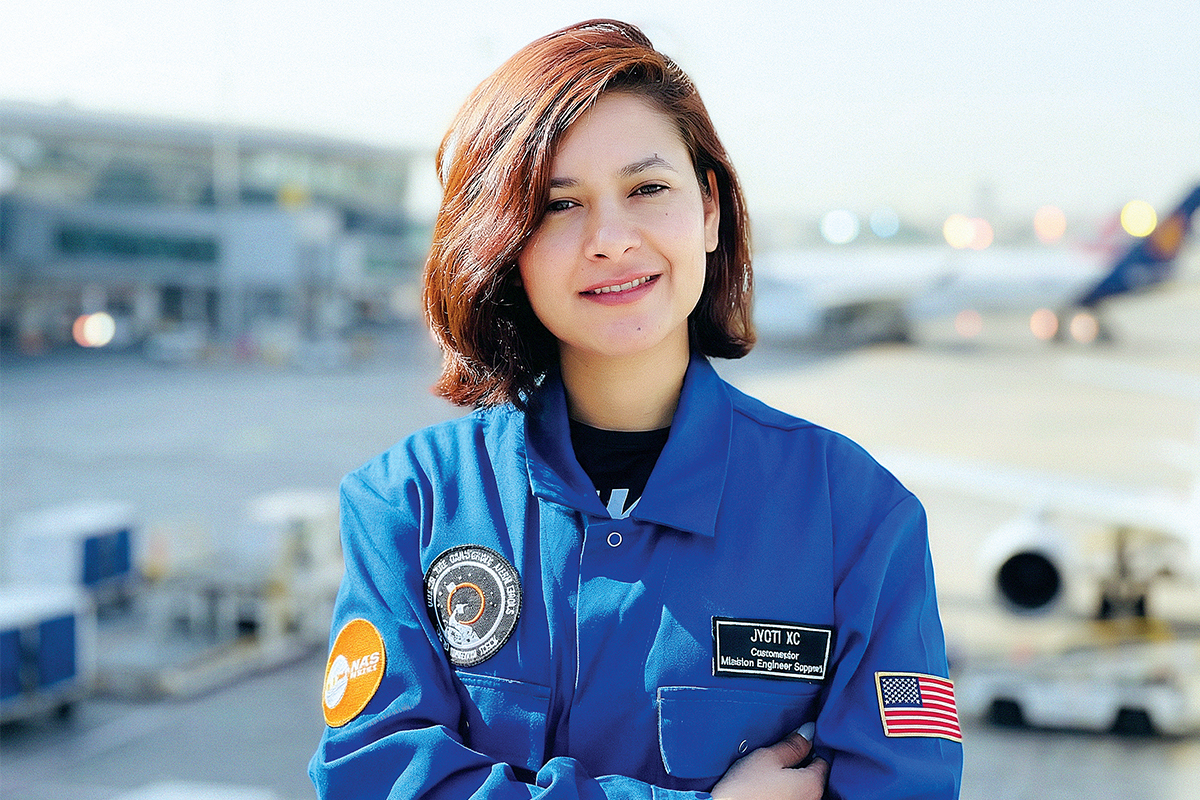
Jyoti KC, Medical Technician, United States Air Force
“Known and unknown challenges quietly shaped my journey. They showed me that strength is not about control or power, but about allowing others to grow and lead. I also experienced being misunderstood, seen partially or inaccurately. While this does not fit into typical success narratives, it forced me to look inward and understand myself more deeply rather than correcting every external perception. Through these experiences and six years in the medical field, I have come to understand a quiet truth: each of us must carry our own oxygen tank”
Jyoti KC made history as the first Nepali-American analogue astronaut selected to join the Lunares Research Station, marking a significant milestone for Nepali representation in space-related research. Born into a middle-class family in Dang, she spent much of her childhood outdoors, finding comfort in nature. At home, she often watched the National Geographic channel, which introduced her to places far beyond her immediate surroundings such as the Sahara Desert, African wildlife and unexplored regions of the world. These early exposures revealed to her that the world extended far beyond her local environment and was rich with diverse cultures and ecosystems. The curiosity and learning habits she developed during these formative years continue to shape both her personal and professional life.
After completing her schooling at Moonlight Boarding School in Dang and her higher secondary education at Mani Mukunda College in Butwal, KC applied for the US Diversity Visa with friends and was selected. She moved to the United States in July 2017. After interacting with members of the US Air Force, she decided to enlist. Pursuing her ambition with determination, KC is now serving as a medical technician and undergoing training to become an analogue astronaut.
In this edition of Business 360, KC shares five experiences that have significantly shaped her life, both personally and professionally.
Decision to join the United States Air Force
One professional milestone I will never forget is the decision to join the United States Air Force and the day I graduated from training. At the time, the choice felt practical rather than symbolic. I stepped into a life of service without fully understanding how unfamiliar and distant it was from anything I had known growing up in Nepal. What I did not realise then was that this decision would transform me entirely.
Military training demanded extensive effort, often unseen or unrecognised. It required airmen to demonstrate three essential attributes: emotional regulation, physical endurance and mental resilience. I experienced intense fatigue as I learned to adapt my behaviour to a structured, performance-driven system. My days were devoted to acquiring new skills, and it was only on graduation day that the meaning of the journey truly settled in.
Standing in uniform, I recognised that I had chosen a path of service in another country, not for recognition or power but out of commitment to a purpose. As a Nepali-American woman serving abroad, I felt profound gratitude that outweighed any sense of achievement. That moment marked the beginning of my personal development, as I learned fundamental social and cultural skills within the military. My purpose - to serve humanity - became clearer and remains the guiding principle of my life.
Medical training that quietly changed my direction
My path took a decisive turn during my Air Force training as a medical technician. At the time, I viewed it simply as a requirement, something to learn and execute correctly. Only later did I recognise its deeper impact on my thinking and direction.
Over 11 months of training, I gained firsthand experience in teamwork by working with airmen from diverse backgrounds, cultures and professional disciplines. Survival and combat training taught me how to function under stress, but it was medical training and its real-world application that transformed me most.
During the Covid 19 mission, I spent nine months providing medical support to more than 80 towns, serving over 200,000 people. We worked through every type of weather, responding to widespread fear, anxiety and uncertainty. Air Force and Army medics worked alongside personnel from multiple branches, united by a shared mission to protect human life.
This became my generation’s first major medical battle. I worked seven days a week to contain the outbreak, protect communities and preserve social connection. In those moments, the importance of breath and blood became unmistakably real. Monitoring oxygen levels, maintaining airflow and controlling bleeding were no longer abstract medical concepts, they were immediate, human necessities.
I witnessed vulnerability in its most honest form. People depended on one another, and that shared vulnerability created a collective responsibility to protect and support each other. Only afterward did I fully understand the depth of that experience. It taught me that service is rooted in care, protection begins with understanding vulnerability, and strength is built through adaptability, collaboration and emotional support. These lessons continue to shape how I lead and work across diverse fields, including the military, engineering and space research.
A setback that stayed
The failure that stayed with me was not a single event but a realisation. I came to understand that my greatest failure would be reaching the end of life having avoided what truly matters, choosing comfort over learning or silence over responsibility. This insight reshaped how I perceive loss and disappointment.
I learned to view delays, misunderstandings and slow progress as integral parts of growth. Complex journeys - especially in high-risk environments - rarely follow straight paths. What matters is not speed, but direction. As long as my actions align with strengthening human connection, setbacks become signals for recalibration rather than reasons to stop.
This shift clarified my motivation. I am not driven by recognition, but by alignment between intention and action. I choose clarity over noise and responsibility over ease. That awareness continues to guide me, reminding me that human life is interconnected and worth protecting. Without understanding humanity, nothing we invent or discover carries lasting meaning, on this planet or beyond.
A moment that still makes me pause
A moment that continues to stay with me connects two major crises in my life. The first occurred during the 2015 earthquake in Nepal, when I was in Kathmandu. I was not trained as a responder then; I simply helped where I could, guiding people to shared tents, making space for families, and cooking meals at a friend’s mother’s home. There was no hierarchy, only the immediate need to care for one another. That experience taught me that what united us was not social difference, but shared vulnerability and compassion.
Years later, during the Covid 19 mission, I found myself in a similar role, this time as a trained medical technician. I administered tests, delivered vaccines and cared for diverse communities. Although the scale and resources differed, the human response was strikingly similar. In crisis, people seek safety, reassurance and connection. They look for someone who will listen, remain present and help them breathe through uncertainty.
What makes this memory linger is its universality. Whether facing an earthquake or a pandemic, humanity responds with the same vulnerability and instinct to protect one another. It reminds me that beyond systems, uniforms and borders, human connection remains the most essential form of care.
Realising interdependence
My perspective did not change through a single achievement, but through a gradual understanding of my journey - including my exploration of space-related work. Just as the roots of an apple tree remain apple roots, human nature remains constant unless shaped by shared knowledge, experience and responsibility. True transformation does not come from recognition or reward alone, but from understanding one’s purpose.
Early exposure to recognition and advancement taught me not to seek validation, but to remain humble and aligned with my values. Independence came early in my life, yet it taught me the importance of investing in human connection. Progress, I learned, is sustained through collaboration, not isolation.
Known and unknown challenges quietly shaped my journey. They showed me that strength is not about control or power, but about allowing others to grow and lead. I also experienced being misunderstood, seen partially or inaccurately. While this does not fit into typical success narratives, it forced me to look inward and understand myself more deeply rather than correcting every external perception.
Through these experiences and six years in the medical field, I have come to understand a quiet truth: each of us must carry our own oxygen tank. Those who cannot breathe independently often lack the capacity to support others. When all energy is spent on personal survival, little remains for compassion or growth. We do not need to fit into someone else’s space to breathe, we already have room to grow within ourselves.
This understanding changed how I move through the world. I now operate with internal clarity of vision, one that prioritises learning, service and unity. Every new responsibility demands new skills, deeper knowledge and adaptation. By staying focused on meaningful impact and committing to small, intentional actions, real and lasting change becomes possible.