
Inside Nepal’s High-Stakes Budget Push for Reform and Growth

The new government, backed by a popular mandate, is preparing to unveil its first budget for Fiscal Year 2026/27 amid soaring public expectations. Finance Minister Swarnim Wagle has already signaled a comprehensive reform-oriented budget while presenting the principles and priorities of the upcoming fiscal plan in Parliament.
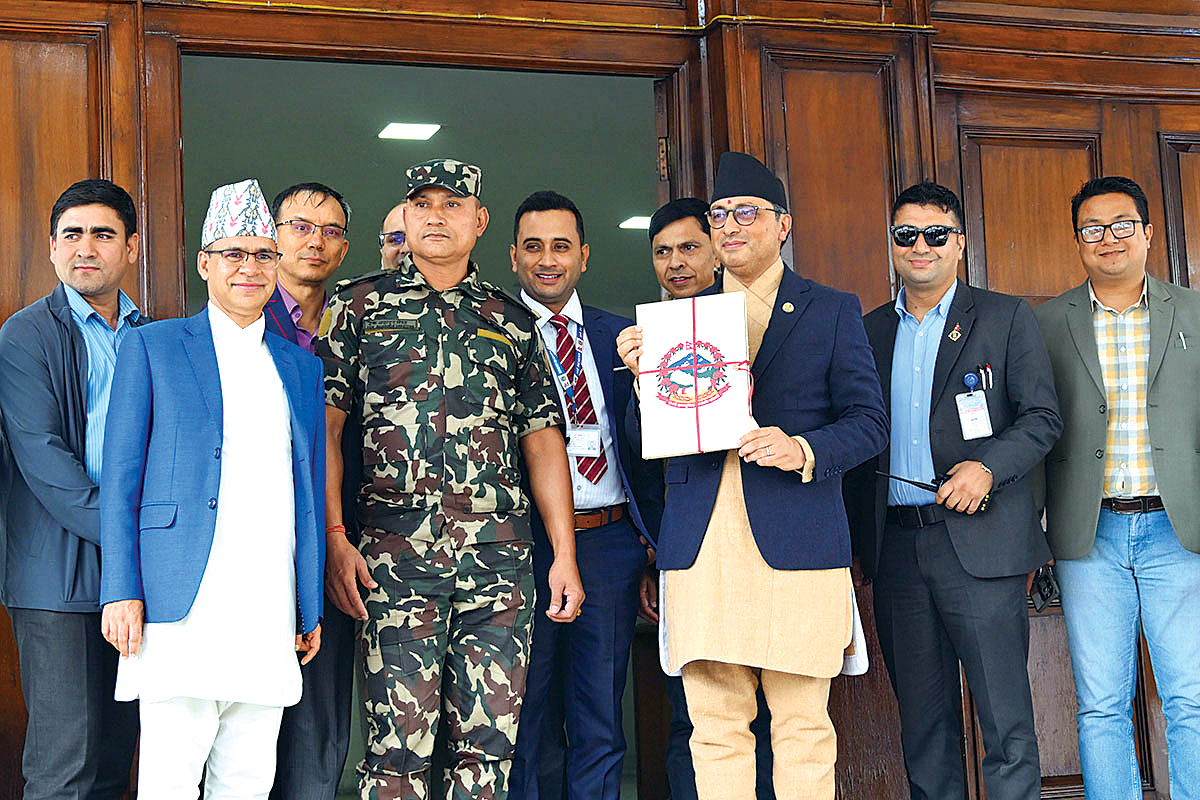
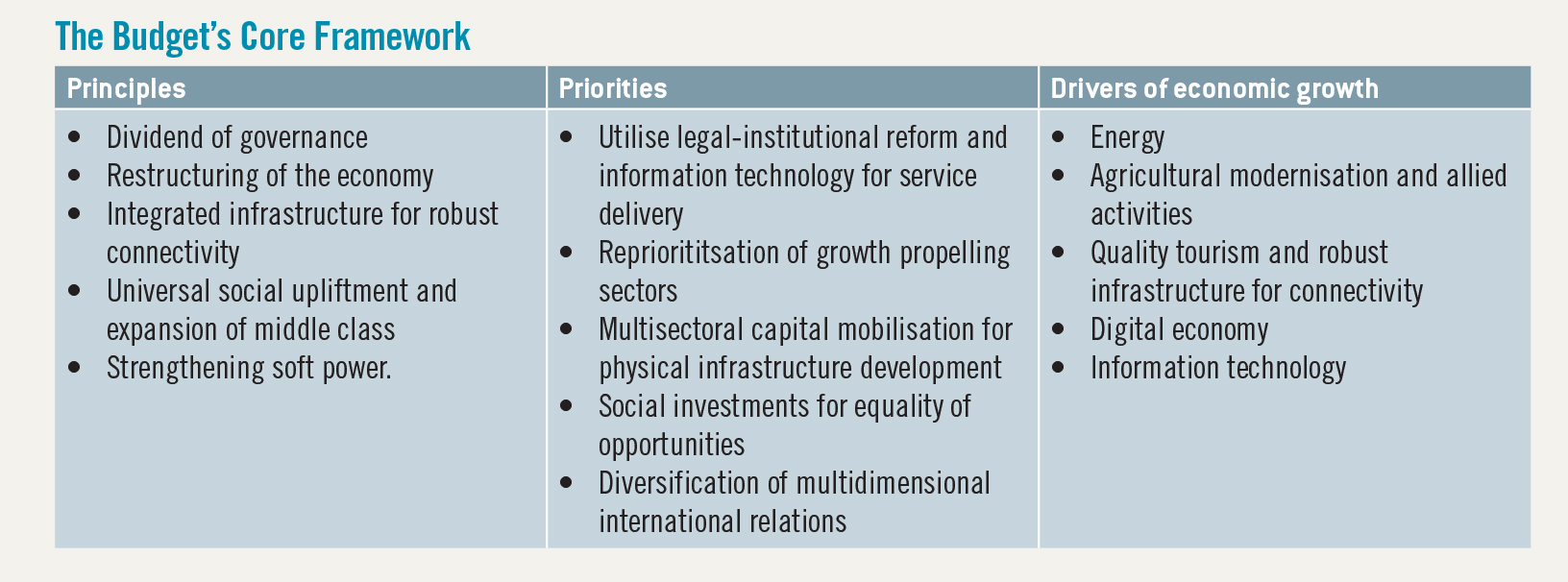
The budget rests on five broad pillars: the dividend of governance, economic restructuring, integrated infrastructure for stronger connectivity, universal social upliftment alongside middle-class expansion, and strengthening Nepal’s soft power.
To achieve these goals, the government has prioritised legal and institutional reforms, technology-driven public service delivery, growth-oriented sectors, multisectoral capital mobilisation for infrastructure development, social investments aimed at equal opportunity, and diversification of international relations.
While the government’s policies and programmes have provided a broad framework, the Budget Formulation Committee led by the finance minister is now finalising the details with a focus on allocative efficiency and implementation capacity.
“Scientific allocation or allocative efficiency, implementation capacity, and accountability of the concerned implementing agencies and authorities are the primary concerns of stakeholders and parliamentarians,” says Finance Secretary Ghanshyam Prasad Upadhyay.
The Budget’s Core Framework
Fiscal Constraints Limit Policy Ambitions
Despite ambitious policy goals, the government faces severe fiscal constraints.
Revenue collection has stagnated even as committed liabilities continue to rise. Foreign grants and external financing remain uncertain due to global economic turbulence. Meanwhile, although banks and financial institutions are flush with liquidity, converting short-term deposits into financing for long-term infrastructure projects remains structurally difficult and risks creating crowding-out effects.
The National Planning Commission (NPC) has reportedly set a ceiling of Rs 1,890 billion for the upcoming budget.
“The space is limited as the committed liability of the government hovers around Rs 1,330 billion,” Finance Minister Wagle has stated.
At the same time, annual revenue collection remains around Rs 1,180 billion, insufficient even to cover committed liabilities. The gap highlights the disconnect between public aspirations and the government’s fiscal capacity.
Economist and former Nepal Rastra Bank Executive Director Nara Bahadur Thapa argues that the government cannot afford to present a conventional budget amid current economic conditions.
“The government should not limit itself. Rather, it should bring an unconventional budget to boost market confidence when aggregate demand is slumping, unemployment is rising, and the overall economy is stagnant,” he says. “Only a counter-cyclical budget can address the ongoing challenges of the economy and spur growth through government expenditure.”
Debt Burden Narrows Fiscal Space
Nepal’s fiscal credibility has long suffered from weak implementation, particularly in capital expenditure. Poor development spending has constrained capital formation and weakened domestic savings over the years.
Against this backdrop, authorities have dismissed the possibility of significantly inflating the budget size for FY 2026/27. According to Gunakar Bhatta, Nepal’s economy is currently trapped in three structural crises: unsustainable private sector debt, deteriorating asset quality, and rising social security liabilities.
Meanwhile, public debt has continued to rise as revenue mobilisation weakens.
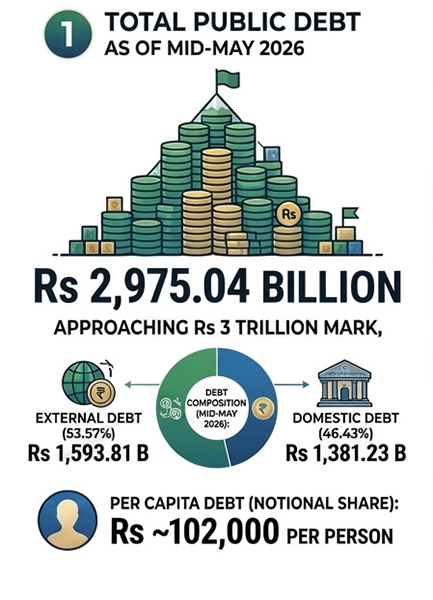
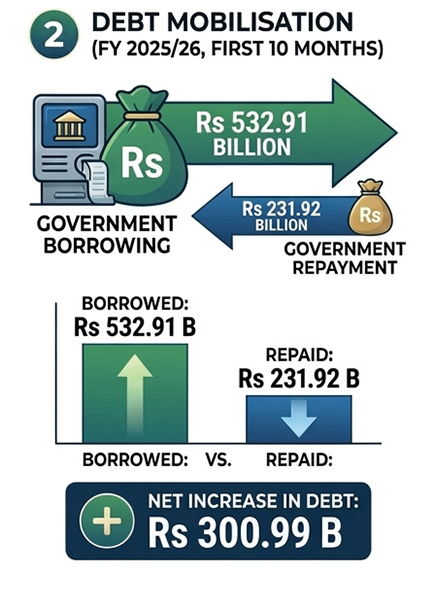
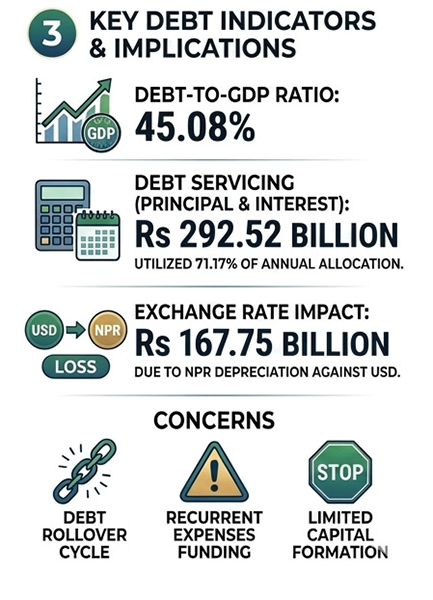
Nepal’s public debt stood at Rs 2,975.04 billion as of mid-May 2026. During the first 10 months of FY 2025/26, the government borrowed Rs 532.91 billion while repaying Rs 231.92 billion, according to the Public Debt Management Office under the Ministry of Finance.
Foreign debt accounts for Rs 1,593 billion, while domestic debt stands at Rs 1,381 billion.
The Public Debt Management Act restricts foreign debt from exceeding one-third of GDP, which is expected to reach approximately Rs 6.6 trillion this fiscal year. Even so, Finance Minister
Wagle has acknowledged that the government has little alternative but to continue borrowing as revenue sources shrink.
Calls for a More Aggressive Fiscal Strategy
Despite fiscal limitations, several experts argue that resources are not Nepal’s primary problem. Instead, they point to weak execution and policy hesitation.
“We do not claim that the government can achieve everything through a single budget. At the same time, the government should not make the mistake of introducing a regular budget during unprecedented times,” says Shesh Mani Dahal. “The fiscal budget 2026/27 should keep the government’s ambition high to drive public aspirations and restore private sector confidence.”
Economists and private-sector leaders have urged the government to adopt bolder financing strategies. Recommendations include issuing long-term development bonds, mobilising excess liquidity of nearly Rs 1,200 billion currently held by banks and financial institutions, divesting state-owned enterprise shares, and utilising overdraft facilities from Nepal Rastra Bank.
Tax Reform Emerges as Central Debate
One of the most closely watched aspects of the upcoming budget is tax reform.
Finance Minister Wagle has pledged to reduce compliance burdens for small and medium enterprises while rationalising tax rates to encourage entrepreneurship, business expansion, and investment.
“Taxpayers try to evade taxes when rates are oppressive,” Wagle has said. “When we adjust them to a rational level, they are encouraged to file taxes, bringing more taxpayers into the tax net.”
However, the government’s debt burden complicates this strategy. High debt eventually requires either higher taxes, reduced spending, or inflationary financing mechanisms, effectively functioning as a hidden tax on the economy.
Business leaders argue that Nepal’s current tax structure discourages productivity and investment. High customs duties on intermediate goods, aggressive excise taxes, and effective income tax rates reaching 39% have created a punitive business environment.
According to Anjan Shrestha, rationalising these rates could trigger an immediate positive response from taxpayers and investors alike.
Reform Agenda Signals Shift in Governance
The government has increasingly framed itself as reform-driven and results-oriented, seeking to move beyond the political rhetoric that has long defined Nepal’s policymaking.
Its broader reform package includes legal, procedural, institutional, and regulatory overhauls aimed at improving governance, easing business operations, attracting investment, and enhancing public service delivery.
Nepal’s economic potential has historically been undermined by political instability, corruption, bureaucratic inefficiency, and regulatory capture, even after the 2006 peace process ended the decade-long armed conflict.
The government now aims to accelerate growth by scaling up enterprises, expanding the middle class, and facilitating investment. It has also set an ambitious target of transforming Nepal into a $100 billion economy within the next five to seven years.
Authorities have announced plans to scrap outdated laws affecting private sector operations and implement recommendations from both the High-Level Economic Reform Advisory Commission and the Public Expenditure Review Commission.
In one of the government’s most notable moves, Finance Minister Wagle announced plans to close the Department of Revenue Investigation, arguing that the institution had become predatory toward businesses.
Yet tensions remain between reform rhetoric and enforcement practices. While the government promises a more business-friendly environment, aggressive punitive actions risk undermining investor confidence if not carefully balanced.
Experts have urged authorities to distinguish between genuine financial crimes and broader business disputes to avoid creating fear within the private sector.
Reform Alone Will Not Be Enough
Economist Thapa remains skeptical about whether reforms will penetrate deeply enough at the institutional level to deliver meaningful results.
“Reform is a necessary condition but not a sufficient condition,” he says. “Comprehensive reform must be backed by the required policies, programmes and laws to institutionalise them. Otherwise, the high-sounding words of reform remain superficial.”
Thapa also argues that Nepal must move toward a second phase of economic reform by considering capital account convertibility, greater exchange rate flexibility, liberalisation of professional services, and opening commercial agriculture to foreign direct investment.
Nepal’s Persistent Budget Execution Problem
Even as new reforms are proposed, Nepal continues to struggle with one of its oldest structural weaknesses: budget execution.
Over the past decade, recurrent expenditure has consistently been exhausted, while capital expenditure has repeatedly fallen short. Capital spending execution has remained below 80% since FY 2019/20 and below 70% over the past three years.
According to former Chief Secretary Baikuntha Aryal, the problem stems from chronic weaknesses including poor project preparation, politically motivated project selection, inadequate resource allocation, weak coordination, delayed procurement processes, and limited institutional capacity among both contractors and administrators.
Authorities say the new government is attempting to address these bottlenecks. Whether those efforts translate into meaningful execution, however, will ultimately determine whether Nepal’s upcoming budget becomes a genuine turning point or another ambitious document constrained by structural realities.
Nepal’s Public Devt Status (FY 2025/26)
(First 10 Months & Mid-May 2026)

-1789290954.jpg)
-1786437470.jpg)
-1784716131.jpg)