Manoj Kumar Gyawali on Nabil Bank’s New Vision and the Future of Banking


“The future of banking will be shaped by speed, convenience, trust and intelligence. Customers will compare banks not only with financial institutions but with the digital experiences they use every day. Nabil continues to strengthen its position as a leading bank in digital adoption, with more than 91% of daily transactions now completed through digital channels. Nabil’s vision places digital capability at the core of banking, while preserving the trust, advice and human connection that define financial relationships”
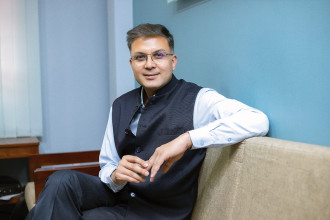
Manoj Kumar Gyawali, Chief Executive Officer, Nabil Bank
For institutions with decades of legacy, the greatest challenge is rarely scale, it is relevance. As Nepal’s financial sector undergoes rapid digital, regulatory and economic transformation, Nabil Bank is undertaking a strategic recalibration designed to preserve the trust it has built over four decades while preparing for a markedly different future.
Leading that transformation is Chief Executive Officer, Manoj Kumar Gyawali, who oversees one of Nepal’s largest banking institutions, with a balance sheet exceeding Rs 636 billion, a customer base of more than 2.5 million, 268 branches and over 3,200 ATMs. Under his leadership, the bank has redefined its vision, mission and core values around a simple but demanding objective: to evolve into a more agile, technology-driven and globally competitive institution without compromising the governance and customer confidence that have long defined its brand.
For Gyawali, digital transformation extends well beyond technology. It is an organisational philosophy where innovation is reinforced by disciplined governance, cybersecurity, regulatory compliance and talent development. This thinking is reflected in the bank’s operational framework built around the ‘Five Ts’ - Trust, Transparency, Talent, Technology and Transformation - drawing inspiration from the Panchatattva philosophy of balance. Equally central to his strategy is embedding Environmental, Social and Governance (ESG) principles into the bank’s growth agenda, from financing renewable energy projects to supporting employment generation and inclusive economic development.
Gyawali’s ambition is not simply to build a more efficient bank, but to position Nabil as a world-class Nepali financial institution whose success is measured by its contribution to the country’s economic progress as much as by its financial performance.
In conversation with Business 360, he reflects on the leadership philosophy, strategic priorities and institutional changes shaping the bank’s next chapter. Excerpts:
After more than four decades in business, Nabil Bank has redefined its vision, mission and values. What changed in the banking landscape or within the institution itself that made this the right time to revisit the bank’s core purpose?
Nabil Bank has always been associated with trust, innovation and leadership in Nepal’s banking sector. Over more than four decades, we have grown alongside the country, served customers across generations, and contributed meaningfully to the evolution of private sector banking in Nepal.
However, the environment in which banks operate today is fundamentally different from the one in which Nabil began its journey. Customer expectations have changed significantly. Banking is now expected to be seamless, transparent, responsive, secure and increasingly digital. At the same time, areas such as governance, compliance, cybersecurity, sustainability and customer protection have become even more critical to institutional resilience.
As of the end of Asar 2082, Nabil stands ahead with a balance sheet size of Rs 636 billion, serving more than 2.5 million customers through an extensive physical network of 268 branches, 21 extension counters and 3,232 ATMs. This milestone reflects the successful achievement of previously defined goals, guided by a clear mission, vision and set of core values.
Nabil has also evolved in scale, reach and responsibility. With the changing scenario and stakeholder’s expectation we need to continue to lead with innovation clarity, discipline and purpose. This made it the right moment to reflect not only on the foundations that made Nabil successful but also on the capabilities and values that will keep us trusted, relevant and impactful in the years ahead.
For Nabil Bank, the redefinition of its vision, mission and values marks a deliberate effort to clarify what the bank stands for, how it intends to evolve and what role it seeks to play in the next phase of Nepal’s banking journey. In a sector being reshaped by technology, customer expectations, governance imperatives and social responsibility, the renewed purpose positions Nabil to preserve its legacy of trust while preparing for a more dynamic and future-ready financial landscape.
The new vision is to become ‘Nepal’s most trusted and future-ready bank’. Trust is something banks have always aspired to, while being future-ready requires constant change. How do you balance preserving trust with embracing transformation at a time when banking is evolving faster than ever?
For any bank, trust is the foundation on which long-term relevance is built. It is earned through discipline, transparency, compliance, security, consistency, responsible conduct and focusing toward expectation of all stakeholders. Yet, trust cannot be understood as resistance to change. A bank that fails to evolve with the changing expectations of its customers risks weakening the very confidence it seeks to preserve. Banking business starts and end with ‘TRUST’.
At Nabil, our approach is rooted in disciplined transformation. We are embracing technology, innovation and new ways of serving customers while remaining firmly guided by strong governance, prudent risk management and robust compliance standards. Our objective is to modernise the delivery of banking services without compromising the principles that have built customer confidence over the years. We are developing products and services that respond to the expectations of all generations and sectors, while placing global compliance standards at the forefront of our priorities. Our focus is shifting beyond transactional banking toward responsible, sustainable and value-driven banking. Through this approach, we aim to establish Nabil as the bank of first choice for all stakeholders, including employees, shareholders, customers, regulators and government authorities. In doing so, we continue to balance trust and transformation as the foundation of our progress.
At Nabil, trust and future-readiness are not separate ambitions; they reinforce each other. Transformation must be pursued with discipline, just as trust must be sustained through relevance and progress. Our focus is not change for its own sake, but purposeful advancement that deepens customer confidence, strengthens institutional resilience and positions Nabil for the future.
The new mission places equal emphasis on innovation, governance, ESG responsibility, compliance and customer-first excellence. In practice, how do you ensure that these priorities reinforce one another rather than compete for attention?
These priorities are not separate institutional agendas. They are closely connected disciplines that reinforce one another in practice. At Nabil, innovation is pursued with responsibility, governance provides the discipline to guide transformation, compliance safeguards customers and the financial system, and ESG principles are embedded into business decisions rather than treated only as reporting requirements.
Nabil is already advancing on this journey through initiatives that align financing with sustainability, economic development and social impact. For instance, the bank has supported 59 hydropower and seven solar financing projects with a total capacity of 3,131.17 MW. Through bank-financed business entities, more than 112,000 direct employment opportunities have been supported, with women representing nearly 30% of the employment generated.
These achievements reflect Nabil’s commitment to integrating ESG principles into core banking decisions as a strategic driver of responsible growth. By financing renewable energy, supporting employment generation, promoting women’s participation in the workforce and contributing to productive sectors of the economy, Nabil is helping advance a more sustainable and inclusive banking model in Nepal.
This alignment is ensured through a structured decision-making approach. Major initiatives are assessed not only for growth potential but also for customer value, risk, regulatory compliance, governance standards, sustainability impact and long-term institutional resilience. This enables Nabil to modernise and innovate while maintaining the trust, transparency and accountability expected of a leading financial institution.
Customer-first excellence remains central to this philosophy. The objective is to deliver better banking experiences, stronger safeguards, more sustainable outcomes, and deeper confidence among customers and stakeholders. In this way, innovation, governance, ESG responsibility, compliance and customer focus do not compete for attention. They work together as the foundation of Nabil’s disciplined transformation.
One of the most distinctive aspects of the rebranding is the introduction of the ‘Five Ts’: Trust, Transparency, Talent, Technology and Transformation inspired by the Panchatattva philosophy. How will customers, employees and investors experience these values differently in their day-to-day interactions with Nabil Bank?
The Five Ts are not slogans. They are behavioural principles that must guide how we think, decide and execute across the bank.
For customers, these values translate into simple processes, clear communication, digital capabilities, timely responses and dependable banking experiences. Transparency is reflected in how we communicate, resolve concerns and protect customer interests.
Employees should experience the Five Ts through continuous learning, clearer accountability, stronger leadership development and a performance culture that rewards capability. Talent remains central to Nabil’s future, because technology and transformation are meaningful only when people are prepared and empowered to use them well.
For investors, the Five Ts should be reflected in sustainable performance, disciplined risk management, robust governance and long-term value creation. Their connection to Panchatattva is particularly relevant: a strong institution, like nature, depends on balance. These values help Nabil balance heritage with progress, people with technology and ambition with responsibility.
Many organisations unveil new vision and mission statements that remain confined to corporate presentations. What specific changes in culture, leadership and performance measurement will ensure that Nabil’s new purpose becomes embedded throughout the organisation?
Purpose becomes meaningful when it shapes conduct. At Nabil, the new vision, mission and values are being embedded into leadership expectations, employee engagement, service standards, decision-making and performance measurement.
Growth will remain a measure of success but it will sit alongside service quality, compliance discipline, risk management, digital adoption, employee development, customer trust and institutional impact.
Leaders carry the responsibility of translating values into action. Values must be visible in how leaders make decisions, guide teams, serve customers and uphold accountability across the institution.
The test lies in consistency between commitment and conduct – at branches, across digital channels, in credit decisions, in customer interactions and in the way people are developed. That is how purpose moves from statement to culture.
You have spoken about building a ‘world-class Nepali bank’. What does a world-class bank look like in Nepal’s context?
For Nabil, this means aligning international standards with Nepal’s economic realities. The bank must advance digital banking, cybersecurity, data analytics, risk management, ESG integration, governance and talent development, while maintaining financial strength, customer focus product development and institutional discipline.
At the same time, Nabil must continue supporting households, entrepreneurs, businesses and productive sectors of the economy. In Nepal’s context, a world-class bank is not defined by efficiency and profitability alone. It is defined by trust, inclusion and contribution to national prosperity. That is the benchmark Nabil is setting for the next five to 10 years.
The banking industry is increasingly shaped by digital disruption, fintech competition and changing customer expectations. How does this redefined vision position Nabil to remain relevant and competitive over the next decade, rather than simply responding to short-term market trends?
The future of banking will be shaped by speed, convenience, trust and intelligence. Customers will compare banks not only with financial institutions but with the digital experiences they use every day. Nabil continues to strengthen its position as a leading bank in digital adoption, with more than 91% of daily transactions now completed through digital channels.
Nabil’s vision places digital capability at the core of banking, while preserving the trust, advice and human connection that define financial relationships. Technology will simplify customer journeys, expand access, improve efficiency, generate insight and strengthen security. Banking, however, will continue to depend on trust, advice, human connection and institutional credibility.
For Nabil, disruption is an opportunity to transform with pace, partner with purpose and serve customers with relevance. The focus is not to follow short-term trends but to build enduring capabilities in digital banking, data intelligence, customer relevance, operational resilience and responsible innovation.
If we were to revisit this conversation five years from now, what measurable outcomes would convince you that this redefined vision and mission have been successfully translated into business performance, customer trust and institutional impact?
Success must be evident in outcomes that customers, employees, regulators, investors and society can recognise. Customers should see faster service, transparency, digital convenience and more effective complaint resolution. It also means a relationship in which customers trust Nabil, engage with the bank and recommend it with confidence.
For the business, success must be reflected in sustainable growth, disciplined risk management, sound governance, profitability and operational efficiency. Within the organisation, it must be visible in employee capability, leadership depth, accountability and agility.
At the institutional level, success must be seen in ESG integration, regulatory confidence, investor trust and Nabil’s contribution to Nepal’s economy and society.
In the end, success will mean that Nabil is not only larger, but stronger in fundamentals; not only digital, but trusted; not only profitable, but prepared for the future and relevant to Nepal’s progress.
Five years from now, Nabil will continue to be the first-choice bank for all stakeholders, driven by in-novation, responsibility, sustainability and compliance. I would want people to recognise that Nabil’s renewal went beyond brand modernisation; it helped set a higher standard for banking in Nepal and contributed meaningfully to the progress of every sector toward greater economic prosperity