Stakeholders call for joint action as study shows poor economic conditions drive child labour in Nepal

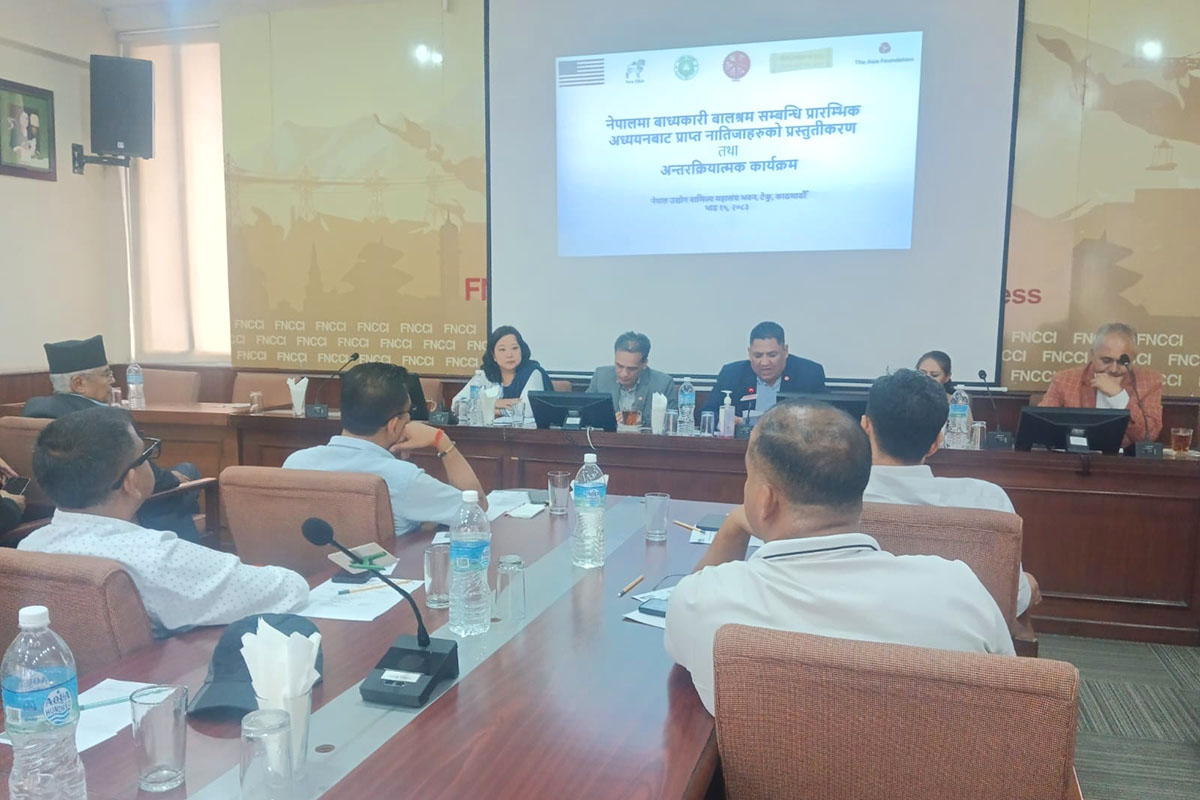
KATHMANDU: Poor economic conditions remain the primary driver forcing children into labour in Nepal, according to a preliminary study on forced child labour presented at an event organised by the Employers' Council of the Federation of Nepalese Chambers of Commerce and Industry (FNCCI) on Monday.
In response, stakeholders across the country stressed the urgent need for collaboration among the government, private sector, workers, families, local authorities, and civil society to eliminate child labour.
Presenting the research findings, Jeevan Baniya and Jyoti Maharjan from Social Science Baha informed participants that financial difficulty is the primary cause of child labour. Their study revealed that 91.7% of respondents working in the entertainment sector, 89.6% in domestic work, and 98.3% in brick kilns cited poor economic conditions as the main reason.
The study further highlighted that some employers hire workers without verifying proof of age. It noted that children in forced labour frequently face threats, withheld wages, and excessively long working hours. Moreover, rescued individuals often encounter a lack of financial support, employment opportunities, skills training, and educational access.
According to the findings, addressing the root causes of child labour requires strengthening family employment, income generation, and social security. To tackle these challenges, the report recommended expanding social security coverage, effectively implementing compulsory education, enforcing labour laws, adopting responsible recruitment practices, and carrying out regular joint monitoring of hazardous workplaces to support the rehabilitation and sustainable livelihoods of rescued child labourers.
Speaking at the event, Prabal Jung Pandey, Vice President of FNCCI and Chairperson of Employers' Council, noted that compliance with international labour standards and responsible business practices is essential as Nepal progresses towards graduating into a developing nation.
"As employers, it is our duty to ensure that children are not exploited in our businesses and supply chains," Pandey said. "Effective monitoring of age verification, responsible recruitment processes, compliance with labour laws, safe workplaces, and fair wages is today's necessity, and the FNCCI Employers' Council is clear regarding this."
Babukaji Karki, Vice Chairperson of the Employers' Council, stated that ending child labour is not the responsibility of a single party alone, but a shared obligation of the government, private sector, workers, families, local levels, civil society, and the wider community.
The findings presented at the event stem from a preliminary study supported by The Asia Foundation and conducted in partnership with Social Science Baha. The research provided key facts regarding the current state of child labour in Nepal, its primary causes, and the role of various sectors in mitigating the issue.
The gathering was attended by FNCCI executive committee members alongside representatives from The Asia Foundation, Social Science Baha, the Employers' Council, development partners, and various stakeholder agencies. Participants emphasised the necessity of moving from awareness to practical implementation, from individual initiatives to institutional commitment, and from isolated efforts to collective responsibility.