DECODING CHANGE


Sujeev Shakya
Author, Nepal 2043: The Road to Prosperity
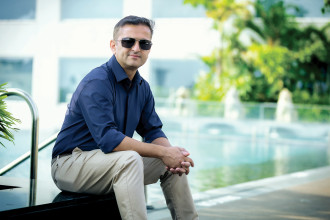
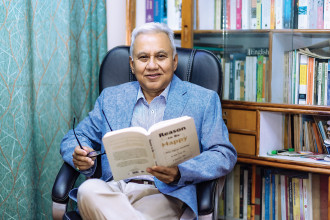
For over 30 years, Sujeev Shakya has been among the most distinctive voices shaping how Nepal understands its economy and the possibilities that could drive Nepal on the path to prosperity. An author, an analyst and a consultant, Shakya has consistently stitched the threads of Nepal’s business landscape, political transitions, cultural shifts and global movements into public discourse. His work is both personal and public. Personal because he draws from his own varied experiences across the corporate world and global advisory roles, and public because he tries to translate those experiences into valuable insights that can help Nepal shape its economic trajectory.
Shakya’s career began in a Nepal that looked very different from today. He joined Soaltee Hotel as a trainee in the early 1990s when the Nepali economy was only just beginning to open up. Over the years, he moved into finance, corporate strategy, business development and senior leadership roles, eventually leading group interests that spanned hospitality, manufacturing and hydropower. Later, he founded beed Management, a consulting firm that now advises organisations across Asia and Africa. He also leads the Nepal Economic Forum which has become a platform for policy-level conversations on Nepal’s economic direction.
Alongside his corporate work, Shakya has been an avid writer. From Nepali short stories in his early days to columns and then full-length books, his writing has reflected a country in transition. ‘Unleashing Nepal’ (2009) tried to capture the country’s shifting identity after the monarchy. ‘Unleashing the Vajra’ (2020) looked at Nepal’s economic and political restructuring after the new constitution. His latest book, ‘Nepal 2043: The Road to Prosperity’, is the most ambitious of all, an attempt to articulate a clear, long-term vision of what Nepal can become two decades from now.
What sets ‘Nepal 2043’ apart is its long horizon. It refuses to be trapped in the narrow cycle of crisis-driven debates that dominate Nepali public life. Instead, it draws from global megatrends like geopolitics, climate change, technology and labour mobility, and places Nepal within a wider story. It challenges old narratives about Nepal’s limitations and instead invites readers to think about Nepal’s demographic advantage, its geographic positioning, the global Nepali diaspora, the country’s resilience, and the economic shifts already underway.
In conversation with Business 360, Shakya discusses the inspirations behind the book, the mindsets Nepal must change, the sectors that will drive growth and why he believes Nepal’s next generation has the power to transform the country in ways that older generations never imagined. Excerpts:
“Sujeev Shakya has given us a book to savour, telling us how Nepal has changed in this century and how it can achieve the national ambition of becoming a high-income country by 2043. This book, [written] by an optimist with practical experience, who is firmly grounded in economic and social reality, is easily one of the best guides to Nepal’s and South Asia’s complex reality and potential future.”

– Shiv Shankar Menon, Former Foreign Secretary of India and National Security Advisor of India
Your professional journey spans multiple sectors.How do you describe the evolution looking back?
It has been a journey of constant movement. I began at Soaltee Hotel in the early 1990s when I was still completing my articleship. After receiving my chartered accountancy qualification in 1992, I joined Soaltee as an Assistant Manager for Funds and Planning. From there, I got the chance to move through different areas, corporate finance, business development, strategy and finally corporate affairs. The group had interests in hydropower, tobacco, hospitality and other sectors, so the exposure was wide.
In 2005, we parted ways and began Tara Management. That eventually led to the Bhotekoshi Power Company acquisition, and I became Group President and CEO. Two years later, I decided to leave and start beed Management. It has now been 17 years and the journey has taken me far beyond Nepal, from consulting in Cambodia and Rwanda to advising companies and organisations across Asia and Africa. I also lead the Nepal Economic Forum and work as Senior Advisor for the Bower Group Asia.
Throughout this career, writing has been a guiding force. I started with Nepali short stories, then wrote columns and eventually books. Whenever I feel uncertain about my own direction, I write. My books are as much about understanding Nepal as they are about understanding myself. Writing creates clarity. It helps me pause, reflect and recalibrate.
Your earlier books examined Nepal’s past and its transitions. What made you shift your focus to the future with ‘Nepal 2043: The Road to Prosperity’?
Nepal is stuck in a cycle of short-term crisis thinking. We move from one political event to another like elections, court decisions, government collapses. In between, we talk about load-shedding, taxes, liquidity crises and administrative hurdles. These are real issues but when we focus only on the present, we lose the ability to dream.
Every country needs to pause once in a while and try to reimagine its future. In Nepal’s case, there is no one better qualified than its chief optimist, Sujeev Shakya, to play that role. You may disagree with his conclusions, but you will find the journey informative and worthwhile.

– Gurcharan Das, Author
My first two books looked back, how Nepal changed, what we learned, and how we could move ahead. With Nepal 2043, I wanted to break out of that backward-looking frame. I wanted a long-term lens.
The world is going through massive shifts. Climate change, technological transformation, new geopolitical alignments and global labour migration are reshaping everything. Nepal cannot afford to stand outside these changes. When you zoom out, you see very clearly that the next 20 years will be decisive for many nations, not just Nepal.
The idea struck me unexpectedly. I was sitting in a tea garden bungalow in Rwanda, reflecting on my own direction in life, and I revisited the 15th Five-Year Plan. The plan contained a long-term vision for Nepal and I realised there was a bigger story to tell, not about where we are but about where we could be in 2043. That became the heart of the book.

Why 2043? What does that year represent?
2043 corresponds to 2100 in the Bikram Sambat calendar. It marks the turn of a Nepali century. Symbolically, it feels right because we need a long horizon that is still within our children’s lifetime. It also matches the target set in the 15th Plan for Nepal to become a high-income country.
Choosing a year grounded in our own calendar system gives weight to the idea. It stops us from simply borrowing global agendas like ‘Vision 2030’ or ‘Vision 2035’. We need our own milestones, rooted in our own planning tradition. 2043 gives us 20, a reasonable span for transformation, long enough to think big but close enough to stay accountable.
You are known for pushing the idea that Nepal is ‘land-linked’, not ‘land-locked’.
Why is this more than just a change in terminology?
Because it changes everything. For decades, Nepal’s ‘landlocked’ identity has been used as a justification for weakness. We internalised it. We allowed it to shape our confidence. But if you look carefully, being landlinked is actually an advantage. We are connected to two giant economies, India and China. Within a short drive, we can reach large consumer bases, education hubs, hospitals and supply chains. And through the 21-km Siliguri corridor, we touch Bangladesh and its large market as well.
To the north, our links with the Tibet Autonomous Region offer possibilities in trade, tourism, energy cooperation and cultural exchange. When you see these connections, you stop thinking of Nepal as isolated. You begin seeing it as a bridge. Geography does not change, mindsets do. Once the mindset shifts, policy, infrastructure and ambition shift too.
Your book opens with statistics that challenge outdated perceptions of Nepal.
What is the most important narrative you want to correct?
That Nepal is a country that ‘never progresses’. This is simply not true. Over the past two decades, Nepal’s GDP has grown six times. The banking sector has expanded. Digital payments have soared. Connectivity has improved. Education levels have risen. The capital market has grown. Remittances have transformed household economies and funded massive improvements in rural infrastructure.We have done all this while dealing with conflict, an earthquake, a blockade and a pandemic. Few countries have had that sequence of disruptions. Yet, Nepal continued to grow. That resilience is extraordinary but it rarely gets recognition.
I wanted to reintroduce Nepal to Nepalis and the world. We need to understand where we actually stand, not just where we imagine ourselves to be based on old narratives.
You call the book a ‘playbook for prosperity’.
This book is an antidote to the gloom-and-doom narrative of ‘Nepal is khatam (over)’ by many professional pessimists. Author Sujeev Shakya makes a plausible case for Nepal reaching an upper-middle income status by 2043 by leveraging its strategic location between two of the world’s largest and rapidly growing economies, and the dynamism of its upwardly mobile, globally adaptable and increasingly digitally savvy youthful population.

– Kul Chandra Gautam, Former Assistant Secretary General, United Nations, and author of ‘Global Citizen from Gulmi’ and ‘Lost in Transition’
If you had to choose three enablers that matter most, what would they be?
The first would definitely be location. Our geography is an incredible advantage if we treat it like one. We sit between India and China, which are projected to be the top two economies globally by 2050. This alone gives us a unique platform for services, tourism, logistics and cross-border cooperation.
The second is our ability to adapt and thrive in chaos. Nepalis grow up navigating uncertainty. Our ability to function in imperfect systems makes us highly productive when placed in stable systems abroad. This adaptability is our hidden competitive strength.
Lastly, it is the demographics. Half of Nepal’s population is under 25. Every year 600,000 young people enter the job market. Migration will continue but if those young people go with skills and return with experience and money, migration becomes an engine of growth. These three pillars will determine how far Nepal can go by 2043.
Hydropower, agriculture, tourism and services are major themes in your book.

Which one will drive Nepal’s next economic chapter?
It will be the services sector. In the last decade, Nepal’s services exports grew from around ten million dollars to nearly a billion dollars. That is a massive shift. Around the world, especially in Europe, countries are facing labour shortages. By 2030, Europe alone will require 85 million to 90 million workers in various sectors.
Nepalis are already going abroad in larger numbers for skilled roles, not just as unskilled labourers. They are chefs, technicians, care workers, machine operators, IT professionals, hospitality managers and more. Nepali restaurants are opening in global cities. Nepali chefs are making Japanese cuisine in Tokyo. Nepalis are running tech support centres in Australia. This is the beginning of something big. Services give us the freedom to grow without competing directly with China or India in manufacturing.
You have written about federalism not just as a political restructuring but as an economic opportunity.
What needs to change for federalism to function well?
The biggest change is cultural. We have a deeply centralised mindset. Whether it is families, businesses or political parties, decision-making tends to stay at the top. Federalism challenges that. It requires delegation, trust and empowerment at the provincial and local levels. We saw during Covid that local governments can be highly effective. They were quick, responsive and community-driven. But we have not fully embraced their potential.
For federalism to be successful, three key shifts are necessary across different domains. The first involves institutional shifts, which mandate the establishment of clear rules, resources and autonomy specifically for local governments. The second required change is organisational shifts, meaning that private sector institutions must also participate by decentralising their decision-making processes. Finally, a crucial change is the mindset shifts, where leaders must actively learn to trust younger people and local leaders to ensure the system’s viability and success.
Federalism will take time but it can unlock growth across the country, not just in Kathmandu.You highlight Switzerland’s vocational training system as a strong model.
What can Nepal realistically adopt from Switzerland?
One of the most important lessons is dignity of labour. In Switzerland, competence matters more than academic degrees. A construction worker or plumber is respected. They are well-trained. They are part of the economic engine.
In Nepal, the caste system and social norms historically looked down on certain kinds of work. But this is changing. Today tailors call themselves designers, barbers run professional salons and the person who brews your coffee might also clean the kitchen without any shame attached to the role. Another lesson is how Switzerland frames its geography. Switzerland does not say it is landlocked. It says it is at the centre of Europe. That mindset matters.
If Nepal normalises vocational training and makes practical skills attractive, we can produce a globally competitive workforce. Not everyone needs a university degree but everyone needs a skill.
The recent Gen Z protests surprised many older Nepalis. What do you think the protests revealed?
They revealed a generational shift. Many young Nepalis have no memory of the monarchy, the insurgency or the blockade. Their world is social media, global culture and digital convenience. Their expectations are straightforward. They want efficiency, respect, transparency and speed.
Their aspirations are global because they see the world through screens. They know how services work elsewhere. When they encounter outdated and inefficient systems in Nepal, they feel it sharply.
The protests showed that young Nepalis are not apathetic. They care deeply about systems that work. They may not always articulate it in policy language but they understand fairness and efficiency. Their expectations are not unreasonable, they are universal. To harness their energy, institutions need to modernise.
You dedicate a full chapter to Nepal’s ability to ‘thrive in chaos’.
Where does this resilience come from?
It comes from geography and history. People in the hills and mountains walked days for basic services. Roads could disappear overnight. Rivers changed course. Weather was unpredictable. Living in such conditions shapes your thinking.
During the earthquake, people organised themselves quickly. During the blockade, they found alternative ways to survive. Nepalis do not wait for the government. They rely on networks of family, friends and community. This builds a strong social fabric.
I have seen it in my own life and in the stories of many Nepalis I know. We adapt fast. We find opportunities in uncertainty. That mindset is powerful, especially in a rapidly changing world.You often write about the ‘Global Nepali’.
What role can they realistically play in Nepal’s economic future?
The diaspora has already transformed Nepal but we do not always recognise it. Remittances have changed rural economies. Skills brought back by returnees have changed local enterprises. Exposure has changed social attitudes.
But we tend to place too many expectations on them. Families depend heavily on money from abroad. Nationally, we expect diaspora investors, diaspora experts and diaspora solutions. This can create pressure and resentment.

Instead, Nepal must become a place where returnees feel they can contribute productively. For that, we need transparent systems, predictable rules and a welcoming environment.
Look at India. The diaspora helped fuel the technology revolution but only when India created conditions for them to return. Nepal can do the same. Migration is part of Nepali identity. We have been moving across regions for centuries. If we manage migration smartly, it becomes a long-term advantage.
Some readers felt the book could have addressed more short-term reforms.
Why did you choose not to focus on immediate fixes?
Because short-term fixes dominate every conversation in Nepal already. Liquidity issues, tax changes, interest rates, doing business hurdles. These are important but they often consume all the space. I wanted to focus on structural issues. Long-term thinking requires stepping back from the noise.
When ‘Unleashing Nepal’ was published in 2009, some ideas felt too long-term. But over the last decade, many of those ideas quietly took shape. That experience convinced me that long-term frameworks are essential for countries like Nepal, where short-term politics often disrupt continuity.
There are many people working on short-term solutions. My role is to hold the long-term vision.
What do you see as the biggest risk that could derail Nepal’s journey to 2043?
The biggest risk is inward thinking. Protectionism, cartels, crony capitalism and unpredictability can trap Nepal. Foreign investors talk openly about the challenges of investing in Nepal. Mandatory local partnership requirements discourage global companies. Policy unpredictability creates fear.
This mirrors what happened during the Panchayat era, three decades of slow growth and limited openness. The intent may have been right but the outcome was isolation.
But I am hopeful because today’s young Nepalis are pushing back against such systems. The Gen Z movement was essentially a rejection of state capture by a small group of actors. This pushback is global and Nepal is a part of that global wave.
As you imagine Nepal in 2043, what gives you the most optimism?
The mindset of the youth. They are not burdened by the past. They want clarity, functionality, dignity and simplicity. They do not want to earn for seven generations; they want meaningful lives.
If institutions evolve to match their speed and their aspirations, Nepal can transform dramatically. The next 20 years can be very different from the last 20. What gives me hope is that change is being demanded not from the top but from the bottom. That is how real transformation begins.