Govt working on legal framework to boost green energy: Minister Sinha

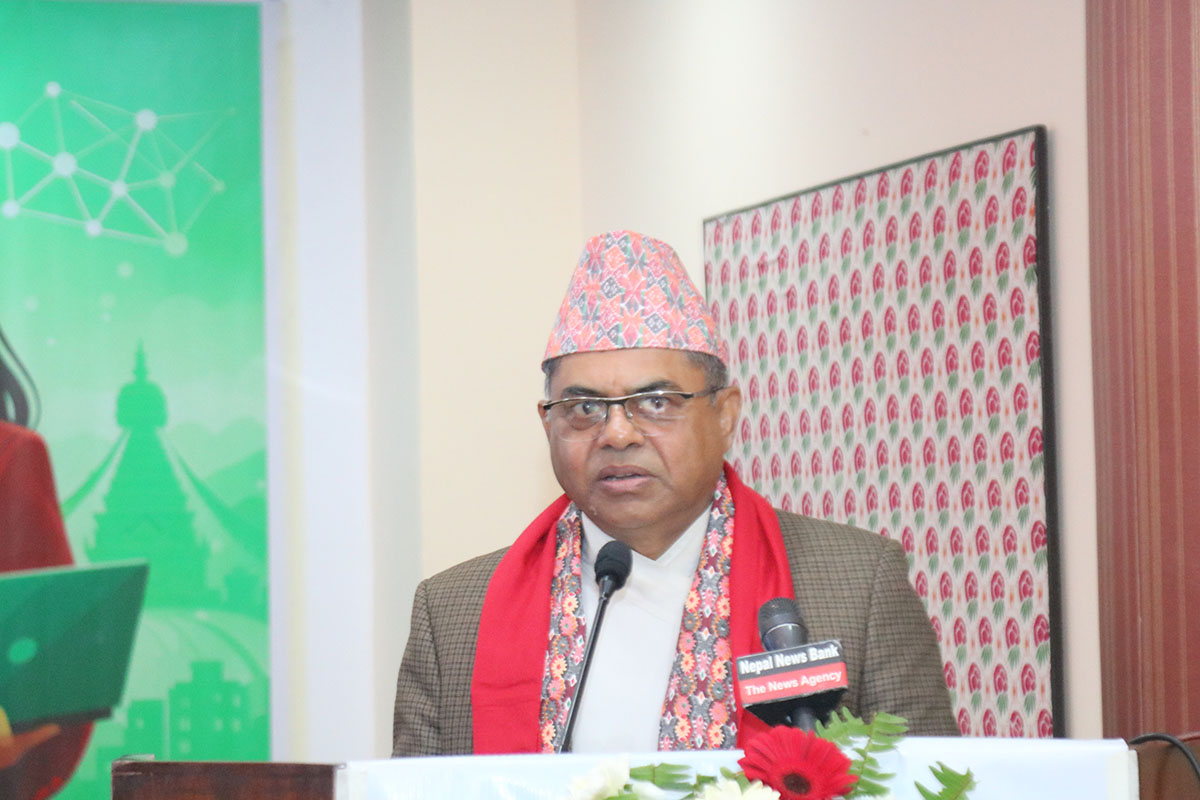
KIRTIPUR: Minister for Energy, Water Resources and Irrigation Anil Kumar Sinha has said the government is working towards creating a strong legal and policy framework to increase the use of green energy. He argued that such an arrangement is necessary to achieve the national goal of reducing carbon emissions to zero by 2045.
Addressing the national conference on green energy and the carbon economy held in Kirtipur today, Minister Sinha stated that such policies are needed to meet the right to a clean environment granted to every citizen by the Constitution and to achieve the sustainable development goals (SDGs).
He said incentives for electrical appliances and vehicles, the goal of reaching an installed solar power capacity of 500 megawatts by 2035, and the recently formulated ethanol‑blending procedures were examples of this. The minister added that facilities have also been provided to convert traditional brick kilns into electric ones.
Prakash Kumar Shrestha, vice-chairman of National Planning Commission (NPC), said that with 60% of total energy consumption still coming from imported fuel, all sectors need to be involved to achieve the national carbon emission target. He also said that despite policy clarity, implementation has been weak, and there has not been significant progress in attracting the private sector.
NPC vice-chairman Shrestha said the private sector should be made well aware that banks have loanable funds worth Rs 1.1 trillion and that it is a good opportunity to invest in green energy while interest rates are low.
Nawa Raj Dhakal, executive director of Alternative Energy Promotion Centre (AEPC), said that so far 140 megawatts of electricity has been generated from renewable sources and that, to increase this, arrangements have been made for a 27‑megawatt solar plant, 132 charging stations and 513 charging lanes to boost green electricity consumption. He added that 4,137 solar pumps have been installed to reduce the consumption of imported fuel for irrigation.
By RSS

-1789409692.jpeg)