At India AI Summit, experts say AI must be synchronised with decarbonisation, regional cooperation

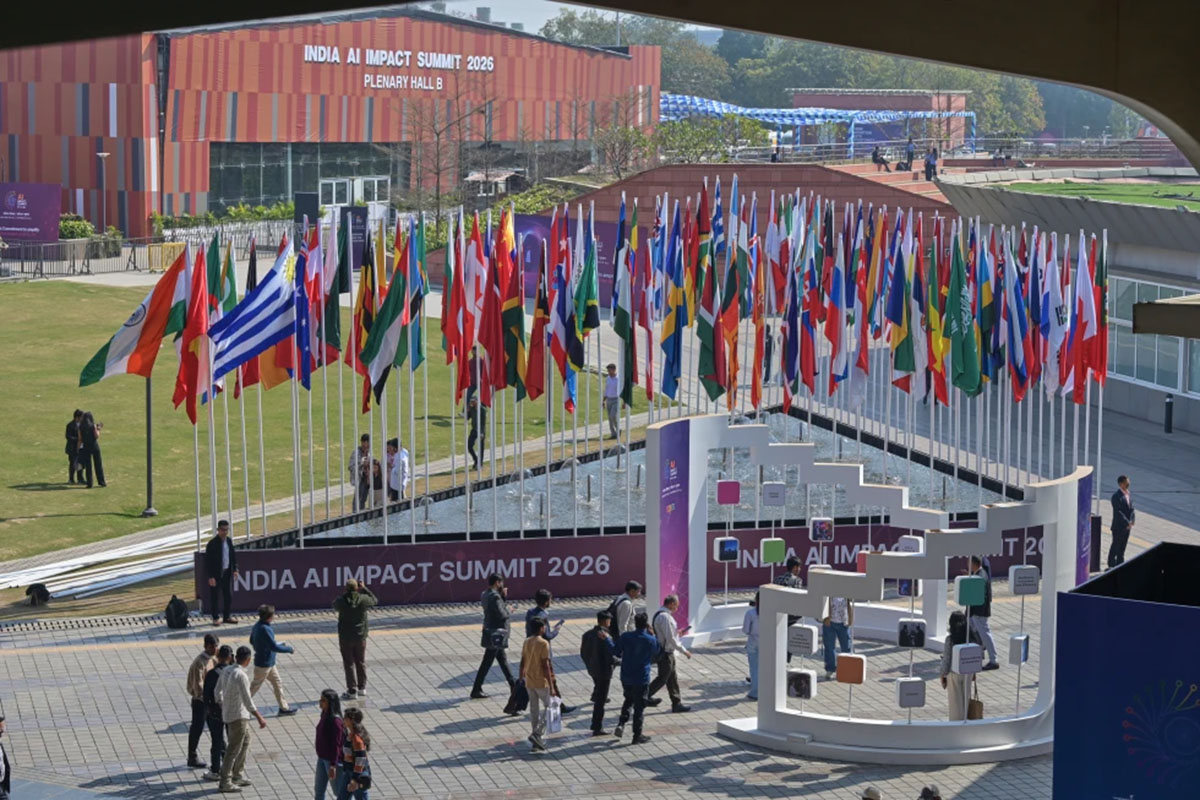
KATHMANDU: Global policy experts at the AI India Impact Summit said that artificial intelligence cannot exist in a vacuum and must be synchronised with the global drive for decarbonisation and regional cooperation.
Arunabha Ghosh, chief executive of the Council on Energy, Environment and Water (CEEW), told a panel that the AI revolution and the green revolution are two strands of the same “double helix”. He said the digital and decarbonisation revolutions were unfolding at different speeds, with different momenta and across different geographies.
Ghosh argued the two technologies must converge rather than run on parallel tracks. “When they come together properly, then AI becomes one more general‑purpose technology to impact another general‑purpose technology, which, in my opinion, is climate action,” he said.
He highlighted practical applications where AI can support climate goals, including optimising solar and wind integration into power grids, providing hyper‑accurate flood forecasting and increasing agricultural resilience. At the same time, he warned of AI’s “duality”, noting that massive data centres are highly demanding of power and water for cooling.
“The data centres are significantly contingent on power demand, on water demand, cooling demand, and you need to then develop this infrastructure that is ready for the future, not just leveraging the present,” he said. He urged nations to measure the energy and water footprints of their AI strategies transparently and to avoid “leveraging the present” at the cost of the future.
Philip Thigo, special envoy from the Office of the President of Kenya, said sovereignty did not mean every country must build its own data centres. He noted that only “1% of global data centres are in Africa, 50% in South Africa” and argued that regional sharing of infrastructure would be more practical and cost‑effective.
Thigo advocated South‑South cooperation, where neighbouring countries share infrastructure and value rather than duplicating expensive investments. “It calls upon cooperation and sharing... it becomes interesting that global cooperation, and especially regional cooperation, but also South cooperation, becomes important, where we have to kind of see where they share value, and we can collaborate and not necessarily spend money on doing anything,” he said.
Former NITI Aayog chief executive Amitabh Kant warned that AI could create a “highly unequal society” and called for a layer of public digital identity and accountability to sit above private systems. “Our digital ecosystem worked because our models were open-sourced. My view is that there has to be a layer of digital public identity in AI, on top of which we should allow the private sector to open and compete,” he said.
Claire Melamed, vice president of the UN Foundation, addressed the governance challenge, saying accountability between states, citizens and tech giants had become blurred and ineffective. She rejected the idea that the tech industry could police itself and called for independent oversight to ensure citizens have a clear path to redress when AI systems cause harm. “We cannot have a situation where the behaviour and impact of companies is monitored and governed by bodies which are set up by those companies themselves,” she said. “It never works. We know that time and time again.”
The panel, held at Bharat Mandapam, brought together policymakers and experts to examine how AI can be harnessed for inclusive, climate‑aligned growth while addressing infrastructure, governance and equity challenges.
(With inputs from RSS/ANI)
-1791630230.jpeg)
-1791623099.JPG)